

Baker Wetlands to host ‘Wings Over Wetlands’ in celebration of environmental centennial
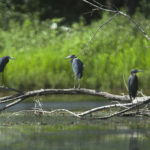
photo by: Nick Krug
Three little blue herons stand along a downed branch extending into one of the ponds at the Baker Wetlands on Thursday, Aug. 11, 2016.
These days, visitors at the Baker Wetlands can expect to see a snowy egret or two wading through the nature preserve’s shallow pools. The birds, which sometimes congregate in small groups at the wetlands’ aptly named “Heron Hangout,” are fixtures not just here but throughout coastal waterways and freshwater bodies across North and South America.
But in the early years of the 20th century, the demand for their striking white plumage, spurred by trends in ladies’ hats, was so high that the birds’ numbers dipped dangerously close to extinction. This year sees the centennial of the legislation that saved the snowy egret and other species from that fate, and a number of local conservation groups are teaming up to celebrate the occasion in style.
On Saturday, in partnership with the Prairie Park Nature Center and Jayhawk Audubon Society, the Baker Wetlands Discovery Center will host a series of family-friendly activities, demonstrations and displays in honor of the landmark 1916 Migratory Bird Treaty.
“We thought we would use this as an opportunity to collaborate with our partners in environmental education to highlight this as a major conservation step that took place early on,” said Marty Birrell, nature education supervisor at Prairie Park Nature Center.
Slated for 9 a.m. to 1 p.m. at the Baker Wetlands Discovery Center, 1365 N. 1250 Road, the event — organizers are calling it Wings Over Wetlands — will encourage folks to get outside too, with a bird-watching walk led by Baker Wetlands education coordinator Roger Boyd.
For conservation advocates like Birrell, the historical importance of the Migratory Bird Treaty — its creation led to the passage of the Migratory Bird Treaty Act in 1918 — is not to be understated. Its impact on conservation efforts, even 100 years later, extends even to the wetlands of northeast Kansas, Birrell said.
Now hailed as a conservation landmark, the treaty provides federal protection to migratory birds across North America. As one of the first U.S. environment laws, the Migratory Bird Treaty arrived amid intensifying global tensions and new threats to the world’s natural resources.
In 1903, President Theodore Roosevelt, one of the country’s earliest and most outspoken conservationists, designated Florida’s Pelican Island as the first U.S. National Wildlife Refuge. The action was meant to protect egrets and other birds populating the wetlands from extinction. Throughout his presidency, Roosevelt created 51 federal bird reserves among the approximately 230 million acres of public land he set aside for federal protection.
Folks around here really enjoy their birds, Birrell acknowledges. They also seem uniquely engaged in conservation issues, at least in her observations of the nearby Baker Wetland’s recent restoration efforts.
“I think the Baker Wetlands Discovery Center has been at the heart of those conservation issues,” she said. “Many, many people were opposed to the South Lawrence Trafficway, including myself, but it has been such a highly successful restoration of wetlands that it has increased the area of wetlands here in Kansas, tripling the size of it and bringing in wetlands birds in a remarkable fashion.”
The preserve’s Discovery Center opened last fall, with more and more wetlands opening to the public in the following months as the restoration project continued. Since then, several varieties of migratory birds — the kinds “people usually don’t get to see,” Birrell said — have been flocking to the Baker Wetlands, among them white-faced ibises, avocets, herons, bitterns, a pair of bald eagles that took up residence at the wetlands about a year ago, and the snowy egret, of course — “On any given day, you will see egrets,” Birrell said.
“Having watched this whole process, it’s been wonderful to watch people go out and see it. It’s created this marvelous wildlife habitat, and at a time when a lot of the conservation messages are negative,” she said. “This is a positive message on many levels.”
For a full schedule of Wings Over Wetlands events, check out Prairie Park Nature Center’s event page on Facebook.
City Government
As they approve bikes plan, Lawrence city leaders ask about data collection, Kentucky and Tennessee streets
Lawrence city leaders want to toughen tobacco licensing rules ‘sooner than later’
Algerian government invites Mayor Brad Finkeldei, Lawrence delegation for a visit
Construction on Wakarusa Drive to resume; city manager says KDOT’s secretary has apologized for delay
Evacuation drill planned Tuesday at Lawrence City Hall
