Watkins Museum antiques event uncovers truth behind collectors’ treasures
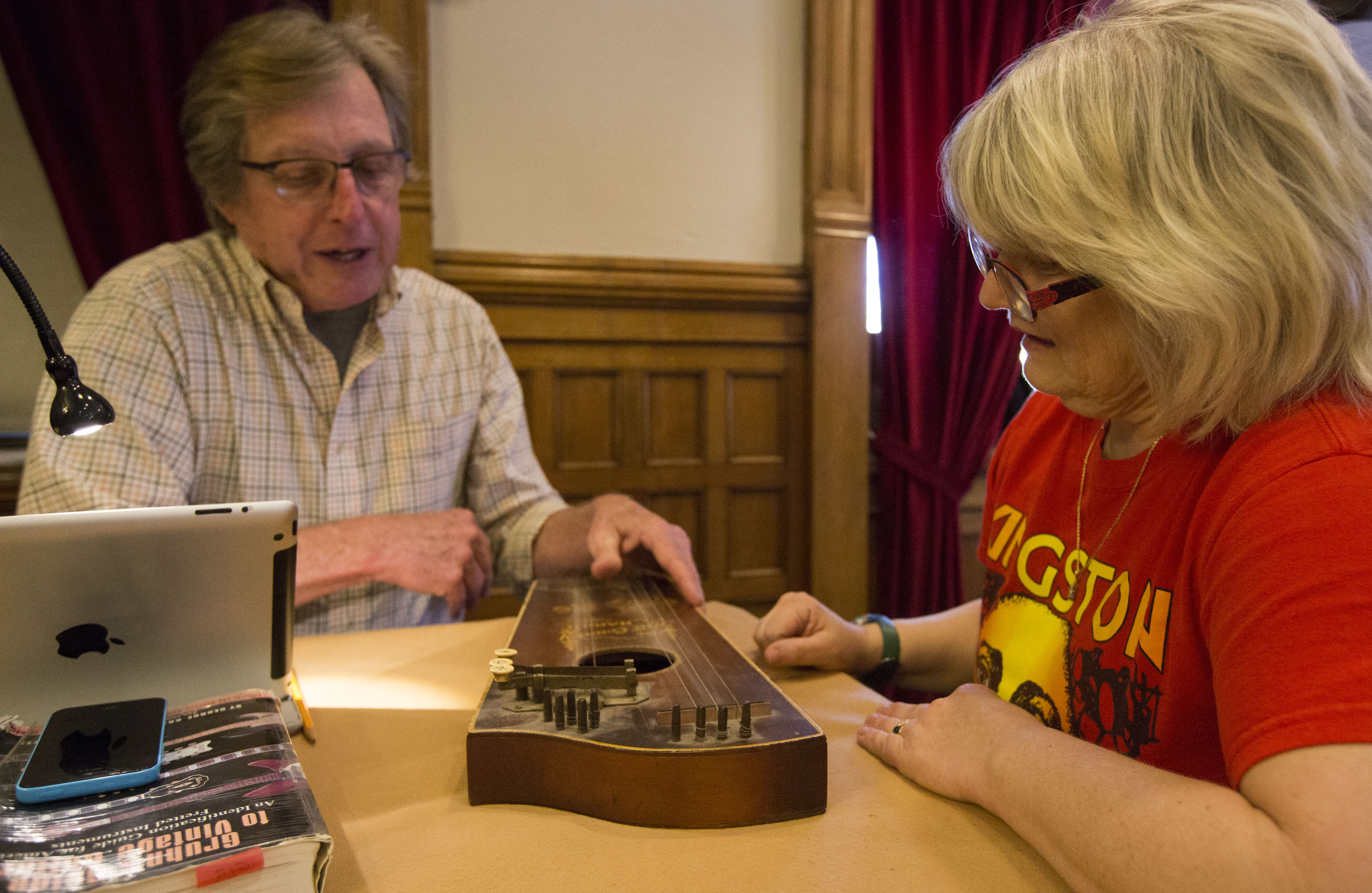
photo by: John Young
Jim Baggett, owner of Mass Street Music, and Patti Hawkins, of Lawrence, discuss a Hill Country Harp brought in by Hawkins during an antique appraisal event Saturday at Watkins Museum of History, 1047 Massachusetts St. Hawkins learned the harp came from the 1940s and said she received it from her father.
Sally Davis had her eye for antiques confirmed Saturday.
As a 35-year member of the University Women’s Club Antique Group, she’s had time to train her eye. Still, it wasn’t her expertise but the location depicted in a woodcut of a windmill that prompted to buy the artwork she brought to the Watkins Museum of History for expert evaluation.
“I was in a Topeka antiques store,” Davis said. “I said, ‘That’s from Lawrence. I’ve got to have that.'”
Davis brought the woodcut and several other items Saturday to the Watkins Museum’s Know Your Antiques event, where fine arts experts Soodie Beasley and Dirk Soulis shared insights on the work of artist Margaret Whittemore, a Kansas artist and writer who died in 1983.
“They said it was worth $500,” Davis said. “I paid $125 for it. That’s pretty good.”
That conversation sounds like those quick interviews that wrap up “Antiques Roadshow,” and the Watkins event’s format was much like that long-running popular show. Area residents brought items for expert evaluation that they had found in their attics, ran across in antiques stores, cherished as part of collections or inherited from deceased family members.
Although Davis did receive a dollar value on her woodcut, most of those attending left with more knowledge of the history of their antiques rather than their value.
Barbara Brackman, an author and former museum curator who was evaluating quilts and textiles, said she did sometimes provide insight into an object’s value through its rarity and other information.
“I tell them if a museum might be interested,” she said. “I haven’t seen anything a museum wouldn’t be interested in.”
She had to share the bad news to some that old doesn’t necessarily mean valuable, Brackman said. That was the case for a paisley shawl she saw that was machine-made more than 150 years ago. She also found rare items, such as a coverlet, which was one of only 18 surviving of its kind. It would have been “extremely valuable” before the market sunk in recent years, she said.
Paul Gosal was prepared for disappointment regarding the Stainer violin he found in the attic of his Kansas City, Mo., home. It was, he said, made in the 1800s as a tribute to a master craftsman of the 1600s.
“I saw on the ‘Roadshow’s’ online site that they are one of the things people think are valuable but aren’t,” he said. “I thought I’d bring it in and find out more about it. I don’t play the violin. Depending on what I find out, maybe I will learn.”
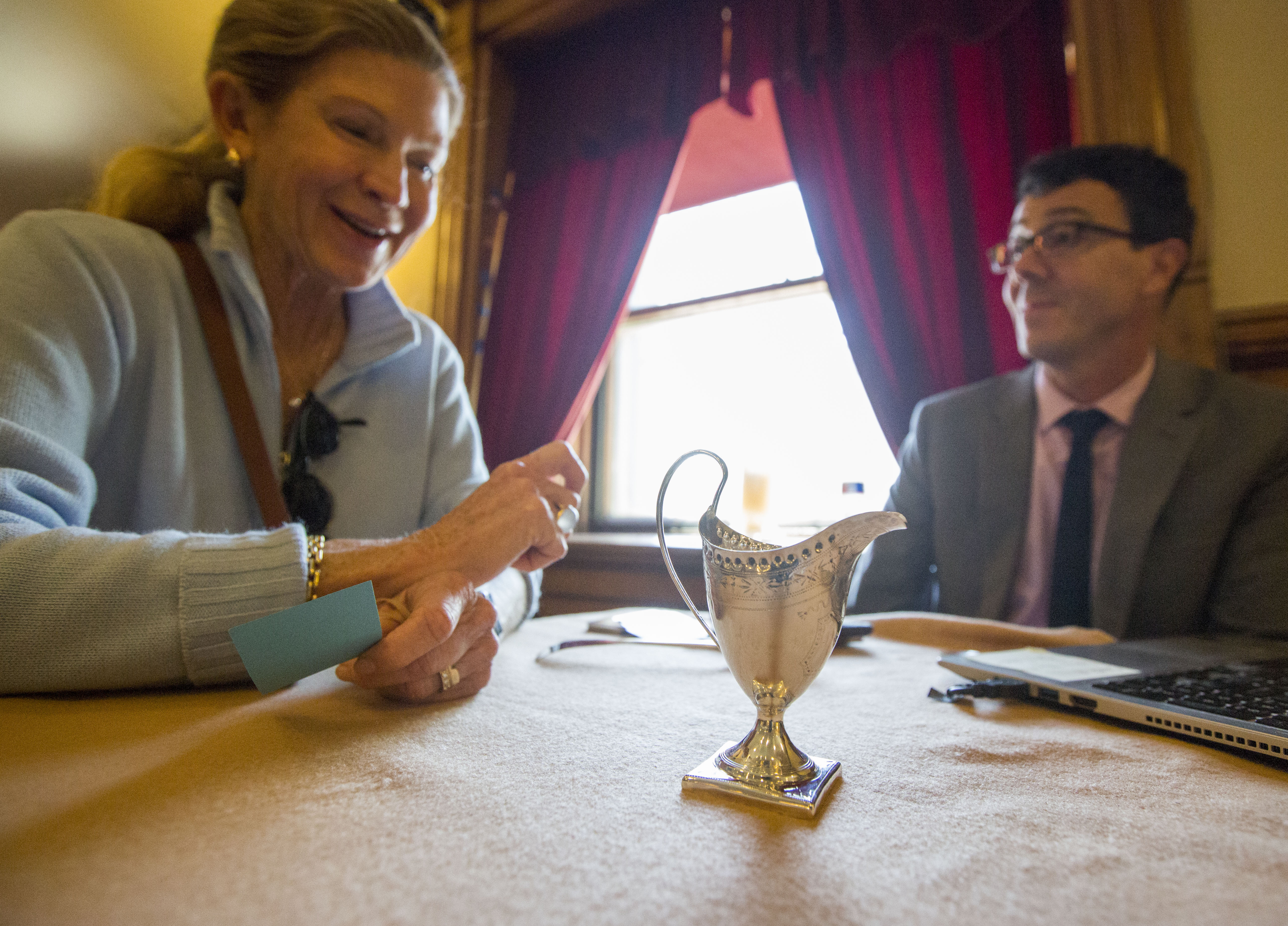
photo by: John Young
Jay Haugh, left, of Lawrence, and antique appraiser Dirk Soulis discuss Haugh's late 1700's creamer during an antique appraisal event at Watkins Museum, 1047 Massachusetts Street on Saturday afternoon. Haugh learned the creamer was made by Peter Bateman and said it has been in her family for three generations.
The event enticed Watkins Museum employee Brittany Keegan to bring pieces from her collection of World War I trench art. It was a collection that would not be a conflict of interest because they are not materials the Watkins Museum collects, she said.
Keegan said there are two kinds of trench art: Those that soldiers crafted during long hours in the field between engagements, and those made by villagers living near the former battlefields and sold to visitors to the many war memorials. She, too, was hoping to learn more about a ring and small and large vases hammered from spent artillery shells, she said.
Watkins Museum board member Jeannette Blackmar said 38 people had signed in to have the experts look at 116 different items with an hour left in the six-hour event. Items ran the gamut of the experts’ fields of jewelry, musical instruments, fine and decorative arts, Asian art and quilts and textiles, she said.
“We do know we’re going to do it again,” she said. “We don’t know when yet, but from the interest we know we will be having another show.”
City Government
Lawrence Police Department receives KDOT’s top traffic safety award for second straight year
Lawrence City Commission approves extra layers of oversight for data centers, asks for patience on further regulations
Lawrence to participate in program that helps nonprofits rehabilitate abandoned properties as affordable housing
Lawrence’s first bike lanes with physical barriers are installed on Ninth Street
Opinion: Don’t give up on trying to use Costco to take tens of millions of dollars from the state of Kansas