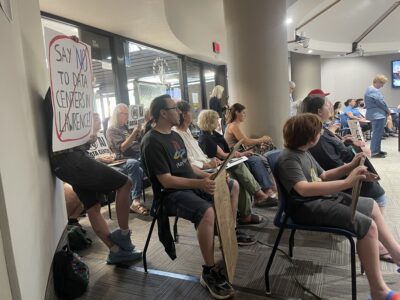
Wetlands advocates look for new ways to stop construction of South Lawrence Trafficway as legal battle ends
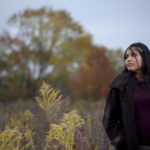
Millicent Pepion, former leader of the Wetlands Preservation Organization, is pictured Thursday at the Medicine Wheel located on the southern edge of the Haskell Indian Nations University campus. Pepion and others fear that this area will be affected by the construction of the South Lawrence Trafficway.
Timeline
Click here to see a timeline of events about the South Lawrence Trafficway.
At one time, Patrick Austin Freeland thought a fancy suit and a trip to Washington, D.C., probably was the best way to stave off the South Lawrence Trafficway.
Freeland, like dozens upon dozens of Haskell Indian Nations University students over the last two decades, has been a crusader to stop the South Lawrence Trafficway from being built through the wetlands that are owned by Haskell and Baker universities along 31st Street.
For Freeland and others, the battle has meant more than carrying a sign to a protest now and then. Freeland served as the president of the Wetlands Preservation Organization, an organization that has been a longtime plaintiff in a federal lawsuit regarding the route of the road.
It also meant trips across the country to lobby to groups both sympathetic and hostile to the cause. Freeland was dressed and ready to depart for such a meeting in Washington when one of the resident assistants at the Haskell dormitory asked the young man in the suit where he was going.
Freeland told him, in essence, he was off to try to save the wetlands.
“He just laughed a bit,” Freeland said of the issue that happened several years ago. “He said I didn’t have to do that, and he was so sure of it. I asked him why, and he said, ‘Because there is medicine down there. The wetlands has its own medicine.’ That has stuck with me.”
Soon, the medicine is going to get tested.
• • •
Last week marked the end of the legal battle over the South Lawrence Trafficway. A deadline to appeal to the U.S. Supreme Court a federal court decision in favor of the road’s wetland route came and went. For the first time since 1994, the trafficway has all the federal permits it needs for construction, and all the legal appeals related to the permits have been exhausted.
Kansas Department of Transportation officials have said construction on the $192 million road project should begin in about a year, about 23 years after Douglas County voters approved a $4 million local bond issue for the road.
But lawyers haven’t been the only constant these past two decades in the trafficway fight. As sure as the sound of the croaking frogs along the wetlands’ boardwalk, a new crop of Haskell students every couple of years would enter the fray and make their own noise.
“Every group has passed the torch to the next one,” said Dan Wildcat, a Haskell professor and a longtime defender of the wetlands.
The issue of protecting the wetlands from the road became so ingrained in Haskell students that it really became a significant part of the educational experience at the university, Wildcat said.
“I think a whole group of students have learned that it is hard work to be politically engaged,” Wildcat said. “It is not easy. But I always have been proud of them. They always have conducted themselves honorably, even when they expressed their opinions strongly.”
Despite the end of the legal proceedings, Wildcat doesn’t think students will stop fighting for the wetlands. Several wetlands supporters last week said they expect the opposition movement to enter a more political lobbying phase, especially seeking to enlist the help of groups that may object to the project’s estimated $192 million price tag.
“It has all the elements to be a national issue, especially in the Indian community,” Wildcat said. “You know, it takes a lot of money to build a highway like that. I think there will be an effort to build political awareness and convince lawmakers that there might be better ways to spend that much money.”
• • •
Millicent Pepion found the wetlands early in her Haskell career.
“My grandma graduated from Haskell in the late ’40s,” said Pepion, who will be a senior when she re-enters the school next semester. “She used to tell me about a place where they would have picnics and hang out. When I first got here, I went looking for that place.”
That’s the way it is with many Haskell students and the wetlands. It is more than just an area of rich environmental diversity. Many in the Haskell community believe the wetlands area — parts of which were farmed in the early parts of the century — are the resting place of children who went missing from the Haskell Institute in the late 1800s and early 1900s.
No graves have been unearthed in the wetlands, but wetland supporters have said they’ll be monitoring construction of the road closely to ensure burial sites aren’t found, if construction does begin on the road.
The spiritual significance of the wetlands is one reason why a multimillion-dollar mitigation plan, which will build more than 300 acres of new wetlands, plus bike paths, camping grounds and a wetlands education just west of the current wetlands, has done little to mute the opposition from Haskell students.
“As I’ve learned more about this, I’ve realized this really isn’t an environmental issue,” said Pepion, who also is a former president of the Wetlands Preservation Organization. “It is really an eco-justice issue. This is about the desecration of a sacred place.”
Freeland said that’s been an element that’s never been well understood during all the legal wrangling, in part because there’s no easy metric to measure how sacred a place is.
“It is like an elderly person,” said Freeland, who is now studying for his doctorate in ecological science and engineering at Purdue University. “Somebody asks you the value of an elderly person. You can’t describe that in one way. You just have to say ‘get to know the person, and you might learn something.'”
• • •
What started out as a search for a picnic spot led to a much longer journey for Pepion.
Last summer, Pepion organized the “Trail of Broken Promises,” an event where she and 12 other wetlands supporters and a dog traveled from Osawatomie to Washington, D.C., primarily on foot, a nine-week journey that led her to take a semester off school.
“My dad is funny,” Pepion said. “He said, ‘Why couldn’t you have just bought a pass to the Jayhawks instead of trying to save the wetlands?'”
But the experience has been worth it, she said.
“I’ve learned a lot about the meaning of politics,” Pepion said. “I’ve learned how it can really affect your daily life. They say that these decisions in Washington trickle down and find their way into your daily life. I understand that now.”
And that’s what she is hoping for in the future. While in Washington, D.C., Pepion made contacts with members of the Senate Committee on Indian Affairs, the National Congress of American Indians, and even had a personal conversation with Bill Clinton at the conference for his Global Initiatives Fund.
Pepion and others are working to build support for a federal law called the Native American Sacred Place Act, which could provide new federal protections to the Haskell and Baker Wetlands.
The bill hasn’t yet had a hearing. Whether the votes will ever be there to pass the legislation is tough to know. But Pepion is confident what won’t be lacking is the one thing that Haskell students long have delivered to the issue: the persistence to keep pushing.
“What I know is, they have been building this road for over 20 years now,” Pepion said. “And it hasn’t been built yet. That is what keeps me going.”
City Government
Soccer gear honoring Lawrence history’s all-star team is now on sale as part of city’s public art exhibition
To honor public servants, Lawrence’s July 4 celebration will have a whole gallery of their photos on display; submissions open now
North Lawrence study consultants look at possibilities for a grocery store, food truck park, traffic calming and more
Algerian ambassador gives Lawrence a gift for supporting national team – a piece of art
Lawrence City Commission approves incentives for Alarm.com’s office project in downtown building