Wall Street roller coaster: Stocks fall nearly 10 percent
New York ? A computerized selloff possibly caused by a simple typographical error triggered one of the most turbulent days in Wall Street history Thursday and sent the Dow Jones industrials to a loss of almost 1,000 points, nearly a tenth of their value, in less than half an hour. It was the biggest drop ever during a trading day.
The Dow recovered two-thirds of the loss before the closing bell, but that was still the biggest point loss since February of last year. The lightning-fast plummet temporarily knocked normally stable stocks such as Procter & Gamble to a tiny fraction of their former value and sent chills down investors’ spines.
“Today … caused me to fall out of my chair at one point. It felt like we lost control,” said Jack Ablin, chief investment officer at Harris Private Bank in Chicago.
No one was sure what happened, other than automated orders were activated by erroneous trades. One possibility being investigated was that a trader accidentally placed an order to sell $16 billion, instead of $16 million, worth of futures, and that was enough to trigger sell orders across the market.
No one was taking blame, either. The New York Stock Exchange said there was no problem with the Big Board’s systems, and all the markets were on a conference call with the Securities and Exchange Commission.
Nasdaq issued a statement two hours after the market closed saying it was canceling trades that were executed between 2:40 p.m. and 3 p.m. that it called clearly erroneous. It did not, however, mention a cause of the plunge.
The NYSE also said it would cancel some trades on its electronic platform.
There were reports that the sudden drop was caused by a trader who mistyped an order to sell a large block of stock. The drop in that stock’s price was enough to trigger “sell” orders across the market.
The SEC issued a statement saying regulators are reviewing what happened and “working with the exchanges to take appropriate steps to protect investors.”
Whatever started the selloff, automated computer trading intensified the losses. The selling only led to more selling as prices plummeted and traders tried to limit their losses.
“I think the machines just took over. There’s not a lot of human interaction,” said Charlie Smith, chief investment officer at Fort Pitt Capital Group. “We’ve known that automated trading can run away from you, and I think that’s what we saw happen today.”
The market was already wobbly because of fears that Greece’s debt crisis will undermine the economic recovery. Traders watched television coverage of protests in the streets of Athens, and the Dow was down 200 when the selloff began less than two hours before the closing bell.
Around 2:40 p.m. EDT, the Dow was at 10,460, a loss of 400 points.
It then tumbled 600 points in seven minutes to its low of the day of 9,869, a drop of 9.2 percent.
On the floor of the New York Stock Exchange, stone-faced traders huddled around electronic boards and televisions, silently watching and waiting. Traders’ screens were flashing numbers non-stop, with losses shown in solid blocks of red numbers.
Then the market bounced back, about as quickly as it fell. By 3:09 p.m., the Dow had regained 700 points. It then fluctuated sharply until the close. The trading day ended with the Dow down 347.80, or 3.2 percent, at 10,520.
National
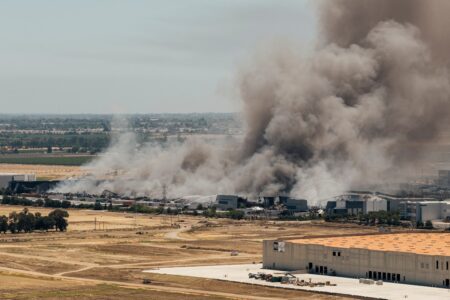
Unhealthy air quality in California city as huge warehouse fire burns for 3rd day
Judge orders Trump administration to restore National Park changes at sites that ‘disparaged’ US
Teens’ reading and math scores have stagnated, US test results show
WASHINGTON (AP) — Younger students have regained ground academically after the pandemic's disruptions while older ...
Lawyers for man accused of killing Charlie Kirk try to block death penalty
Trump’s name poised to come off Kennedy Center