Dying faces and body bags: How trauma hits a U.S. unit
Forward Operating Base Bostick, Afghanistan ? More than half a year after one of the deadliest battles ever waged by U.S. forces in Afghanistan, the men of Bravo Troop, 3rd Squadron, 61st Cavalry are still fighting in — and with — their memories.
They cannot forget Oct. 3, 2009. On that day, 300 insurgents attacked two outposts in eastern Afghanistan manned by 72 soldiers, sparking a 12-hour fight. By nightfall, eight U.S. soldiers were dead. Three days later, the outposts were closed.
Like so many of their comrades, they suffer from mental trauma. Nearly 20 percent of the 1.6 million troops who had returned from Iraq and Afghanistan reported symptoms of post-traumatic stress or major depression, according to a 2008 study by Rand Corp.
Only slightly more than half of those sought treatment. So more and more, the army is bringing treatment to them whether they ask for it or not.
After Oct. 3, most of the 18 men in Bravo troop — part of the Army’s 4th Brigade Combat Team from Fort Carson, Colo. — met with counselors. Some went voluntarily, others under orders.
When they go, they have much to talk about.
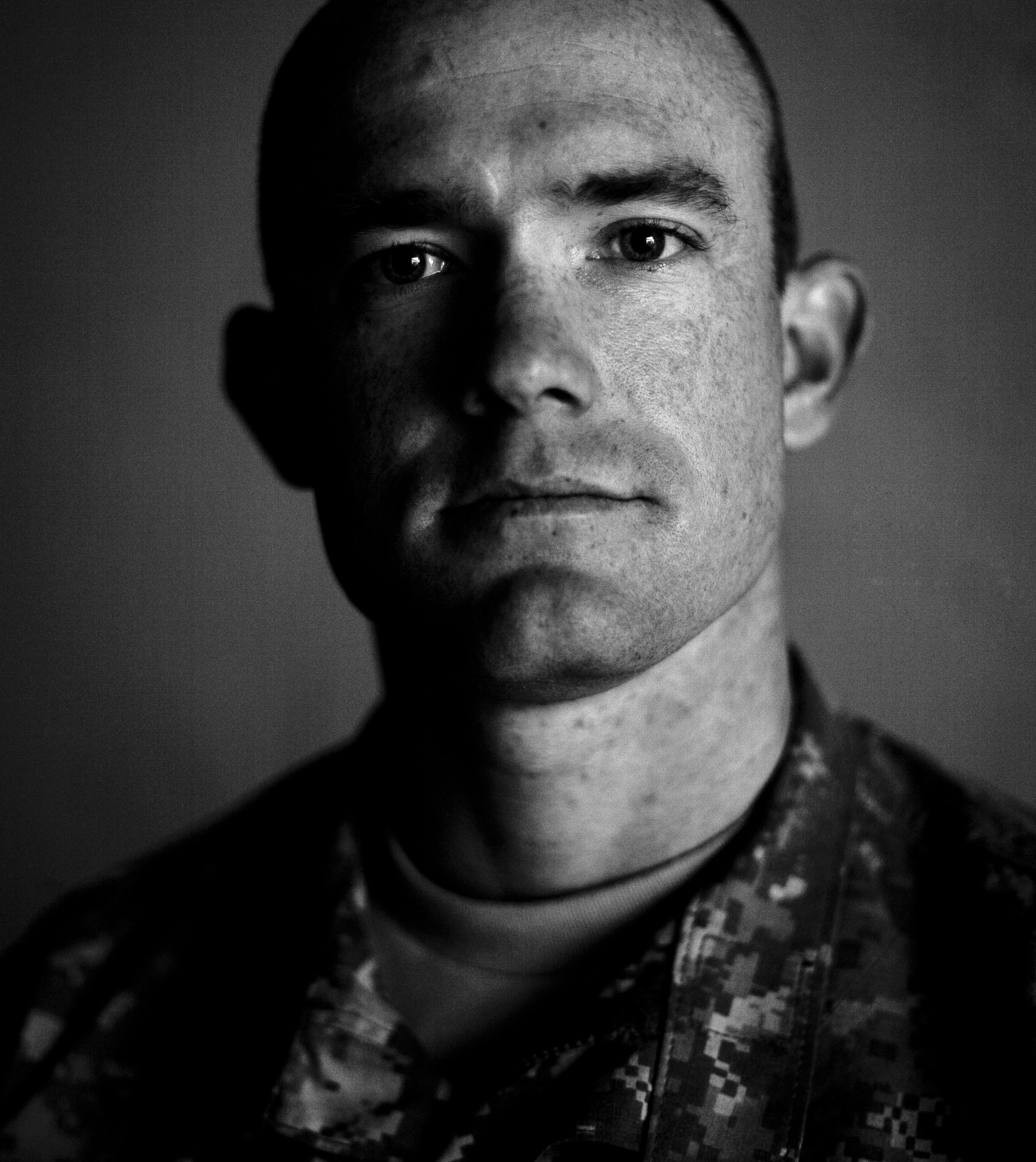
Specialist Ty Michael Carter, 30, of Antioch, Calif., with Bravo Troop, 3rd Squadron, 61st Cavalry
• • •
For Spc. Ty Carter, the hardest time is at night. When he closes his eyes, gunshots from months ago echo through his head. He sees a wounded soldier dragging himself through the dirt on his forearms, shouting for help.
Only it isn’t a nightmare — Carter doesn’t sleep deeply enough in Afghanistan to dream. It’s a memory of the excruciating 45 minutes when Carter had to watch that crawling man and do nothing, under strict orders from his superior officer.
Carter replays it over and over in his mind: Shrapnel hits Spc. Stephan Mace as he runs to a nearby building. Another soldier is also hit and killed immediately, going down like a spinning top. Mace, injured and unable to walk, crawls to his fallen comrade and shouts for help.
Carter — 30 feet away — hears the cries. Under orders, he cannot go.
“You’re no good to Mace if you’re dead,” the officer says.
Carter knows that sergeant probably saved his life. But even now, he feels the anger that welled up in him.
“It felt like nails in the stomach and acid on the brain,” he says. “You have no idea what it feels like to watch a good man lie there in total pain, suffering. I knew that I could help him, I knew I could make it to him. But the answer, even after arguing, was still NO.”
When Carter finally got the OK, he scooped Mace up and carried him to the aid station. To no avail — Mace died that night.
Carter, a towering 30-year-old from Northern California, says he couldn’t keep his hands from shaking for days. He had trouble controlling his anger. A military psychologist and an Army chaplain suggested sleep aids, so he went on Ambien.
For weeks, he refused to talk with anyone. He skipped a mandatory group counseling session. He started wearing sunglasses inside the brightly lit mess hall so no one would bother him, and no one would see when his eyes welled up.
His platoon leader, Sgt. Jonathan Hill, ordered him into a private counseling session.
“He grabbed me and said, ‘You of all people are going to go down there,”‘ Carter says. “Which he was totally right to do, because I was done. I couldn’t hold any emotions in. I was a walking zombie.”
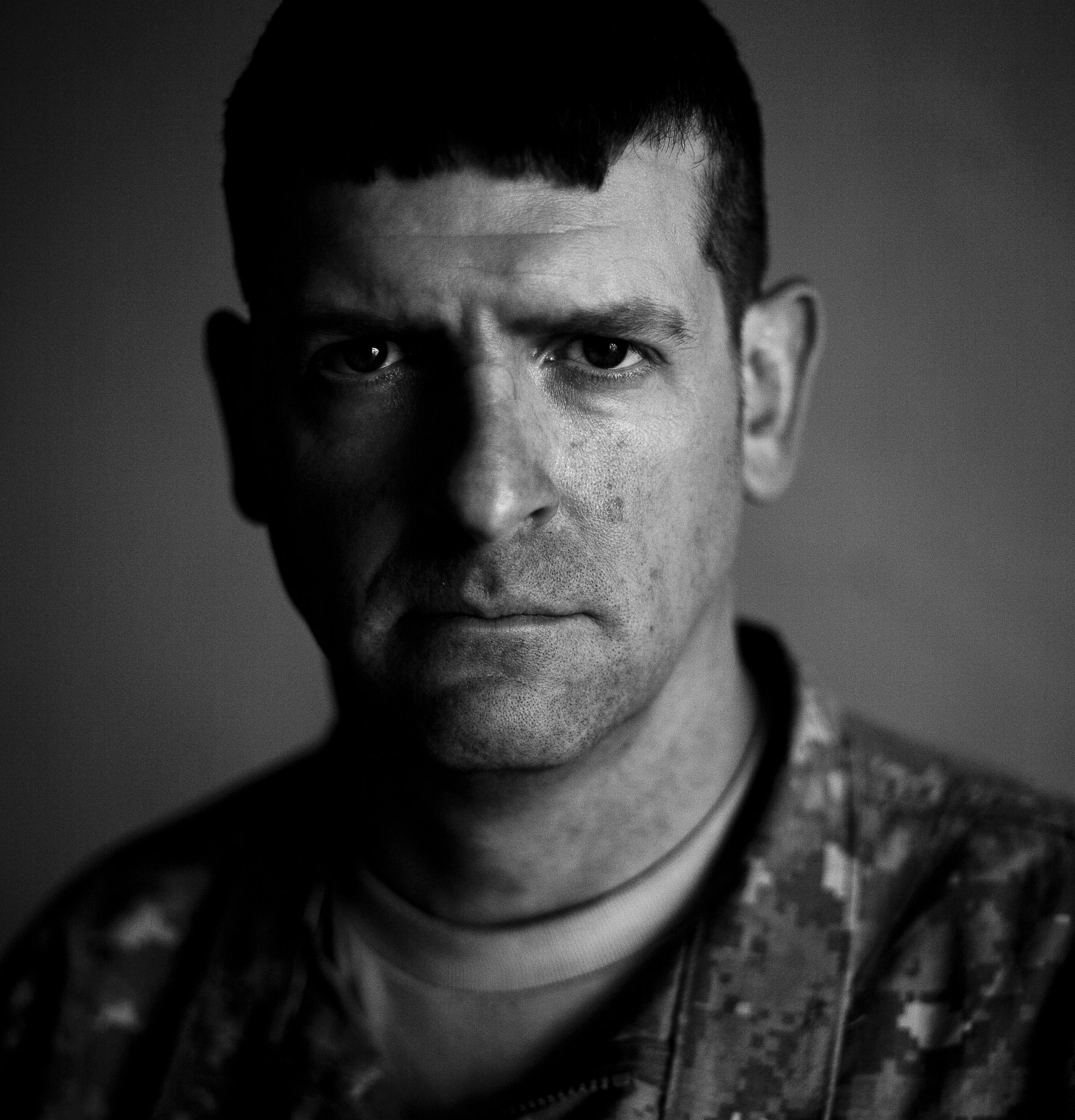
Sgt. Jonathan Hill with Bravo Troop, 3rd Squadron, 61st Cavalry
• • •
Hill, the sergeant, has encouraged his soldiers to meet with psychologist Katie Kopp. He himself has met with her once a week in the months following the attack.
Kopp has taught him to write his emotions down in a journal. The first few times, he found himself writing about fellow soldiers with such anger and force that he nearly broke his pencil.
Hill is haunted by the memory of seeing another soldier die — and knowing that but for a few minutes, it would have been him. When he talks about what happened, his voice is calm, but he smokes cigarettes ceaselessly. The 38-year-old doesn’t remove his sunglasses, and his hands fold and unfold nervously as if they have a troubled life of their own.
At 6 a.m. on Oct. 3, he woke up to an explosion and fire that turned his barracks into a clay oven. He ordered his 18 men to grab their weapons and get out.
Hundreds of militants with ammunition slung over their tunics were running down a dirt road toward the base. Mortar rounds hit every 15 seconds, and the smell of gunpowder hung heavy in the damp air. Hill felt bullets hit in front of his face and behind his head.
Another soldier, Sgt. Joshua Kirk, ran into a building first, while Hill stopped to grab some ammunition.
Then the building exploded.
Hill went for help. When he returned, others were carrying Kirk out of the building on a stretcher.
“He was pretty floppy. He had no life in him. His arms were just hanging off the stretcher. When I saw that I pretty much gathered that he didn’t make it,” Hill says, his face strained with the effort of keeping his voice even.
Hill is certain that if he had been a few seconds quicker, he would have died too: “I was supposed to be right where he was.” He thinks about his two children — an 8-year-old girl and a 12-year-old boy — and how they could have grown up without a father.
Hill remembers vividly how he zipped three of his fellow soldiers into body bags that evening, and carried the heavy, lifeless sacks to a waiting helicopter.
“Having to put all those young soldiers in body bags …,” he starts, his voice trailing off. “That’s a memory that’s never going to go away.”

Sgt. Daniel Rodriguez, 22, of Stafford, Va., with Bravo Troop, 3rd Squadron, 61st Cavalry
• • •
Sgt. Daniel Rodriguez sees the face of a dying soldier when he tries to sleep.
“There’s not a night that I go to sleep that I don’t think about it,” says Rodriguez, 22. “He was speechless. His eyes were open like he was trying to tell me something and it didn’t come out. And he was gurgling. And I’m trying to pull him in and it just isn’t happening, and it kicks in that there’s nothing I can do for my friend.”
When the explosion rocked the base, Rodriguez jumped up and ran to his post, the mortar pit. He remembers muzzle flashes everywhere, looking like popcorn hitting around him.
As soon as he made it to the mortar pit, he saw Private Kevin Thomson die — shot in the head as he passed in front of Rodriguez. He’s seen it again in his mind many times since.
Rodriguez, who is on his second tour in three years, doesn’t want his time in the military to define his life. After returning from Afghanistan, he planned to go to school: first junior college to save money, then on to a degree in business or nutrition.
Rodriguez, a small man with a young face, went through the required sessions with the psychologist, but says he doesn’t plan to seek further counseling. He says it’s unnecessary — he’ll talk to friends and family.
With Rodriguez, it’s hard to draw the line between practicality and bravado.
“They think all of us around are going to be serial killers within the next five years,” he says. “When I get home and people automatically assume that I’m going to be crazy, I’m like no, I’m fine. Yeah, I’ve seen some (expletive), but I’m not going to snap.”
“Either you’re built for it or you’re not,” he says. “We’ve seen our friends killed in front of us. We’ve put them in body bags, and we’re still strong.”
National
Unhealthy air quality in California city as huge warehouse fire burns for 3rd day
Judge orders Trump administration to restore National Park changes at sites that ‘disparaged’ US
Teens’ reading and math scores have stagnated, US test results show
WASHINGTON (AP) — Younger students have regained ground academically after the pandemic's disruptions while older ...
Lawyers for man accused of killing Charlie Kirk try to block death penalty

Trump’s name poised to come off Kennedy Center