Lessons of a weekend of free health care
Nonprofit group offers help to the uninsured through the desperate
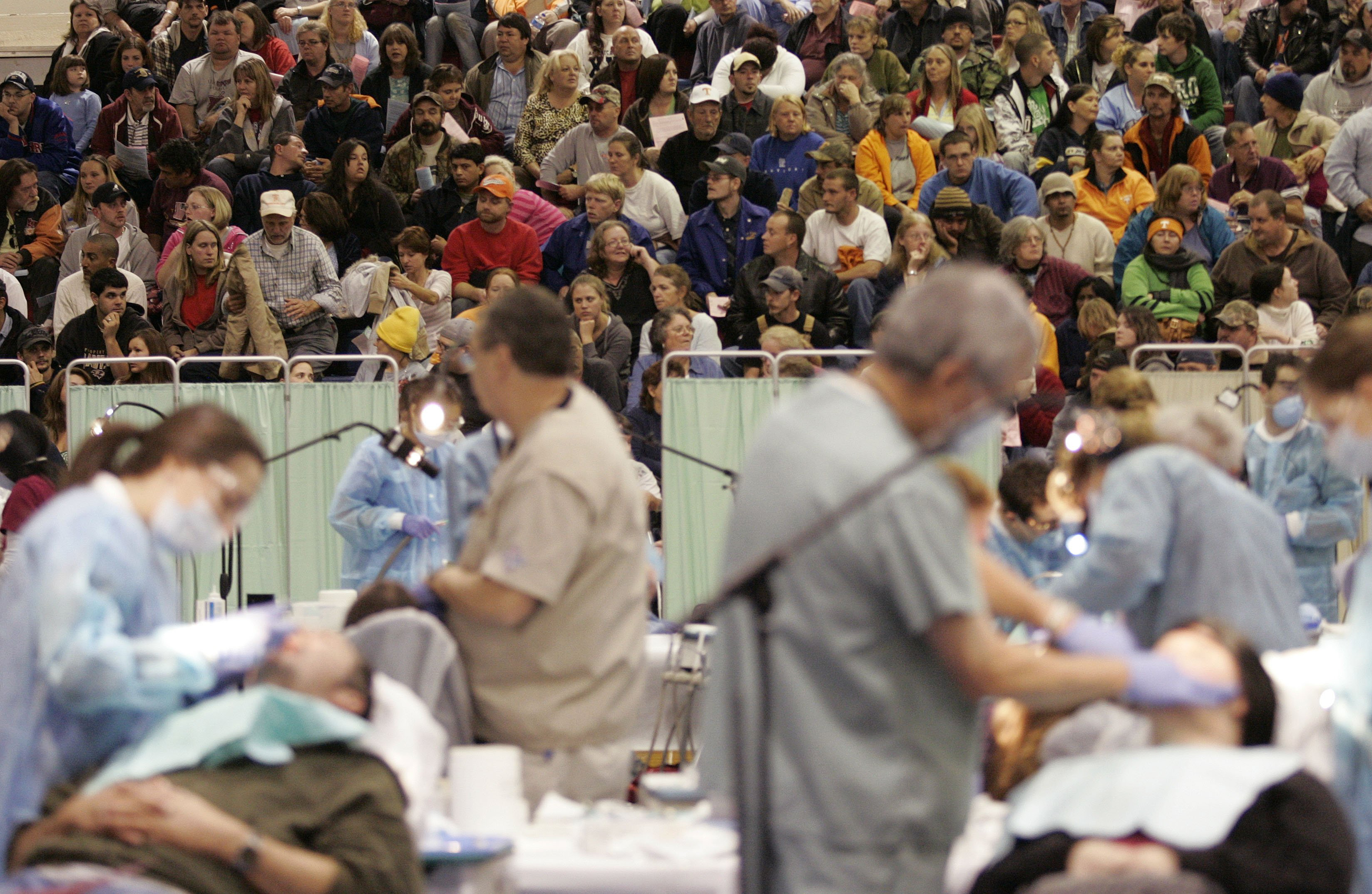
People wait their turn as others receive dental care during a clinic held by Remote Area Medical on Nov. 14 at Union County High School in Maynardville, Tenn.
Maynardville, Tenn. ? The two-hour drive is done, but Hannah and Jack Hurst leave the Honda’s engine running.
Hannah’s prayers have brought them here. Now there’s little to do but turn up the car’s heat, get some sleep and wait for morning — and a set of glass and metal doors to open.
Still, Hannah doesn’t complain. The 26-year-old mother of three has waited “pretty much as long as I can remember” to escape the pain throbbing through her jaws. Jack lost his road construction job a year ago and health insurance is out of the question. If the answer to Hannah’s misery lies behind those doors, what’s 10 hours more?
Out in the dark, the Hursts have plenty of company. Even before 10 p.m. on this Friday in late fall, nearly 50 cars ring the lot. By 6 a.m. Saturday, more than 400 men and women stand tightlipped and bleary-eyed under the Big Dipper.
By day’s end, as long as they keep tempers in check and sleep from their eyes, they will win the privilege of care from a dentist or a doctor.
In a country convulsed over health care, the scene is alarming. But it is always the same, Stan Brock says. For 17 years, Brock has piloted a nonprofit called Remote Area Medical, offering free health care to the uninsured, the underinsured and the desperate.
Brock has seen so many crowds like the one outside Union County High School he chides himself for losing track of whether this is RAM’s 578th expedition or its 587th. Yet in every crowd, there are hundreds of Hannah Hursts, each a unique testament to the nation’s ragged pursuit of health care answers.
Over the next two days, RAM’s volunteers will examine, extract and prescribe hundreds of solutions for individual aches and afflictions. They will, in the few moments left, attempt to convince patients they’ll probably never see again of the virtues of healthier living and continuous care. They will try to answer Hannah Hurst’s prayers.
Lawmakers debating reform could almost certainly learn something here in the trenches.
But the most striking lesson might also be the most daunting: To fix health care inequities, expanding insurance alone may not be enough.
• • •
It is precisely 6 a.m. and Brock has just pushed open the high school’s doors, questions ready.
“Who’s here to see a dentist?”
More than half raise their hands. Who needs an eye doctor? Almost as many. Who needs a medical doctor? Scattered hands go up, but Brock expects that, too.
“Really, they all need to see a doctor,” he says. “They just don’t want to lose their place on line.”
• • •
“Who’s got No. 1?”
The day’s first patients are waved in to “triage” — the school cafeteria. Decide which need is today’s priority, volunteers urge. There won’t be enough time or doctors to deal with them all.
“Dental?” Go to the gym.
“General medical?” In the classrooms down the hall.
It’s just 45 minutes from RAM’s base in Knoxville to Maynardville, the center of a county of 19,000 set amid corduroy ridges.
Although the Hursts got to Maynardville early, they lost their place in line when police cleared the parking lot because of shots from nearby woods. It turned out to be just some teenagers hunting.
By the time the couple reaches the gym, dentists clustered around 38 portable dental chairs fill the Union County Patriot’s home court. Patients pack the bleachers.
Finally, Hannah Hurst is called to a chair and explains why she’s come.
In pregnancy, her mother suffered from a calcium deficiency. Hannah’s baby teeth decayed fast. It was even worse with her permanent teeth and disease filled her gums, swollen with abscesses. Insurance either wasn’t enough or dental wasn’t covered. Four years ago, Hannah saved enough to reach a dentist’s chair, when her phone rang. Her aunt, hospitalized with cancer, had taken a turn for the worse. She rushed out, even though a spring breeze can trigger pain that knocks her to her knees.
Back home in Campbell County, worshippers at Sled Creek Holiness Community Church have prayed, even fasted, to help Hannah heal.
Today Hannah is ready to embrace the answer.
Please, she asks, pull them all out.
• • •
The truth is, many are here only because their blood pressure registered too high to undergo the dentist’s drill.
Daniel Drake’s blood pressure came in at an eye-popping 200/120. He chalks it up to an energy drink and leaves happy when a pill brings it down enough to get his tooth fixed. But Dr. Alan Weder, a Michigan researcher volunteering for the weekend, shakes his head.
“If that’s the way he’s walking around, his risk of having a heart attack or a stroke in the next five years is probably 20 to 30 percent,” Weder says. “And that’s for want of 30 cents in medicine.”
Comprehensive insurance could resolve the patient cost dilemma, Weder says. But the problems go beyond that.
Weder notices many patients who say they can’t afford basic prescriptions — now carried by discounters for as little as $4 a month — have cigarettes in their shirt pockets that cost more than the pills.
When Kevin D’Angelo, a dentist from upstate New York who’s volunteered at more than 20 RAM expeditions, asks patients what they drink, the most common answer is Mountain Dew, often five or six cans a day. The only way to get teeth as bad as some he sees, D’Angelo says, is almost never to have brushed at all.
While some of those waiting speak glowingly of their regular physicians, others recount the difficulty of getting in to see a doctor or a dentist in rural areas where providers and openings for people without insurance are in short supply.
There’s only so much a weekend’s barrage of free care can solve.
RAM, says Bruce Behringer, an expert on Appalachia’s public health needs at East Tennessee State University, “is a symptom of the problems in the health care system, not a solution.”
• • •
Hannah Hurst is back for Day 2.
Yesterday, RAM’s dentists pulled 16 of her teeth. In the gym, Trey Parker, a University of Louisville dental student, welcomes her return. But before reaching for his tools, Parker honors Hannah’s request, linking hands with Jack and two other volunteers.
“Lord,” Parker says, “let Hannah have the strength to bear through getting all her teeth pulled; that she can hold up; that her jaw will be made whole and that she can live a happier life being a mother. In the name of Jesus Christ.”
“Amen.”
Today is a bit of a gift. By 9 a.m., just 260 patients have come through the door. RAM’s volunteers may get to everybody. But patients still fill the bleachers and line a hallway, a case study in needs health care reform may not answer.
Take Hannah Hurst’s teeth. Proposals by Congressional Democrats, while they would greatly expand traditional medical coverage, won’t cover dental care, except for children.
It’s no better for vision care, not covered for adults under either the House or Senate bills.
Changing the economics, though, is just the start.
“There’s a culture that sort of surrounds the problem,” Brock says.
It can be hard reaching a doctor in thinly populated counties with few roads and mountains. Many people don’t see a doctor regularly and many doctors are unable to build the continuous relationships with patients to help ensure care.
• • •
When the numbers are totaled, Expedition No. 587 into America’s health care jungle will be recorded as followed:
Over 1 1/2 days, 701 patients have come through RAM’s doors.
Its dentists have extracted 852 teeth and filled 234 others; 345 pairs of eyes have been tested; 87 people have been examined by a medical doctor.
If RAM was going to send out a bill, it would total $138,370.
Does that make it a solution to a crisis or a symptom? The answer may lie beyond the bottom line.
When Hannah Hurst — her toothless mouth stuffed with gauze — is helped from the chair, she hugs her caregivers. At church, raising money for dentures may have to wait until spring. But, at last, her prayers have been heard.
National

Unhealthy air quality in California city as huge warehouse fire burns for 3rd day

Judge orders Trump administration to restore National Park changes at sites that ‘disparaged’ US
Teens’ reading and math scores have stagnated, US test results show
WASHINGTON (AP) — Younger students have regained ground academically after the pandemic's disruptions while older ...
Lawyers for man accused of killing Charlie Kirk try to block death penalty

Trump’s name poised to come off Kennedy Center