Law enforcement, other advocates get special training in Lawrence for dealing with sexually abused children
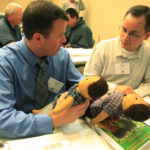
Andrew Bauch, front left, an assistant with the Kansas Attorney General’s Office, and Mark Simpson, an assistant with the Douglas County Attorney’s Office, discuss the use of dolls to help children express themselves when trying to describe abuse.
The scene might have been mistaken for grown-up playtime as a roomful of law enforcement officers, prosecutors and social workers held up dolls and talked.
The subject was a very serious one, however.
The group of about 30 was participating in a weeklong Finding Words Kansas training, a workshop that teaches professionals how to interview children that have been sexually assaulted.
“These dolls are not toys, they are tools that help us do our job,” instructor Helen Swan told the group sitting in a conference room at Lawrence Douglas County Fire Medical Station No. 5.
The intention of the anatomical dolls and training is to provide professionals the skills to help children describe, in their own words, what sexual abuses have occurred.
“Most adults have a hard time talking about anything sexual. So to expect children to be able to come in and start talking about this kind of stuff is not realistic. We need to make them feel comfortable,” said Kelly Robbins, executive director of Finding Words Kansas, a nonprofit organization.
The group holds weeklong workshops three times a year throughout Kansas. The one underway this week is the first of its kind in Lawrence and was co-hosted by GaDuGi SafeCenter.
Participating in the training were Lawrence police officers, Douglas County Sheriff’s Office detectives, Douglas County assistant district attorneys, GaDuGi advocates and social workers from the Kansas Department of Social and Rehabilitative Services.
Others attending came from as far as Bourbon and Brown counties.
Rita Fulton Mays, a detective with the Douglas County Sheriff’s Office, said this was the first training she’s received that focused specifically on child interviews.
“I won’t be as nervous as I have been in the past,” Fulton Mays said.
Child sexual assault crimes can be the hardest cases, said Robbins, a former forensic scientist and Kansas Bureau of Investigation agent.
Investigators have to ensure they don’t ask a child leading and suggestive questions. In many instances, the biggest piece of evidence is the child’s testimony, she said
“Not only do we want the child to be interviewed properly so the interview stands up in court. We don’t want to re-victimize the child by having multiple agencies talking to them,” Robbins said.
Public Safety

Defendant who violently beat woman gets another chance at probation; state had requested that she serve over 4 years in prison

Last-minute confidential settlement reached in Douglas County case in which surgeon removed wrong organ

Lawrence police seek information on weekend burglary at smoke and vape shop

Perry-Lecompton school district implements AI gun detection technology to protect students and staff from threats

Man convicted of battery against Douglas County corrections workers dies at El Dorado prison