Agriculture industry defends itself over grisly chick video
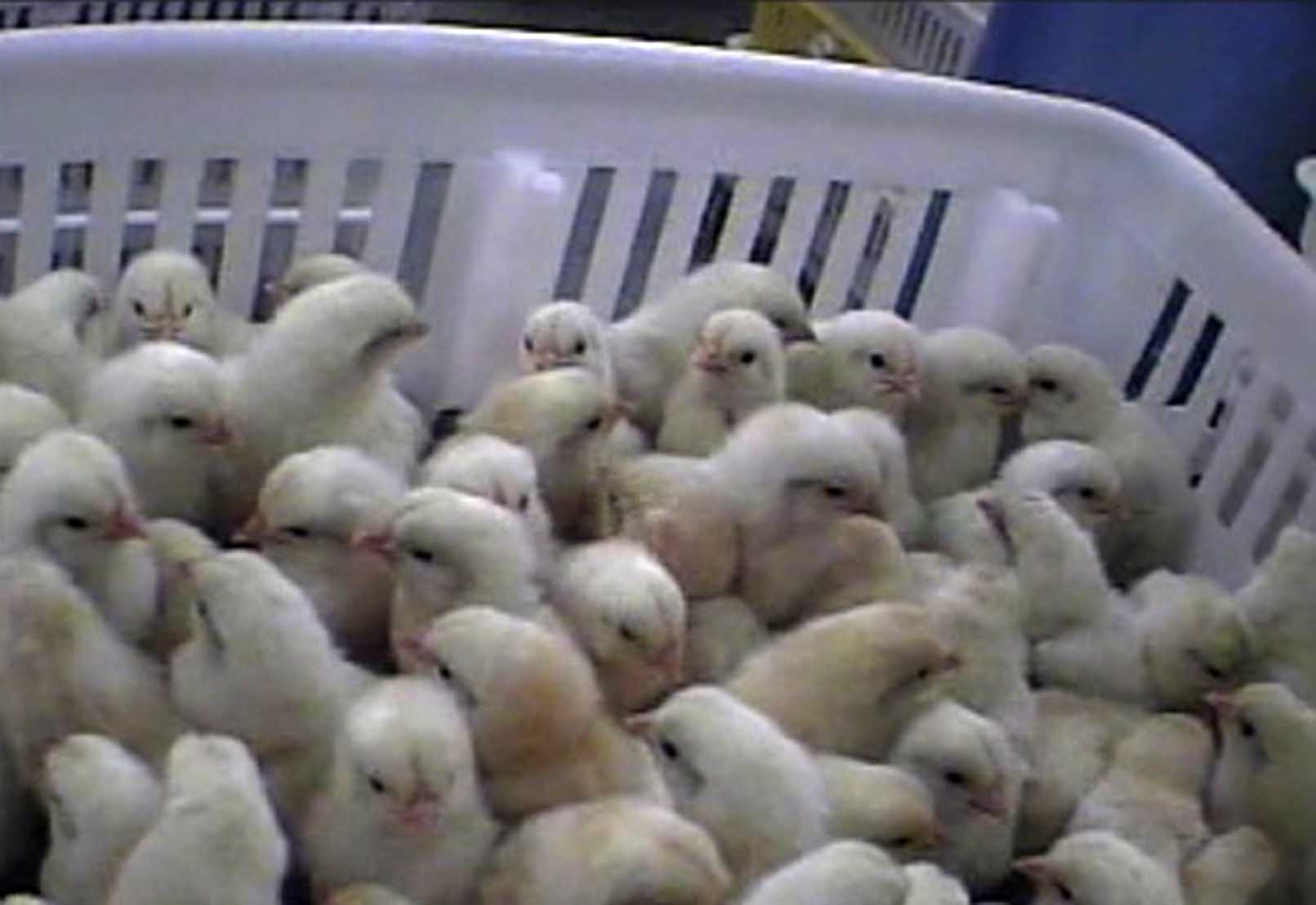
Chicks are coralled at Hy-Line North America’s hatchery in Spencer, Iowa, in this undated image made from video and provided by Mercy for Animals on Tuesday. An animal rights group is calling on the nation's largest grocery story chains to post warnings on egg cartons that unwanted male chicks are ground up alive, after videotaping the common industry practice at an Iowa egg hatchery.
Iowa City, Iowa ? Paul Lasley cringed when he heard about an undercover video showing unwanted chicks being tossed alive into a grinder at an Iowa hatchery.
The images were upsetting, to be sure, but as someone who grew up on a farm, Lasley knows that bringing meat and poultry to America’s dinner table is often a grisly business.
“When our parents made the decision to send this cow or pig or lamb to market, it was a sad day,” he recalled. “But it would be sadder if we couldn’t make the payment on the farm.”
Lasley, a sociologist at Iowa State University who specializes in rural issues, and others argue that most Americans in this age of supermarkets, suburbanization and multinational agribusinesses know little about farming and how animals raised for food are treated and why.
They contend that videos like the one in Iowa stir up people’s emotions without addressing important business considerations — in this case, the need to dispose of male chicks that have little value because they can’t lay eggs or grow large enough or fast enough to be raised profitably for meat.
“Part of that I think is the disconnect that many consumers have with agriculture,” Lasley said. “Fewer people actually grow up on a farm and kill animals.”
Animal rights groups, for their part, say the industry needs to change its ways and treat chickens, hogs, cattle and other animals with more care.
“There’s a real disconnect between our love for animals in society and these practices that are hidden largely from the public,” said Michael Markarian, chief operating officer of the Humane Society of the United States. “We believe that all animals should be treated humanely, including animals raised for food. That’s a mainstream American value.”
The video was filmed with a hidden camera at a hatchery in Spencer owned by Hy-Line North America. It shows several chicks dying on the factory floor and male ones being tossed into a grinder, a standard industry practice that was adopted just after World War II, when farmers began raising some hens for the meat and others for just the eggs.
Nationally, chicks also are killed on electrically charged plates and by suffocation with carbon dioxide.
The images in the video aren’t pretty, but industry groups said the chicks die instantly. And they said the footage belies an overall trend of improved treatment of animals in the past decade. The poultry industry, for example, has abandoned forced molting, in which hens are starved for a week or two to get them to lay more eggs.
Last year, California voters approved a measure that bars farmers from confining veal calves, pregnant pigs and egg-laying hens in spaces so small that they can’t turn around, lie down or extend their limbs. The major elements of the law will take effect in 2015 over the objections of farmers, who worry it will be costly to expand henhouses and buy more land.
Hens often are kept in small cages because it is cheaper. The hens take up less space, and because they can’t move around and expend energy, they eat less.
“Most people think their food comes from a grocery store,” said Dave Warner, spokesman for the National Pork Producers Council. “In processing food animals, there are things that you have to do to get them there.”
Emily Patterson-Kane, an animal welfare scientist with the American Veterinary Medical Association, said she worries that public revulsion to the grinding up of live chicks could force a shift to techniques that would be worse for the animals. Gassing male chicks, for example, might appear more humane, but chicks are resistant to the sedative effects and might suffer more than if they were quickly ground up, she said.
National

Unhealthy air quality in California city as huge warehouse fire burns for 3rd day

Judge orders Trump administration to restore National Park changes at sites that ‘disparaged’ US
Teens’ reading and math scores have stagnated, US test results show
WASHINGTON (AP) — Younger students have regained ground academically after the pandemic's disruptions while older ...

Lawyers for man accused of killing Charlie Kirk try to block death penalty

Trump’s name poised to come off Kennedy Center