

‘Rust’ proof: Meyer rides his own route to literary acclaim
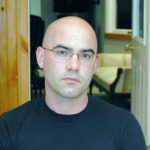
Philipp Meyer’s first novel, “American Rust,” follows two high school friends in a depressed steel town who are seeking a way to break free.
Baltimore ? It wasn’t apparent to anyone for the longest time that author Philipp Meyer had hopped the freight train to success — just like the protagonist of his acclaimed debut novel, “American Rust.” Every time Meyer’s line of boxcars seemed to be chugging along the straight and narrow, it would grind to a halt and shift into reverse.
For starters: Despite a high I.Q., Meyer dropped out of Baltimore City College High School at age 16. After three tries, he elbowed his way into Cornell University. After graduating, Meyer worked as a trader on Wall Street and made piles of money before deciding that he wasn’t cut out for the life of empty materialism. So he quit, moved into the basement of his parents’ home and picked up odd jobs in construction. Then, Meyer, who had been writing seriously since college, sold his first novel for $400,000.
The miracle isn’t that Meyer survived. It’s that his stout parents, Eugene and Rita Meyer, made it through those twists and turns alongside their son without losing their dinner.
“My parents were amazingly supportive,” says Meyer, 34. “My friends thought I was deluded.”
“American Rust” tells the story of two high school friends living in a depressed steel town: the slight, cerebral Isaac English and Billy Poe, a former football star with a hair-trigger temper. When Isaac tries to leave home, he and Billy have an encounter with three homeless men that turns violent. Things proceed from bad to worse, and the harder the friends struggle to escape, the more they are trapped.
Meyer has drawn comparisons to such writers as John Steinbeck, Richard Russo and William Faulkner. In a review, The New York Times proclaimed:
“‘American Rust’ announces the arrival of a gifted new writer … who understands how place and personality and circumstance can converge to create the perfect storm of tragedy.”
And although the novel is set in Pennsylvania’s Monongahela Valley, Meyer drew on his Baltimore upbringing for many elements. For instance, in the early 1980s, a man was nearly murdered in front of Meyer’s home.
“It turned out that he had been shot by a guy in a bar who was protecting his friend,” Meyer says — a turn of events echoed in the novel.
“He died in prison,” Meyer says, who now lives outside Ithaca, N.Y. “That was when I began to think about how an awful choice becomes the best choice someone can make. Growing up in that neighborhood and seeing the struggles of all these working-class folks and lower-class folks, I began to realize that their morality was shaped by their circumstances.”
And it was in the Hampden neighborhood northwest of downtown Baltimore that Meyer realized that appearances can be deceiving.
“I learned that people who might not get a lot of credit for being deep thinkers may have rich and complex visions for their own lives that might not be apparent on the surface,” he says.
Good listener
That description could apply, as well, to Meyer, who had near-perfect SAT scores but dropped out of high school because he was bored. (He later earned his GED.)
“We were not happy when he dropped out of school,” says his mother, Rita Meyer. “I remember telling him that by quitting, a lot of options were being closed off. But, we knew that he was very smart and very creative, and it was clear that school wasn’t working for him. It was just a question of him finding out what he wanted to do.”
Meyer’s parents held onto their faith throughout the next two decades. Eugene Meyer recalls that when Philipp was living in their basement, he worked construction jobs with ex-cons and occasionally as an emergency medical technician, where he learned his way around hospital trauma centers.
“Philipp was a good listener,” Eugene Meyer says. “He’d come home from work and sit at the kitchen table and tell me these stories. He always looked for the good in the people he was talking about. I think that’s where he got the prison scenes for the novel.”
But the budding author was going through a crisis of confidence. He had written two novels in college and while working on Wall Street that attracted no interest. He thought about giving up and becoming a paramedic.
“That was when I really began to confront the demons,” Meyer says. “I told myself, ‘You have failed at the one thing you really care about. You consider yourself a writer, but the world disagrees.'”
Meyer began thinking hard about the qualities defining great literature.
“I realized — finally — that I was writing for an audience,” he says. “I began to consider how I wanted my readers to feel and how to achieve that. All of a sudden, I started to get short stories published.”
Punk maturation
With a few credits under his belt from such respected literary magazines as the Iowa Review and McSweeney’s, Meyer was admitted to the Michener Center for Writers in Austin, Texas, and began work on “American Rust.”
His professors were impressed with the manuscript and helped their student sign with two agents. In December 2007, Random House bought the novel.
“One day, I’m this little punk kid,” Meyer says, “and the next day, I’m a published author and I know that I’ll be able to pay my bills and keep writing. It felt incredible.”
Arts and Entertainment
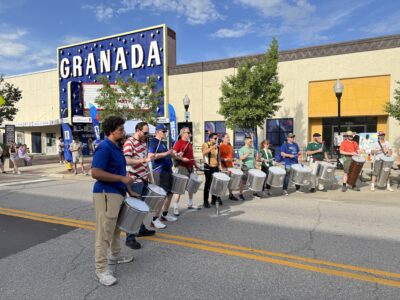
Photos: Lawrence begins World Cup festivities with downtown block party
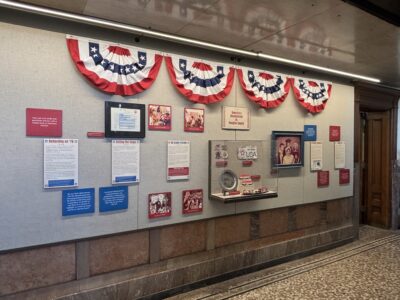
Watkins Museum to open special exhibit detailing how Douglas County celebrated America’s Bicentennial

Go, See, Do: Kaw River Roots Festival, markets and more
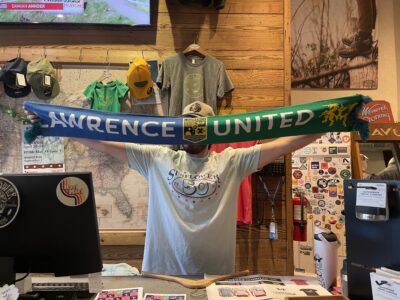
Soccer gear honoring Lawrence history’s all-star team is now on sale as part of city’s public art exhibition

Nominations, call for artists open for Lawrence’s 2026 Phoenix Awards