Salt mining a light in recession’s dim tunnel
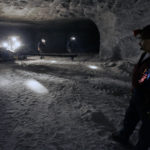
Miners prepare cutting equipment in the mine Dec. 11 at American Rock Salt in Hampton Corners, N.Y.
Hampton Corners, N.Y. ? A thick seam of salt courses 1,300 feet beneath the rolling farmland of Livingston County, almost as far down as the World Trade Center stood tall. Extracting the crystalline commodity for de-icing roads has been a solid livelihood for five generations and, these days, it’s a steady lamplight in the dim tunnel of recession.
Families here trace their histories with the mines’ ups and downs, but few have known tragedy and triumph like that of Joseph Bucci.
His grandfather, Nicholas, an immigrant from Italy in 1901, employed a shovel and a mule. His father, Joe, a GI Bill beneficiary after World War II, rose to chief engineer of the largest salt mine in the Western Hemisphere, a checkerboard maze of excavated chambers that grew to the size of Manhattan.
At first, Bucci didn’t follow in his forebears’ footsteps. He pursued a passion for teaching — his income supplemented by work as a real-estate agent — until a terrible day in 1975 changed everything.
He was teaching history at a high school a mile away when he heard the boom of a methane gas explosion at the huge mine. It was the sound of his father dying.
Reflecting on how that event reordered his own life, Bucci says now, “I know my father was part of maybe a mistake that got three other guys killed. I just thought if he was alive he’d want me to stay involved some way.”
And so, putting aside personal regrets and community rancor and never anticipating he’d become a salt baron, Bucci signed on part-time as a mineral rights buyer for International Salt Co. A few years later, he reluctantly put teaching aside to devote himself full-time to bringing up the rich mineral left behind when a shallow sea dried up 400 million years ago.
The salt bed, an elevated section of a 600,000-square-mile field, was first exploited in 1885. William Foster, the first salt baron in rural western New York, created the company town Retsof, its name his own spelled backward.
A new mine
In time, the Retsof mine where Bucci’s father worked was taken over by the Dutch conglomerate Akzo Nobel N.V. Years after his death, another thunderous crash occurred.
The colossal cave-in in March 1994, registering a magnitude 3.6 on seismic detectors, sent a torrent of aquifer water flowing into the mine. No one was hurt, but the effects soon became clear on the surface.
Two sinkholes hundreds of feet wide engorged fields in the Genesee River Valley. Trees toppled, a bridge foundation crumbled, wells were sucked dry. Volatile methane seeping from the ground had to be corralled and ignited in flares.
Unable to plug the leak, Akzo laid off 300 miners as the 18-square-mile mine filled with water over two years. But the company also pushed ahead with plans to build a new mine outside the river valley in Hampton Corners, a crossroads hamlet 8 miles from Retsof.
As the project’s real-estate negotiator, Bucci often rose at 4 a.m. to catch dairy farmers at the start of their workday. He spent 18 months acquiring 10,000 acres of mineral rights. Offering $300 an acre helped — Akzo had never topped $100 an acre — yet it was still a difficult sell.
“I had to convince them we were going to mine safely, the way we did for 100 years,” he says. “It’s always amazed me that so many cooperated. Just one farmer out of 57 didn’t sell.”
Betrayal
In a largely agrarian county where high-paying industrial jobs are precious, the mining company was a rare jewel. And yet, after spending $18 million on the long-planned new mine, Akzo executives in 1996 had stunning news. Gathering miners in a warehouse, they announced the company was selling its mining interests in North America.
The sense of betrayal was thick in the air. “A lot of grown men were crying, let me tell you,” Bucci says.
He knew right away he had a new and more desperate mission: finding a way to open the new mine himself.
Bucci found an immediate ally in Gunther Buerman, a business lawyer in Rochester who had negotiated compensation for a farmer whose home was endangered by subsidence. They were joined by a Wall Street financial adviser, Neil Cohen, and the trio launched American Rock Salt Co. at a cost of $126 million in 1997 — much of it debt they’re gradually repaying.
Since a shaft was sunk in 2000, 1,000 acres have been mined of up to 4.4 million tons a year and the payroll has grown to 275. Today, Bucci and the other two executives guide operations at the single biggest-producing rock salt mine in the United States.
‘The ultimate topping’
With $190 million in sales and rising profits from two snowy winters, American Rock Salt supplies much of New York and Pennsylvania and icy points from Wisconsin to Virginia.
About 50 million tons of salt are produced in the U.S. each year. Ice-melting salt, sold in large crystals, accounts for nearly half of the $1.5 billion in sales, said Richard Hanneman, president of the Salt Institute, a trade association.
After a harsh winter, road-salt suppliers went into high gear in 2008 to meet surging demand and the 20.5 million-ton record set in 2005 was likely eclipsed, Hanneman said.
“We went through a lot of years where we just broke even,” Bucci says. “This winter’s like the ultimate topping.”
With overtime, many workers make $40,000 to $60,000 a year, according to Buerman.
“It gives you a quality of life hard to find in Livingston County,” says foreman Scott Garrett, who has three children in college.
About 2,500 people work rock salt mines in Kansas, Texas, Louisiana, Ohio, Michigan and New York. Compared with coal mining, fatal accidents are relatively few. The last of the 36 deaths at Retsof occurred in 1990 when a roof slab buried two men.
“I’ve seen the best of mining and I’ve seen the worst. All in all, this is a pretty darn safe job,” says drill operator Dennis Raftery, a 31-year veteran.
National
Unhealthy air quality in California city as huge warehouse fire burns for 3rd day

Judge orders Trump administration to restore National Park changes at sites that ‘disparaged’ US
Teens’ reading and math scores have stagnated, US test results show
WASHINGTON (AP) — Younger students have regained ground academically after the pandemic's disruptions while older ...
Lawyers for man accused of killing Charlie Kirk try to block death penalty
Trump’s name poised to come off Kennedy Center