

Behind the Lens: Mentor photographer known for firsts in the business
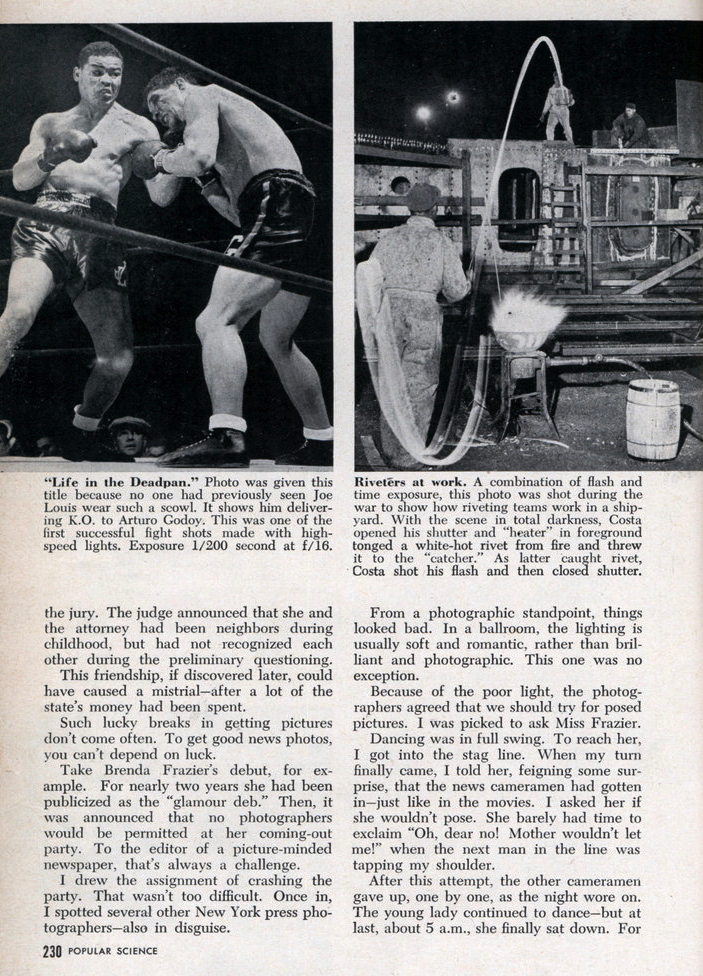
These two photographs and captions by photojournalist Joe Costa are from a September 1950 Popular Science article called “These Are Photos I’ll Always Remember.” Costa was a photojournalist who witnessed the change in lighting equipment from flashbulbs to electronic flash.
I recently visited with a photojournalist friend from Indiana, where we both attended Ball State University in the early ’80s. We swapped stories about one of our former professors, Joseph Costa.
For nearly 44 years, Costa was photographer, chief photographer or photo supervisor on several papers including the New York Daily News and the New York Daily Mirror. In 1945, he was a founder and the first president of the National Press Photographers Association.
By the time I sat down in his photojournalism class, Joe was 78, quick with a story, lively on his feet and a very demanding instructor. He wore a tie with long-sleeved shirts and cufflinks — even in the darkroom. He was an imposing figure and slightly intimidating.
I remember driving through the journalism school parking lot in the rain one morning, taking a turn a little to quickly. There was Joe, wagging his finger at me as I nearly splashed him.
For a photojournalist, Costa’s era was so drastically different than mine, especially in regard to lighting equipment. When I set up electronic flashes for a shoot, I recall some of Costa’s stories of the difficulties he faced in using flashbulbs.
Joe got an assignment to photograph a flea circus, a popular sideshow attraction early in the 20th century. Joe set up his camera, probably a Graflex Speed Graphic 4×5, and mounted his single-use flash bulbs into his reflector pan. The owner of the flea circus set out his miniature performers and their assortment of circus props.
On Joe’s first attempt, the shutter snapped, the flashbulb fired and the fleas were fried! He killed ’em all. Because of the heat and proximity of the bulbs, his subject would require a different approach. He later re-shot the assignment using an electronic flash, then a recent invention of Harold “Doc” Edgerton and now a common part of almost every camera on the market.
Moving to a much larger subject, Joe one time arranged to photograph a U.S. Navy aircraft carrier — at night. He supervised the installation of hundreds of flashbulbs around the decks of the ship, all connected by one wire. From a helicopter above, Costa was to radio the deck when to fire the flashbulbs to sync with his camera. There was a miscommunication, and the bulbs flashed out of sync with Costa’s camera. A redo in this case meant another installation of hundreds of flashbulbs and a second helicopter flight. But the second time worked, and Costa succeeded in capturing a unique photograph, probably a first in maritime history.
Arts and Entertainment
Photos: Lawrence begins World Cup festivities with downtown block party
Watkins Museum to open special exhibit detailing how Douglas County celebrated America’s Bicentennial

Go, See, Do: Kaw River Roots Festival, markets and more

Soccer gear honoring Lawrence history’s all-star team is now on sale as part of city’s public art exhibition

Nominations, call for artists open for Lawrence’s 2026 Phoenix Awards