Mid-America Business Conditions state-by-state glance
Omaha, Neb. ? The Institute for Supply Management, formerly the Purchasing Management Association, began formally surveying its membership in 1931 to gauge business conditions.
The Creighton Economic Forecasting Group uses the same methodology as the national survey to consult supply managers and business leaders. Creighton University economics professor Ernie Goss oversees the report.
The overall index ranges between 0 and 100. A figure greater than 50 indicates an expanding economy over the next three to six months.
Here are selected state results of the December survey in the Mid-America region:
Iowa: For the seventh month in a row, Iowa’s overall index remained below growth-neutral. It slumped to a record low of 30.4, down 6.4 percentage points from November’s 36.8. Components of the overall index were new orders at 19.6, production at 23.9, delivery lead time at 50.0, employment at 39.1 and inventories at 31.8. “A less robust farm economy, the U.S. economic recession and a struggling biofuels industry will place continuing downward pressure on the Iowa economy,” Goss said. “I expect Iowa’s seasonally adjusted unemployment rate to rise above 5 percent in the first half of 2009 with another 2,000 jobs lost. Losses will also continue for vehicle parts suppliers and related firms in the state.”
Kansas: December’s overall index dropped to 31.1 from November’s 32.7 and October’s 50.5. Components of the overall index were new orders at 27.3, production at 22.7, delivery lead time at 45.5, employment at 31.8 and inventories at 40.9. “A weakening transportation equipment manufacturing sector and lethargic farm income will push the state’s unemployment rate above 5.2 percent (seasonally adjusted) in the first quarter of 2009, with job losses approaching 3,000 by the end of the first quarter,” Goss said. He expects job losses in the state’s telecommunications industry to continue as well, although at a slower pace.
Missouri: Missouri’s overall index remained below growth-neutral for the third month in a row, dipping to 36.9 from November’s already weak 39.3 and October’s 48.1. Components of the overall index were new orders at 31.6, production at 35.1, delivery lead time at 43.7, inventories at 40.0 and employment at 40.0. Since October 2007, Missouri has lost almost 24,000 jobs, Goss said. “Based on our surveys, these losses are expected to continue well into 2009,” he said. He expects 10,000 more jobs will be lost and the state’s unemployment rate to rise a half percentage point.
Nebraska: The state’s overall index rose slightly in December, but remained below growth-neutral at 37.1. November’s figure was 33.5. Components of the overall index were new orders at 27.5, production at 35.6, delivery lead time at 50.4, inventories at 45.2 and employment at 39.6. Goss said slowdowns have been reported by computer and electronic component manufacturers and by companies with links to vehicle manufacturing. Nebraska has lost more than 9,000 jobs since August. “Based on surveys over the past few months, I expect the state to lose another 5,000 jobs,” Goss said. He expects a half-point rise in the unemployment rate by mid-2009. November’s rate was reported at 3.7 percent.
Oklahoma: Oklahoma was one of two states in the region, along with North Dakota, reporting an overall economic index above growth-neutral. The index rose to 51.6 in December from 40.2 in November. Components of the overall index were new orders at 49.3, production at 50.3, delivery lead time at 52.1, inventories at 54.4 and employment at 51.4. “There are more workers employed in Oklahoma than ever before,” Goss said, pointing to expansions in mining and natural resources and durable-goods manufacturing. “While Oklahoma’s economy has clearly avoided the national recession, I expect recent economic strength to dip as the global economic recession weakens the state’s manufacturing sector,” he said.
National
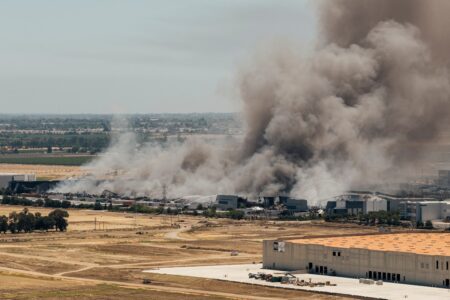
Unhealthy air quality in California city as huge warehouse fire burns for 3rd day

Judge orders Trump administration to restore National Park changes at sites that ‘disparaged’ US
Teens’ reading and math scores have stagnated, US test results show
WASHINGTON (AP) — Younger students have regained ground academically after the pandemic's disruptions while older ...

Lawyers for man accused of killing Charlie Kirk try to block death penalty

Trump’s name poised to come off Kennedy Center