

‘Producers’ appearance shows changing attitudes about Hitler
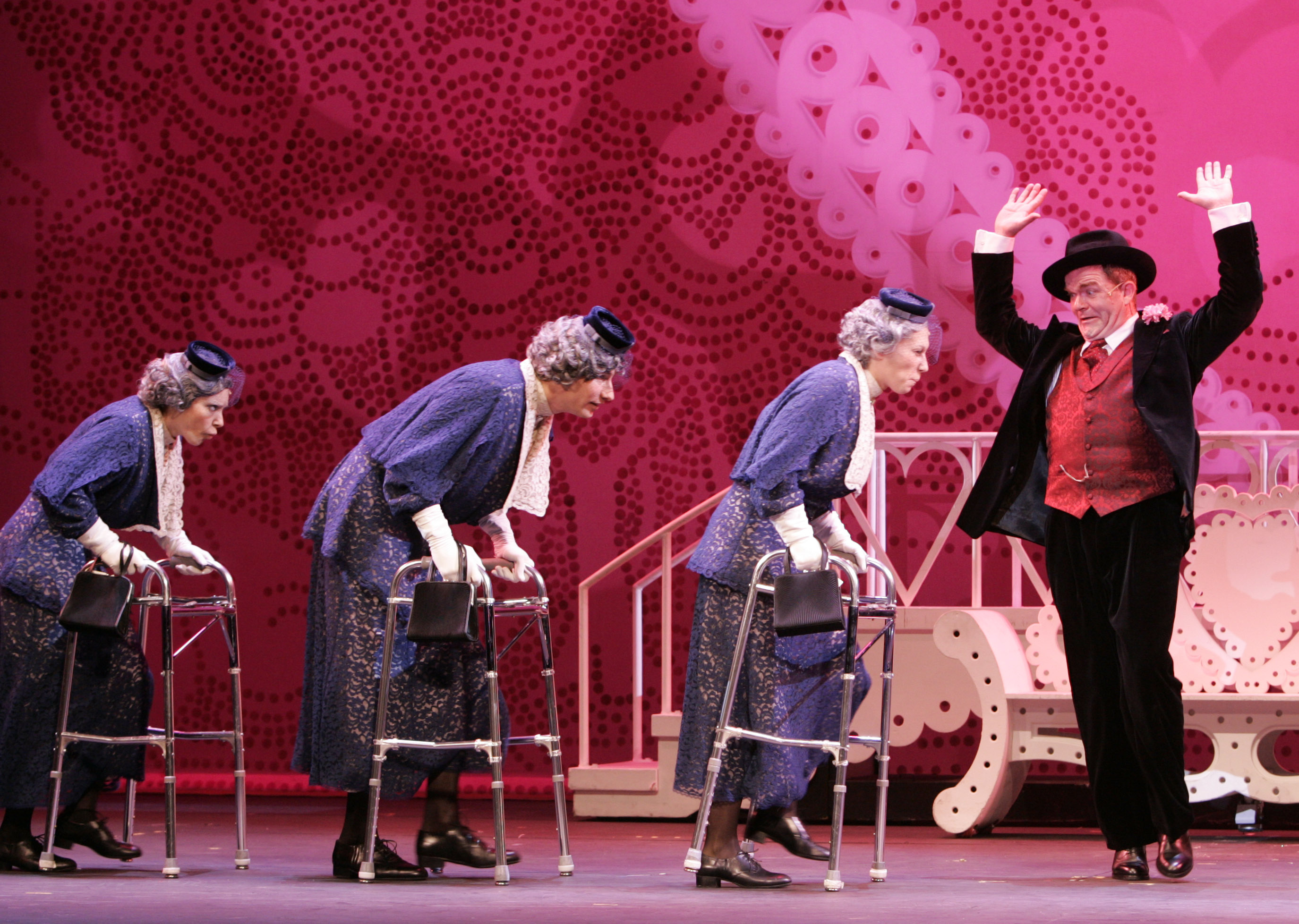
Cornelius Obonya, right, in the role of Max Bialystock, performs during a dress rehearsal for Mel Brooks’ musical “The Producers” at Vienna’s Ronacher Theater in this June 25, 2008, file photo.
Berlin ? A musical in Berlin with swastikas, goose-stepping and a catchy tune called “Springtime for Hitler” might be expected to draw outrage from a German public sensitive to playing the Nazi past for comedy.
But on May 15, the German-language version of the Broadway hit “The Producers” is opening at the Admiralspalast theater, and so far no one seems to be complaining.
Three years ago, a Hebrew-language production played in Tel Aviv to packed and laughing audiences. Then a German production was staged in Austria, Adolf Hitler’s birthplace. Now the same troupe is bringing the show to the German capital.
It all suggests that even in the countries most closely associated with the Holocaust, as perpetrators or as victims, new generations are managing to take their darkest hour in stride and laugh at a tale of two New York Jewish rascals who devise the ultimate in bad taste-for-big bucks — a musical comedy about Hitler.
“Berliners, and Germans in general, have processed and reprocessed the Third Reich,” said Michaela Ronzoni, who translated the show into German. “I think it’s possible to make jokes about it.”
Memories of war
Demographics are bolstering the trend: Even the youngest victims and perpetrators are getting old, and multiple generations now have no memory of the war.
Older people in the audience may “quarrel with the whole idea of having fun with what they thought was the most serious part of their lives,” Mel Brooks, the musical’s co-author, told The Associated Press.
But for people aged 35 or 40, “I don’t think there’s any problem at all. … They’re hip, they’re bright, and Berlin has always been a great theater town. They’ve always broken ground.”
Even today, however, Germans have to tread carefully when it comes to the Third Reich. Last July, a wax Adolf Hitler at Madame Tussaud’s Berlin museum was beheaded by a 41-year-old man shouting “No more war!” And in January, a coffee shop chain recalled 700 placards that said “To Each His Own” because it was the slogan on the gates of Buchenwald concentration camp.
Yet two years ago, when a Swiss Jewish director portrayed Hitler as a comical idiot in “Mein Fuehrer: The Truly Truest Truth about Adolf Hitler,” reviewers focused on the film’s debatable cinematic merits rather than on the treatment of the Fuehrer as comedy.
Historical sensitivities
Dieter Graumann, a vice president of the Central Council of Jews in Germany, said that while he isn’t a fan of such parodies, making light of Nazis could help a new audience talk frankly about the past.
“It’s a matter of taste,” Graumann said. “As long as you don’t glamorize and glorify the Nazi era, it’s all right.”
The theater staging the 2 1/2-month Berlin run has historical baggage of its own.
Built in the 1920s, it became a favorite of the Nazis and even added a “Fuehrer’s box” on the first balcony to honor the dictator.
“Too bad he’s not alive today to see the show,” Brooks said.
Hitler’s appearance in “The Producers” is brief, as a character in a play within the play, which tells of two failed producers who stage a surefire flop, in which case they will keep their investors’ money for themselves. Instead the play is a hit and everything goes wrong.
In a telephone interview from his office in Culver City, Calif., Brooks said he stayed away from the Israeli show because “I was afraid the Jews would kill me. But I’m not crazy, I wouldn’t do a musical about concentration camps or anything like that. It’s just too chilling and too horrible. It’s too sad.”
Brooks, 82, said he has been to Germany several times, starting with a brief U.S. Army stint in World War II and later to see theater and festivals. Asked whether he would attend the Berlin production, he said, “I’m going to try to sneak over” at some point.
He said he didn’t see the Vienna production, but listened to a recording of it, and understood enough German and Yiddish to follow along.
Arts and Entertainment
Photos: Lawrence begins World Cup festivities with downtown block party
Watkins Museum to open special exhibit detailing how Douglas County celebrated America’s Bicentennial

Go, See, Do: Kaw River Roots Festival, markets and more

Soccer gear honoring Lawrence history’s all-star team is now on sale as part of city’s public art exhibition

Nominations, call for artists open for Lawrence’s 2026 Phoenix Awards