The littlest victims
Legal system not always a good fit for children who suffer sexual abuse
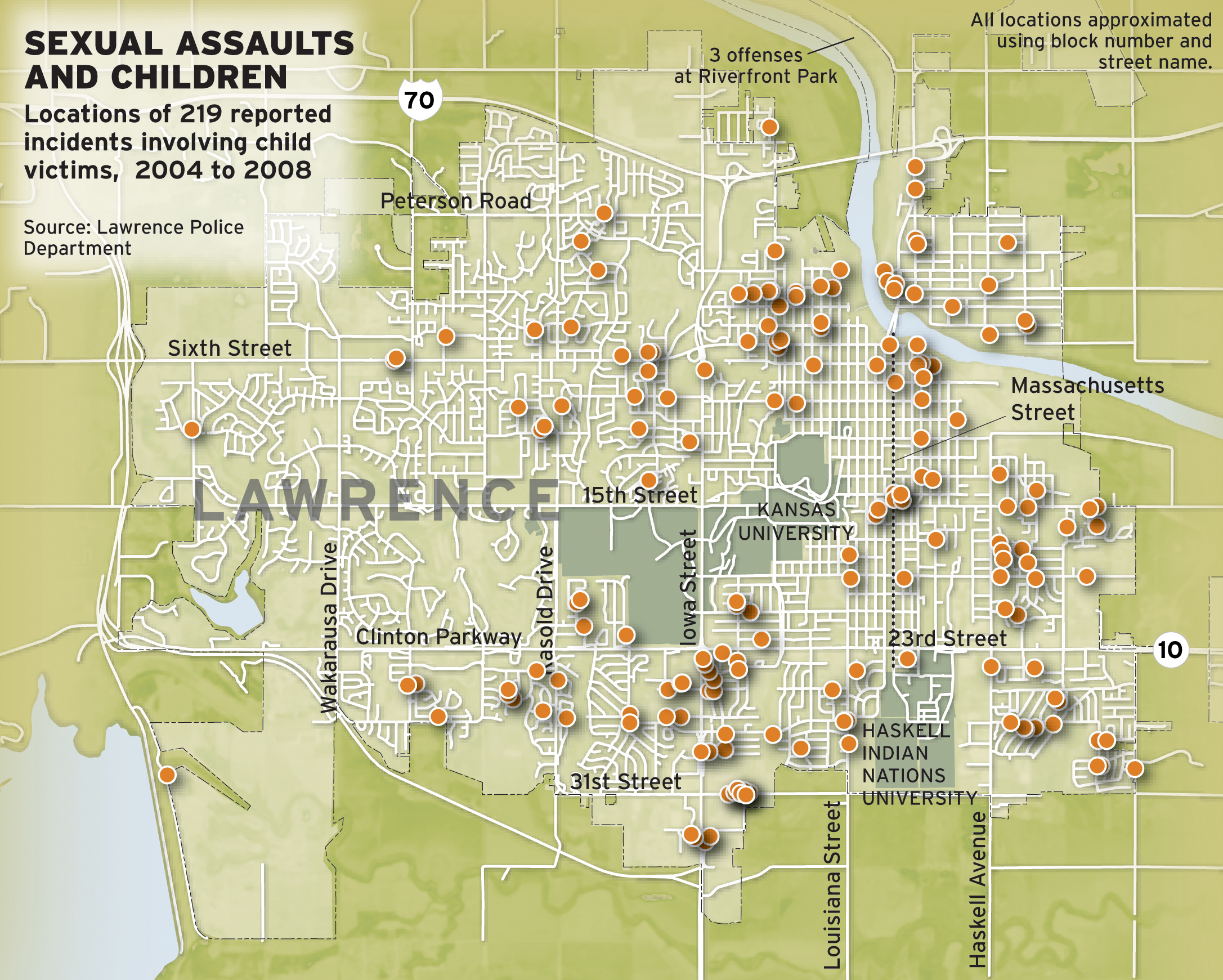
Locations of 219 reported sexual assaults involving child victims, 2004 to 2008.
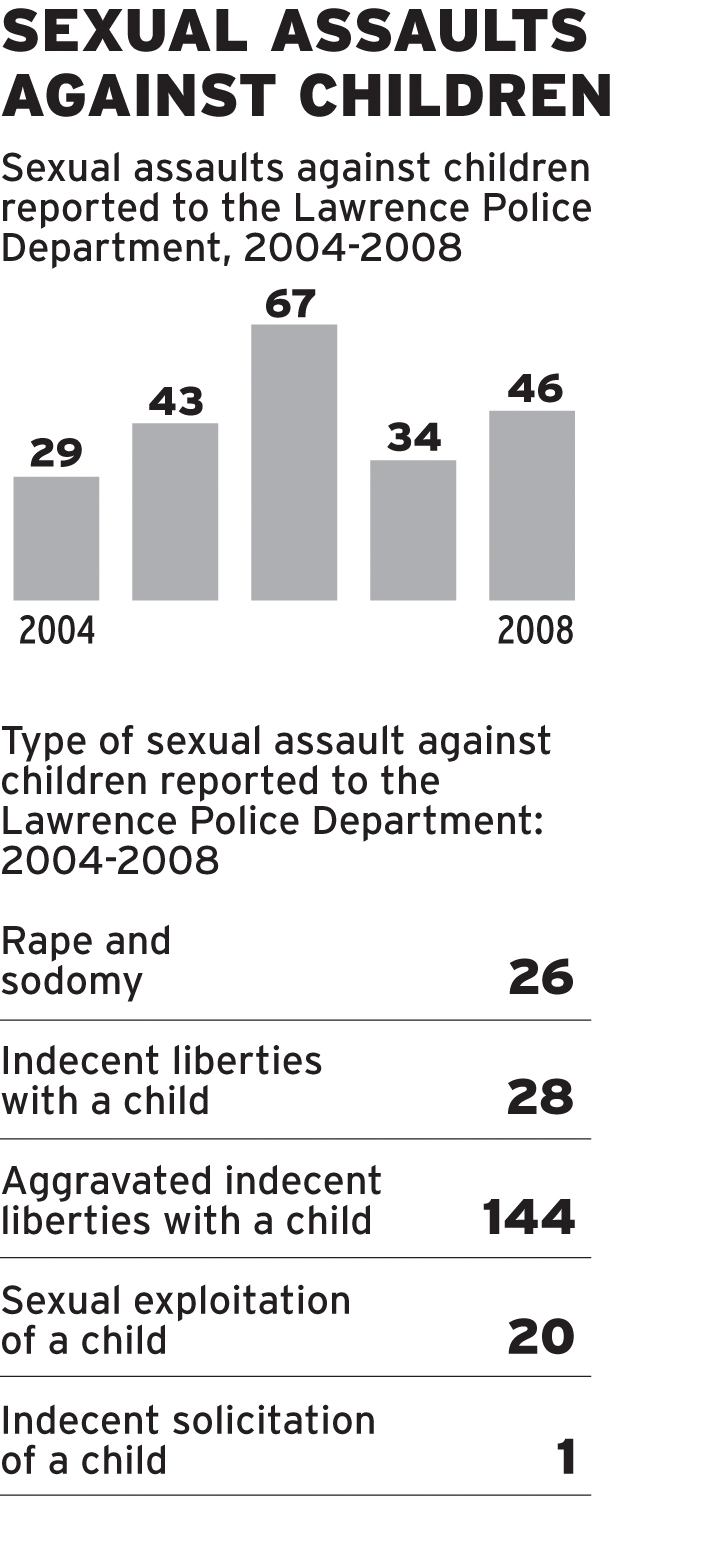
Sexual assaults and children
- It’s a reporting issue: Risk factors for abuse not easy to pinpoint
- Sexual abuse reports at Central not cause for alarm, district says
- Child sex predators not usually strangers: Family members, friends responsible for most assaults
- Cycle of abuse can be seen in families
- Signs of sexual assault
- How to help a child
- Who must report suspected abuse
When Amy McGowan talks about her years prosecuting child sex crimes, she recalls when she had to scramble to find a booster seat from a restaurant so a 3-year-old could testify on the witness stand.
“And, that was when I went, ‘Oh this is wrong,'” said McGowan, Douglas County chief assistant district attorney.
From the time a child has to tell his or her story in front of a team of investigators to when a final sentence is handed down by a judge, there are many faults in a system that is not designed for its youngest victims.
More could be done in Douglas County so that the process intended to bring justice on behalf of children doesn’t end up traumatizing them a second time, local community members said.
A Lawrence Journal-World/6News investigation found that in the past five years more than 200 cases of child sexual assault had been reported to the Lawrence Police Department.
“It’s not a child-friendly system. It isn’t at all. I feel for any family and any child that has to go through it,” McGowan said. “Do I encourage everybody to not take the law into their own hands and let us do what we need to do, absolutely. But, it’s just not built for it.”
A lack of services
Lawrence doesn’t have a medical provider who can do a forensic sexual assault exam on children age 14 and younger. The closest medical facilities are Children’s Mercy in Kansas City, Mo., or Stormont-Vail Regional Health Center in Topeka.
That drive can be an added burden for a family that is already going through a stressful experience, said Pam Lawrence, GaDuGi SafeCenter coordinator of adult and child services.
Lawrence Memorial Hospital doesn’t see enough cases to do the exam, said hospital spokeswoman Belinda Rehmer. She noted that in 2008, the facility didn’t see anyone requesting such a service. Agencies where sexual assaults are reported, such as GaDuGi and police, refer clients elsewhere.
“It’s all about how many you see, and the more you see the better you are at what you are doing,” Rehmer said. “And, we really don’t want to make any mistakes in what we are doing.”
While signs of sexual assault are found in only around 5 percent of child cases, Lechelle Williams, a pediatric nurse practitioner at Children’s Mercy, said any child who has been victimized needs to have a medical exam. Even if the report is delayed, Williams said, medical professionals can test for infections and injuries.
Children’s Mercy has a specific clinic for abused and neglected children. The clinic has nurses who have completed a two-day training session as part of the Sexual Assault Forensic Examiner program. It also has doctors, nurse practitioners, social workers and child life specialists who are trained in areas focused on pediatrics and child abuse.
Regardless of how many children need the service, the Lawrence community should look at providing it, said Sarah Jane Russell, director of GaDuGi SafeCenter, a nonprofit agency that provides a 24-hour sexual assault hot line and helps shepherd survivors through the healing process.
“The issue is how serious are we about providing a continuum of care for victims of sexual assault, from children to adults,” she said.
Building a safe place
Before children are interviewed about a sexual assault, they must first wind their way through the intimidating world of a police station, Douglas County District Attorney Charles Branson said.
“If we can put kids in a comfortable environment, we reduce their stress, which is important. We don’t want to put them through another traumatic event,” Branson said.
The police department does have a child interview room painted a welcoming shade of light blue and furnished with leather couches, a child-sized table, drawing pads and dolls. The department also has two designated juvenile officers who have received training on how to interview children.
“You have to have training so you don’t coerce anything out of them,” Lawrence Police Sgt. Bill Cory said. “They are very susceptible, especially to adult figures. And, there are certain ways to interview them to get the whole story as to what actually happened.”
The community has reduced the number of times a child has to talk about the abuse. If possible, the Kansas Department of Social and Rehabilitation Services and the Lawrence Police Department work together to do a joint interview.
That interview is videotaped and can be reviewed by the D.A.’s office before determining whether charges should be filed. Medical examiners also interview the child about the assault.
“It can be very difficult and it’s not one social worker or detective alone,” said Phaedra Wade, who is the Douglas County Child and Family Services social work supervisor. “It’s a team effort. No one individual makes a decision as to what will happen.”
GaDuGi, the D.A.’s office and SRS have advocated for a child safety center that would provide a one-stop shop for abused or neglected children and their families. They envision a child-friendly environment where law enforcement officers, medical examiners and social agencies could be on-call 24 hours a day to respond to reports of abuse.
Such centers are scattered across the state in office buildings, donated homes and even a renovated RV.
“The services are being provided for kids in Douglas County; the question is how would those services look if they were under one roof,” Russell said. “And, if they were under one roof, would we get more reports?”
In 2007, GaDuGi SafeCenter and SRS received a one-time $28,000 planning grant. The money was used to train officers and staff, buy office equipment and create partnerships to form a child abuse response team. From that money, Russell said, memorandums of understanding were signed by law enforcement and social service agencies on how services would be provided at a safety center.
As of now, the project is stalled by a lack of funding for a building, support staff and operating expenses. The hope was to receive state money to open the center. But with the budget shortfalls, the state isn’t willing to pay for any new ones.
“We’re in the queue,” Russell said.
All or nothing
The legal process also has its shortcomings for child sexual assault victims. McGowan said that more stringent sentencing guidelines under Jessica’s Law have resulted in more children testifying in court.
Jessica’s Law, which is based on legislation passed in Florida, went into effect in 2006 in Kansas.
The law hands down a life sentence with parole eligibility after 25 years for anyone 18 years or older committing a sexual offense in which the victim is a child younger than 14. If released from jail, the offender has to register as a sex offender and be monitored for life. The sentence is the same penalty as for first-degree murder.
The offenses that come under Jessica’s Law range from child rape to attempting to fondle a 13-year-old girl. The judge can depart from Jessica’s Law if there are substantial or compelling reasons.
For the D.A.’s office, pressing charges for a child sex crime has become an all-or-nothing proposition, Branson said.
Few offenders are willing to plead guilty to charges that can bring 25 years in prison, and prosecutors don’t have any leeway in striking any other plea bargains. So, prosecutors must have evidence and witnesses they can take in front of jury, or they can’t press charges.
“We have to look at these cases and decide can we go all the way with this case and if for some reason we can’t go all the way with this case — sometimes you have a victim who is incapable of withstanding the trial process … we may not be able to file,” Branson said. “Whereas before, we might have been able to run something through that could have put (the offender) on the books, that could have somehow had them identified.”
For those who do go to trial, the child has the burden of testifying in front of his or her offender.
“The thing that is detrimental about Jessica’s Law, no one is going to waive the preliminary hearing, no one is going to plead guilty, so that kid has to go through court two times,” McGowan said.
GaDuGi and the D.A.’s office work with children before they testify in court. But as in the case of the 3-year-old in need of a booster chair on the witness stand, the system is often ill-equipped to handle them.
“It tears everyone up,” Branson said.
State Government

Opinion: The Lawrence man seeking to break the power of Republican, Democratic parties this election
State tax receipts top estimate by $147M for quarter
TOPEKA — The state of Kansas collected $147 million more in taxes than anticipated during the first quarter of ...

Rep. Tracey Mann to skip candidate forum in Lawrence; spokesman scarce on details

Kobach, Mann debate criminal justice priorities at Tuesday event as they campaign in attorney general race

Kansas must count mail ballots that arrive three days after November election, appeals court rules