Hawaii coin to end US Mint’s popular state quarter program
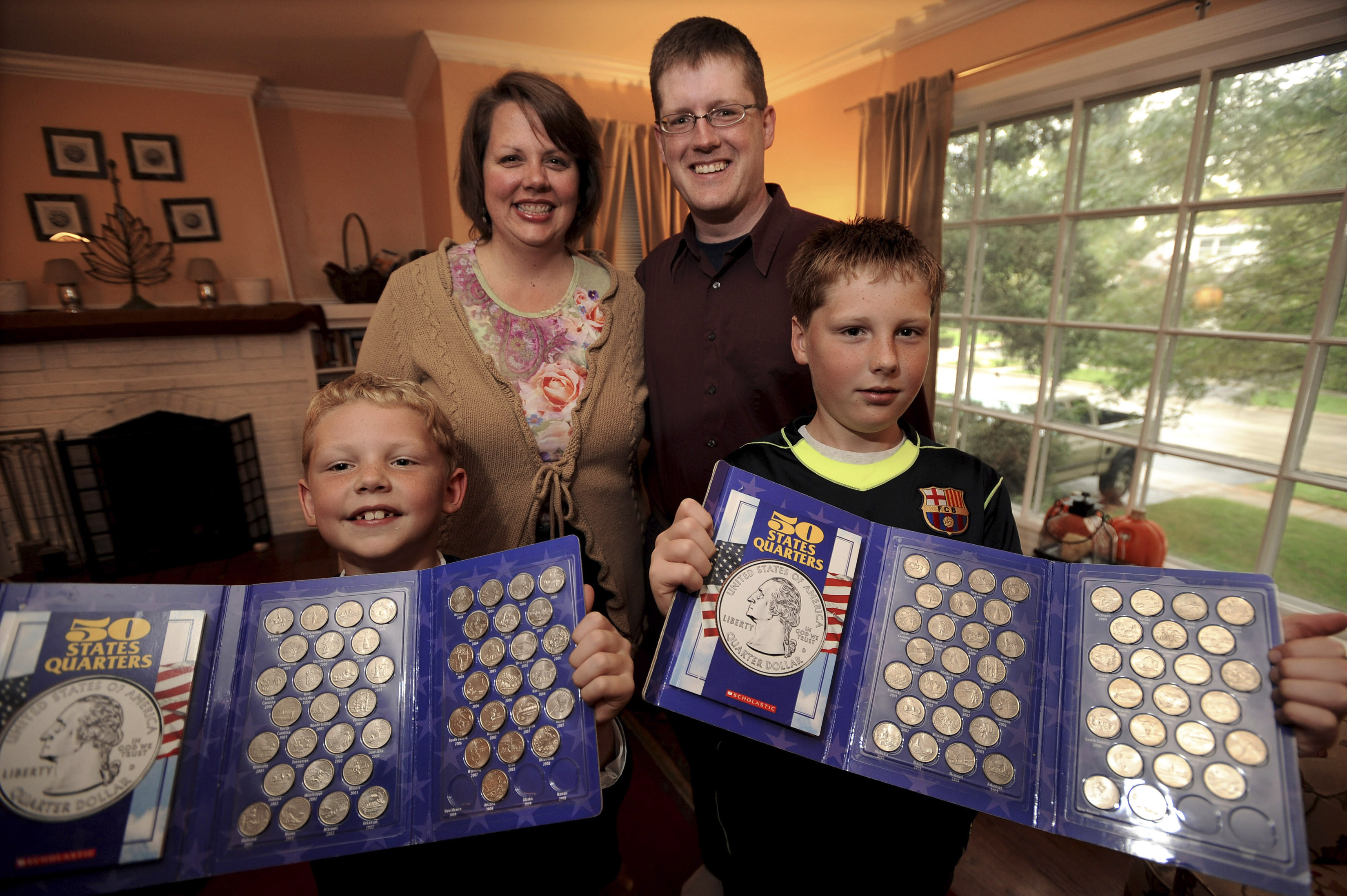
Ted Miller, 7, left, and brother Grey Miller, 10, right, hold their state quarter collections with parents Karen and Bob Miller last week in Elmhurst, Ill. With the release of the Hawaii state quarter in November, the U.S. Mint's coin program will end.
New York ? With a big aloha to Hawaii, a new generation of coin collectors will soon shut their books on the U.S. Mint’s popular 10-year state quarter program full of fond family memories and a fun dose of history.
While not terribly rare, considering about 34 billion were produced, the commemorative quarters have captured the frenzied fancy of kids and their parents as they’ve drawn extended family, tip-collecting waitresses and friendly bank tellers into the hunt.
Coveted by roughly 147 million collectors in the U.S., the coins have also been lucrative for the Mint, bringing in $3.5 billion in pure profit by the end of last year, excluding special-issue sets.
The Mint knew the program would be successful, said spokesman Michael White, “but it turned out to be even more popular than expected. This is the most popular coin program in history.”
Come November, it will end with Hawaii as the last state honored, having fulfilled one of the government’s goals – to ignite interest among young people in U.S. history, geography and coin collecting.
Bruce Chapman, 54, of Yorba Linda, Calif., and his 23-year-old daughter, Valerie Cope of Provo, Utah, will miss “The Ceremony.”
“I’ve been collecting state quarters with my dad since I was 14,” Cope said. “I remember wondering what I’d be doing in 2008 when the state quarters were finally all out. It seemed so far away.”
The two get together with each new release after Chapman picks up a fresh $10 roll at his bank. Cope gets to choose which coin to press into their slotted map, but dad provides the muscle to adjust it just right.
“We sing a little song: ‘It’s the quarter ceremony!’ Imagine really bad operatic-style singing,” Cope said. Using a napkin to polish, they “sit back and marvel at how many quarters we’ve collected.”
The Mint issued the quarters in the order each state joined the Union, with five releases a year at intervals of about 10 weeks. Colorful collection books, often in the shape of U.S. maps, are full of state trivia and history covering each state.
Teachers have also hopped aboard, downloading thousands of free lesson plans on the quarters from the Mint’s Web site.
“I like learning about the state nicknames, what year the state joined the U.S, what year the quarter was made and what the flags look like for each state,” said Grey Miller, 10, of the Chicago suburb of Elmhurst.
Added his 7-year-old brother, Ted: “I like it because you can see what’s on each state’s quarter and talk about why flower or animals or whatever are on them.”
With the end of the program comes special complete sets of the quarters as well, including uncirculated collections with a satin finish and silver proofs.
And collectors looking for a fresh fix should keep eyes peeled next year. That’s when quarters will be issued for the left-out District of Columbia, commonwealths of Puerto Rico and the Northern Mariana Islands, and the U.S. territories of Guam, American Samoa and the U.S. Virgin Islands.
National

Unhealthy air quality in California city as huge warehouse fire burns for 3rd day

Judge orders Trump administration to restore National Park changes at sites that ‘disparaged’ US
Teens’ reading and math scores have stagnated, US test results show
WASHINGTON (AP) — Younger students have regained ground academically after the pandemic's disruptions while older ...

Lawyers for man accused of killing Charlie Kirk try to block death penalty

Trump’s name poised to come off Kennedy Center