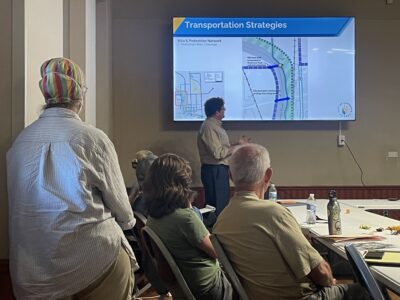
Transportation funding idles outside city
State leaders work to find options to fund comprehensive program
Do it yourself
Think you can come up with a successor to the state’s 10-year, $13 billion comprehensive transportation program – the financial road map for roads, highways and related projects and programs for all of Kansas?
Give it a spin.
The Kansas Department of Transportation has set up a T-LINK calculator, an interactive online tool to let anyone compile his or her own program.
The calculator allows users to make their own choices about construction priorities, preservation efforts, bridge improvements, safety enhancements and investments in various modes of transportation, including public transit.
Users then can forward their plans to the department, which provides feedback to members of the T-LINK Task Force that is advising Gov. Kathleen Sebelius.
To use the calculator or for more information, visit www.kansastlink.com/ calculator.
– Mark Fagan
Just because Lawrence voters resoundingly found a way to finance major road projects, pavement repairs and transit operations during the next 10 years doesn’t mean all questions about financing are resolved.
The approval of new sales taxes in Lawrence to pay for such projects and services is only the beginning, officials concede, because larger financing programs remain very much unresolved at higher levels of government.
“The state needs to do the same and the federal government needs to do the same, in terms of the funding,” said Pat Weaver, executive director of the Kansas University Transportation Center. “We feel that there’s a recognition that these programs are essential – we know they’re essential – but now what?”
Weaver isn’t necessarily suggesting that the state and federal government join Lawrence in boosting sales taxes to finance transportation needs. It’s just that Lawrence now has access to 10 years of voter-approved financing, after voters on Tuesday overwhelmingly approved three separate sales-tax increases for infrastructure and transit.
The questions passed with about 70 percent of the vote, and won support in each and every precinct in Lawrence.
“It’s incredible,” Weaver said.
Now, attention turns to state efforts to pass a new comprehensive transportation program.
The current program – $13 billion over 10 years – expires in June, and legislators are gearing up to mull a variety of options beginning in January. Gov. Kathleen Sebelius has asked advisers to consider options other than increasing taxes on motor fuels, a direction that has launched discussions about the potential for increased use of options including tolls, income taxes, registration fees and traffic fines.
‘A critical point’
Weaver is among 30 members of the Sebelius-appointed T-LINK Task Force – that stands for Transportation-Leveraging Investments in Kansas – scheduled to meet next month to compile a report, one expected to outline spending priorities and financing options.
“We’re at a critical point right now,” said Weaver, who also serves as associate director for the KU Transportation Research Institute, which oversees the university’s transportation center, flight research lab and Infrastructure Research Institute. “But it’s impossible for me to say where this thing is going to go.”
At Lawrence City Hall, Chuck Soules will be watching intently.
Soules, the city’s director of public works, already has a plan to spend the millions of dollars expected to be generated each year by increased sales taxes. The plan includes rebuilding Kasold Drive, from Clinton Parkway to 31st Street and from Harvard Road to Bob Billings Parkway; 19th Street, from Iowa Street to Naismith Drive; and 31st Street, from Haskell Avenue to O’Connell Road.
But the city also gets $1 million a year from the state to help finance such work, plus more from other programs to help repave roads and take care of other needs.
“We rely a lot on state funding,” Soules said. “We’ve made a lot of promises with the sales tax money, that we’re going to do more work – and we are. We’ll do the work we promised. But if we lose money from the state we won’t be able to do other projects. :
“It’s significant.”
Revenues in reverse
The discussion comes after an Election Day warning from state budget experts: Legislators will open their session in January with a $137 million shortfall in the state budget.
Sebelius on Wednesday ordered state agencies to cut their spending by 3 percent.
One transportation project that has yet to secure state financing is completion of the South Lawrence Trafficway, which would connect U.S. Highway 59 at the southern edge of town with Kansas Highway 10 near Noria Road.
Douglas County commissioners have supported completing the trafficway, but results in Tuesday’s election conceivably could change that. Incumbent Commissioner Charles Jones long has opposed the project’s approved route, which would run along a 32nd Street alignment through the Baker Wetlands, but his stance has been in the minority.
Now, with the election of fellow Democrat Nancy Thellman, opponents of that route will be in the majority. Thellman has said that she does not favor the alignment, and would prefer to consider a route south of the Wakarusa River for completing the trafficway.
Jones, for his part, said that it would remain to be seen whether he or Thellman would seek to redirect the commission’s support on the trafficway.
The commission will have plenty of other issues to grapple with, he said, from redevelopment of property at the former Farmland Industries fertilizer plant to regional transportation issues, including effects of a new interchange on the Kansas Turnpike north of Eudora.
Besides, he said, the trafficway not only is facing a lawsuit that challenges its alignment; the project also lacks another necessity that is a major question mark for folks in Lawrence, elsewhere in the state and, for that matter, the rest of the country.
“The SLT’s dependent on funding,” he said, noting that the trafficway is not included in the current highway plan, and might not be in the next one, either. “I really don’t know what the process is for that.”
City Government
Developer seeks incentive from City of Lawrence to build 131 units of housing near Wakarusa and Queens

Lawrence city leaders will consider whether to keep Community Building open, make 2 other rec centers free to access
A STAR Bond application raises questions for city leaders about Costco and housing west of the SLT
Soccer gear honoring Lawrence history’s all-star team is now on sale as part of city’s public art exhibition
To honor public servants, Lawrence’s July 4 celebration will have a whole gallery of their photos on display; submissions open now