Big rate cut expected from Fed, but will it stem the tide?
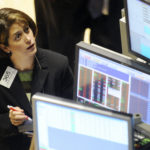
Jacqueline Bucello of UBS Securities watches early trading Monday from the floor of the New York Stock Exchange. Wall Street clawed back from sharp losses as investors snapped up bargain stocks following JPMorgan Chase & Co.'s government-backed buyout of the stricken investment bank Bear Stearns Cos.
Washington ? All eyes are on the Federal Reserve today as its policy-making committee tries to spark the sick U.S. economy back to health, slashing short-term interest rates by what Wall Street believes may be a full percentage point.
As recently as Friday, investors were signaling that they expected the Fed to cut rates by half a percentage point. But that was before the spectacular weekend collapse of investment bank Bear Stearns, whose value stood Friday at $3.5 billion before it was sold Sunday night for just $236 million to J.P. Morgan Chase after a run on it by investors.
The Fed brokered the $2-a-share sale of Bear Stearns. Shares of J.P. Morgan Chase, which purchased it, rose 11 percent Monday, pulling the Dow Jones Industrial Average into positive territory. The Dow closed Monday up 21.16 points to 11,972.25.
Sunday night the Fed also widened access to credit like never before in a muscular bid to keep banks and other institutions lending and corporations and investors borrowing.
“These moves by the Fed are a prelude to additional bold action to reduce rates,” said Brian Bethune, U.S. economist with forecaster Global Insight in Lexington, Mass. He predicted a full percentage-point cut.
Wall Street is all but certain that a cut of at least three-quarters of a percentage point is coming and hopeful for a full percentage point, which would put the Fed’s bellwether short-term “federal funds” rate at 2 percent. That would bring the prime rate, which banks charge to their best customers, down to 5 percent.
“We continue to expect the funds rate eventually will reach 1.5 percent,” said Mickey Levy, chief economist of Charlotte, N.C.-based Bank of America, in a note to investors.
What such low interest rates would mean for consumers isn’t clear because turmoil in the credit markets means that banks aren’t lending. Instead, they are hoarding capital to shore up their balance sheets.
Lower rates could bring down some variable rates on credit cards, but credit card companies have been raising rates out of fear that the economic downturn will lead to more loan defaults.
The falling rates could help ease the sting for homeowners whose adjustable-rate mortgages are about to reset higher. But many of these loans adjust based on factors not directly affected by the Fed’s benchmark rate.
The Fed has already cut the funds rate from 5.25 percent last September to 3 percent in January. So far that’s done little to revive the U.S. economy, which has been in increasing turmoil since August.
The Fed has also made available more than half a trillion dollars in credit to banks and securities dealers in hopes of spurring lending and preventing credit markets from seizing up.
Overseas stock exchanges took heavy losses Monday, particularly in Asia, spooked by the sudden fall of Bear Stearns.
But a similar rout on U.S. stocks was averted. After falling almost 200 points at the start of trading, the Dow Jones Industrial Average turned positive in the final hour to close up 21.16 points. The S&P 500 was down 11.54 points to 1,276.60 and the Nasdaq closed off 35.48 to 2,177.01.
Oil prices fell $4.53 a barrel to $105.68 on fears of a deep U.S. economic slowdown, the largest one-day drop in 17 years.
National
Lawyers for man accused of killing Charlie Kirk try to block death penalty

Trump’s name poised to come off Kennedy Center
Suspect in Texas shooting had fired at police days earlier, officials say
Man pleads guilty to killing a top Minnesota Democrat and her husband

New tornadoes outside Chicago as severe storms pummel the Midwest