Bush highlights Iran concerns
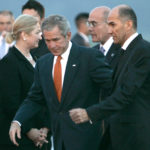
President Bush is greeted by Slovenian Prime Minister Janez Jansa, right, after arriving at Ljubljana International Airport in Ljubljana, Slovenia, on Monday. Bush is making his final tour of Western Europe as president this week.
President Bush’s weeklong tour through Berlin, Rome, Paris and London appears every bit the old-style farewell tour with a leisurely schedule, jaunts to country castles and lavish dinners.
But it’s actually a high-stakes diplomatic mission, spurred by Bush’s fear that Iran is an increasingly urgent threat and that Europe may not take it seriously enough.
Bush has never been popular in Western Europe after the U.S. invasion of Iraq. So it was puzzling that he decided to buzz through all of Western Europe’s Big Four nations this week, risking large protests and pointed questions, instead of choosing, as he usually does, to stop in formerly communist, newly democratic Central and Eastern European countries where he always gets rock-star welcomes.
Iran helps solve the mystery.
Bush started his trip Monday in Slovenia, where he will take part in the annual U.S.-European Union summit. He will also travel to Italy, Germany, France and Great Britain.
Bush is visiting nations and leaders critical to a stepped-up U.S. effort to get new and harsher measures aimed at preventing Iran from proceeding with a suspected plan to build a nuclear bomb. Britain, Germany and France, along with the United States, Russia and China, are developing a package of fresh penalties and incentives aimed at reining in Tehran’s alleged atomic ambitions. Italy wants to join the effort, too.
“He is going to try to stiffen European resolve on Iran,” said Stephen J. Flanagan, director of the international securities program at the Center for Strategic and International Studies.
Iran and Iraq
On Monday in Tehran, Iran, Iraq’s prime minister made little headway in easing Iranian opposition to a U.S.-Iraqi security pact, as Iran’s supreme leader told him that American troops must leave the country.
The deal, which is still under negotiation, could lay the groundwork for a long-term U.S. military presence in Iraq. The Iranians fear the deal would solidify U.S. influence in Iraq and give American forces a launching pad for military action against them.
Iraqi Prime Minister Nouri al-Maliki met over three days with Iranian leaders in Tehran, trying to ease the neighboring country’s opposition to the agreement. But in talks Monday, Iranian supreme leader Ayatollah Ali Khamenei made clear his rejection of any agreement.
In Baghdad, some Iraqi lawmakers also objected to the security pact, in which they say the United States is demanding 58 bases that will allow U.S. troops to remain in the country indefinitely.
Leading members of the two ruling Shiite parties said in a series of interviews the Iraqi government rejected this proposal along with another U.S. demand that would effectively hand over the power to determine whether a hostile act from another country is aggression against Iraq.
Other conditions sought by the United States include control over Iraqi air space up to 30,000 feet and immunity from prosecution for U.S. troops and private military contractors.
National
Lawyers for man accused of killing Charlie Kirk try to block death penalty
Trump’s name poised to come off Kennedy Center

Suspect in Texas shooting had fired at police days earlier, officials say

Man pleads guilty to killing a top Minnesota Democrat and her husband
New tornadoes outside Chicago as severe storms pummel the Midwest