Empty prison in Iraq a monument to US waste
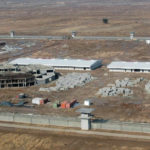
The Khan Bani Saad Correctional Facility, about 12 miles northeast of Baghdad, is seen in this June 2007 photograph taken by the United States Army Corps of Engineers and released by the Special Inspector General for Iraq Reconstruction. The unoccupied prison in the desert is just one example of U.S. government waste, misguided planning and construction shortcuts that overall have squandered more than billion of the 1 billion reconstruction effort.
Baghdad ? In the flatlands north of Baghdad sits a prison with no prisoners.
It holds something else: a chronicle of U.S. government waste, misguided planning and construction shortcuts costing $40 million and stretching back to the American overseers who replaced Saddam Hussein.
“It’s a bit of a monument in the desert right now because it’s not going to be used as a prison,” said Stuart Bowen, the special inspector general for Iraq reconstruction, whose office plans to release a report today detailing the litany of problems at the vacant detention center in Khan Bani Saad.
The pages also add another narrative to the wider probes into the billions lost so far on scrubbed or substandard projects in Iraq and one of the main contractors accused of failing to deliver, the Parsons construction group of Pasadena, Calif.
“This is $40 million invested in a project with very little return,” Bowen told The Associated Press in Washington. “A couple of buildings are useful. Other than that, it’s a failure.”
In the pecking order of corruption in Iraq, the dead-end prison project at Khan Bani Saad is nowhere near the biggest or most tangled.
Bowen estimated up to 20 percent “waste” – or more than $4 billion – from the $21 billion spent so far in the U.S.-bankrolled Iraq Relief and Reconstruction Fund. It’s just one piece of a recovery effort that swelled beyond $112 billion in U.S., Iraqi and international contributions.
Depressing site
But the empty prison compound – in the shadows of more than two dozen watchtowers now dotted by birds’ nests – is an open sore for both American watchdogs and local Iraqi politicians who had counted on the prison as an economic boost.
The head of the municipal council in Khan Bani Saad, Sayyed Rasoul al-Husseini, called it “a big monster that’s swallowed money and hopes” – including those for more than 1,200 new jobs.
He sometimes drives out to the site, near groves of date palms and a former Saddam-era military training camp about 12 miles northeast of Baghdad and just over the border in the tense Diyala Province.
Al-Husseini says he walks the perimeter and wonders what can be salvaged. A housing development is not possible, he said. Many concrete walls lack proper iron reinforcements and “can collapse at anytime,” he said. Birds and small animals have found homes in the towers and crannies.
“But some of the cell blocks are good,” he suggested. “So maybe it can become a factory. I don’t know. It’s depressing.”
Doomed from start
The idea for the modern-style prison began with the Coalition Provisional Authority running Iraq after Saddam’s fall.
On behalf of the authority, the U.S. Army Corps of Engineers awarded a $40 million contract in March 2004 to global construction and engineering firm Parsons to design and build an 1,800-inmate lockup to include educational and vocational facilities. Work was set to begin May 2004 and finish November 2005.
Nothing went right from the start, the report says.
The Sunni insurgency was catching fire. The U.S. was under pressure to improve prison conditions following the abuses exposed at Abu Ghraib.
Washington’s focus shifted quickly from rebuilding to just holding its ground. The prison project got started six months late and continued to fall behind – until Parsons asked to push the completion date to late 2008, the report said.
The U.S. government pulled the plug in June 2006, citing “continued schedule slips and … massive cost overruns.” But officials hadn’t abandoned the hope of finishing the project – awarding three more contracts to other companies in a doomed effort.
The waste was made more egregious by the fact that Diyala badly needs more prisons to handle a growing inmate population. Bowen’s team was told that about 600 inmates are crowded into an existing Diyala prison designed for 250 inmates and that the overcrowding and health conditions are so grave that several inmates have died, the report says.
Problem much larger
The problem at Khan Bani Saad is only one example of the millions of dollars auditors found were wasted on construction projects by Parsons, which left Iraq two years ago.
In a companion report also being released today, Bowen said the prison was part of a $900 million Parsons contract to build border posts, courts, police training centers and fire stations. It was one of 12 contracts awarded in 2004 in hopes of restoring Iraq’s infrastructure.
Of 53 construction projects in the massive Parson contract, only 18 were completed.
As of this spring, Parsons had been paid $333 million. More than $142 million of that – or almost 43 percent – was for projects that were terminated or canceled.
While the failure to complete some of the work was “understandable given the complex nature and unstable security environment in Iraq, millions of dollars” were likely wasted, the report said.
Bowen said only about 10 U.S. contracting officers and specialists were working on the $900 million contract, whereas 50 or 60 would be assigned to a comparable undertaking in the United States.
In a last wasteful act at Khan Bani Saad, the U.S. government allowed $1.2 million worth of construction supplies to be left unguarded at Khan Bani Saad after work was suspended in June 2007 – fencing, gravel, piping and other items. Most of it is now missing.
National
Teens’ reading and math scores have stagnated, US test results show
WASHINGTON (AP) — Younger students have regained ground academically after the pandemic's disruptions while older ...
Lawyers for man accused of killing Charlie Kirk try to block death penalty
Trump’s name poised to come off Kennedy Center

Suspect in Texas shooting had fired at police days earlier, officials say

Man pleads guilty to killing a top Minnesota Democrat and her husband