Feral cats go on rat patrol
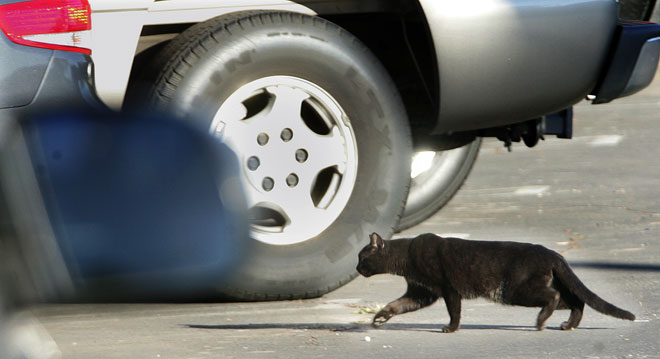
A feral cat, one of six recently installed, roams the parking lot of the Los Angeles Police Department's Southeast Division. The Working Cats program of Voice for the Animals places the feral cats in police stations with rodent problems. It is mostly the feline scent that repels the rats.
Los Angeles ? They are the homeless of the domestic animal world – colonies of feral cats that roam residential neighborhoods and lurk around office buildings and commercial garages, scavenging for food.
Unlike other strays that might rub up against a leg hoping for a crumb or a head rub, these felines are so unaccustomed to human contact that they dart away when people approach. Feral cats cannot be turned into house pets. When they end up in municipal shelters, they have little hope of coming out alive.
But one animal welfare group has figured out a way to save their lives and put them to work in Los Angeles. The Working Cats program of Voice for the Animals, a Los Angeles-based animal advocacy and rescue group, has placed feral cats in a handful of police stations with rodent problems, just as the group placed cats in the rat-plagued downtown flower district several years ago – to great effect.
Six feral cats recently were installed as ratters in the parking lot of the Los Angeles Police Department’s Southeast Division, and another group will be housed at the Central Division early this year.
Their reputation as furtive and successful exterminators grew after feral cats were introduced to the parking lot of the Wilshire Division nearly six years ago. Rats had been burrowing into the equipment bags that bicycle officers stored in outside cages; inside the facility, mice sometimes were scurrying across people’s desks.
“Once we got the cats, problem solved,” said Cmdr. Kirk Albanese, a captain at the Wilshire station at the time. “I was almost an immediate believer.”
After Albanese moved to the Foothill Division in the northern San Fernando Valley, he introduced feral cats to the building’s mice-infested basement in 2004.
“I think it’s a very humane way to deal with a very stubborn problem,” said Albanese, now assistant to the director in the office of operations at downtown’s Parker Center, which has its own rat problem.
The cats generally don’t solve the rodent problem by killing rats and mice – although the cats are game for doing so if they catch them. Rather, the cats simply leave their scent. Once rodents get a whiff of feline presence, like gangsters under a gang injunction, they move on.
“It’s the smell of the cat and the cat urine,” said animal rescuer Jane Garrison, a member of Voice for the Animals’ board, who selected the half-dozen feral cats for the Southeast station.
Less grisly than glue traps – and usually more effective – the cats go about their “work” naturally: “They prowl, they eat, they sit in the sun,” said Melya Kaplan, founder and director of Voice for the Animals, who was responsible for putting cats in the flower markets.
When the cats are new to an area – as they are at Southeast – they spend much of their time hiding from view.
“They’ve got to play it safe and see if they’re OK,” said Southeast Officer Sandra Magdaleno, who feeds and cares for the cats.
Magdaleno, who has been rescuing animals for 25 years, can describe each of her elusive crew: two black cats, two gray and whites, a tabby and a huge gray bruiser who hissed at everyone during his days in the holding cages that the cats are confined to while they acclimate. When his cage was opened, the bad boy timidly looked out.
“He jumped out of the cage and looked around, then he heard a car and jumped back in,” Magdaleno said.
Garrison said the Working Cats program can be used anywhere. “We are willing to put cats in any safe area – businesses, hotels, industrial parks, even residences – and we will do that for free.”
National
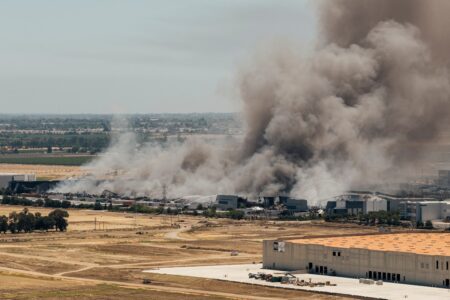
Unhealthy air quality in California city as huge warehouse fire burns for 3rd day
Judge orders Trump administration to restore National Park changes at sites that ‘disparaged’ US
Teens’ reading and math scores have stagnated, US test results show
WASHINGTON (AP) — Younger students have regained ground academically after the pandemic's disruptions while older ...
Lawyers for man accused of killing Charlie Kirk try to block death penalty

Trump’s name poised to come off Kennedy Center