Satellite strike alters weapons debate
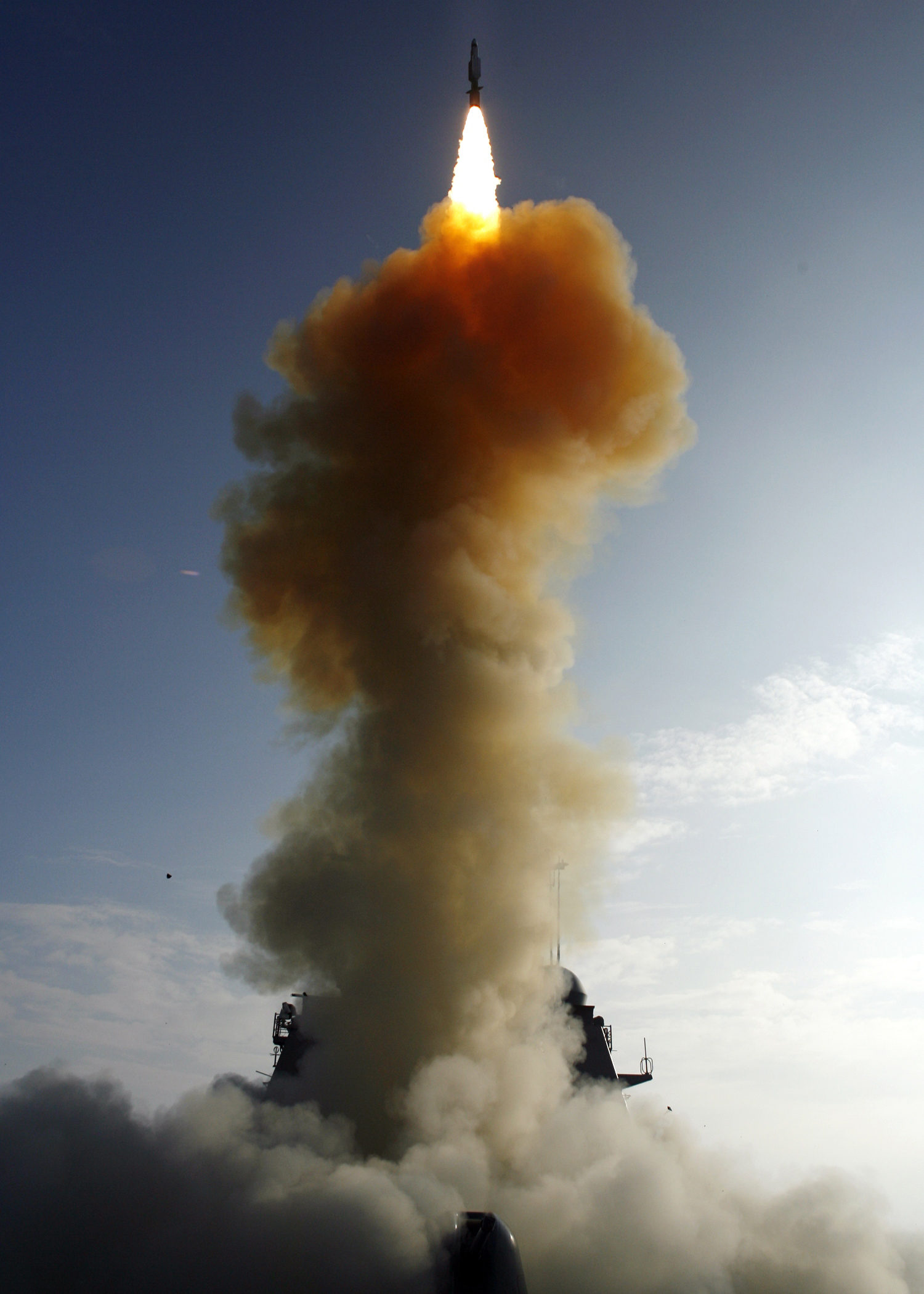
In this image provided by the U.S. Navy, a single modified tactical Standard Missile-3 launches from the U.S. Navy Aegis cruiser USS Lake Erie. The missile, launched Wednesday to neutralize a threat from a falling spy satellite over the Pacific Ocean, has added another aspect to the debate over banning weapons in space.
In last week’s space spectacular, a U.S. missile did more than turn a dead satellite into bits of space scrap. It also blew another hole in hopes that the world’s nations could forge a treaty making outer space a weapons-free realm, analysts say.
Wednesday’s orbiter shootdown by a U.S. Navy missile came just eight days after Russia and China, at the U.N. Conference on Disarmament in Geneva, submitted a draft treaty to ban weapons from space.
The U.S. action, ostensibly to eliminate a threat from a falling spy satellite, showed the world that the hundreds of communications, weather, reconnaissance and other satellites circling far overhead are vulnerable – as did a similar Chinese shootdown a year earlier.
The strike by a Navy cruiser’s anti-missile missile also pointed up the fact that offensive “space weaponry” and defensive “missile shields” can be two faces of the same technology. The Navy’s Aegis system, designed to intercept incoming ballistic missiles in space, became a tool of attack last week.
Missile shields are one reason Washington has long resisted efforts in Geneva to negotiate a comprehensive treaty banning weapons in space. Some U.S. shield designs even envision using orbiting systems to knock out missiles. And the Americans aren’t alone.
“Hit-to-kill” technologies are spreading, to China, Japan, Israel and India, for example, noted Jeffrey Lewis, an arms-control expert at Washington’s New America Foundation.
“It seems to me we may never have had the opportunity to constrain the technology,” he said. “It’s pretty hard for me to see that happening now.”
In fact, the Russian-Chinese draft treaty doesn’t directly address this difficult area of ground-based systems that can “kill” satellites.
A new Geneva pact would be the first since the 1967 Outer Space Treaty, which outlawed only nuclear and other weapons of mass destruction in space. For four decades since, the rest of the world has pressed in U.N. forums for a broader ban on space weapons, but the United States has blocked it.
At the current Geneva disarmament session, because of the satellite strike, “people will beat up on the United States,” said Michael Krepon, an arms-control specialist at Washington’s Stimson Center.
“The Russians and Chinese will point to their treaty and try to drum up support. But it isn’t really going anywhere, for familiar reasons. Nobody can define a space weapon and nobody can verify a space weapon.”
It’s not just anti-missile missiles that defy easy categorization. There are also ground-based or space-based lasers or jammers that could cripple satellites, and even satellites that could be maneuvered to collide with other orbiters. The Russians once wanted the U.S. space shuttle deemed a military system.
Instead of the elusive, legally binding treaty, violation of which might draw U.N. sanctions, the Stimson Center promotes the idea of a less formal “code of conduct,” a halfway step by which governments pledge to avoid “harmful interference” with satellites, and not to test space weapons. The European Union and Canada are among those endorsing such a code.
“There’s a growing consensus among nations, including space-faring and missile-possessing nations, that there should be some rules of the road, some standard for responsible behavior in space,” said Daryl Kimball, of the Arms Control Association in Washington.
National

Lawyers for man accused of killing Charlie Kirk try to block death penalty

Trump’s name poised to come off Kennedy Center

Suspect in Texas shooting had fired at police days earlier, officials say

Man pleads guilty to killing a top Minnesota Democrat and her husband

New tornadoes outside Chicago as severe storms pummel the Midwest