Gates says European reluctance in Afghanistan linked to war in Iraq
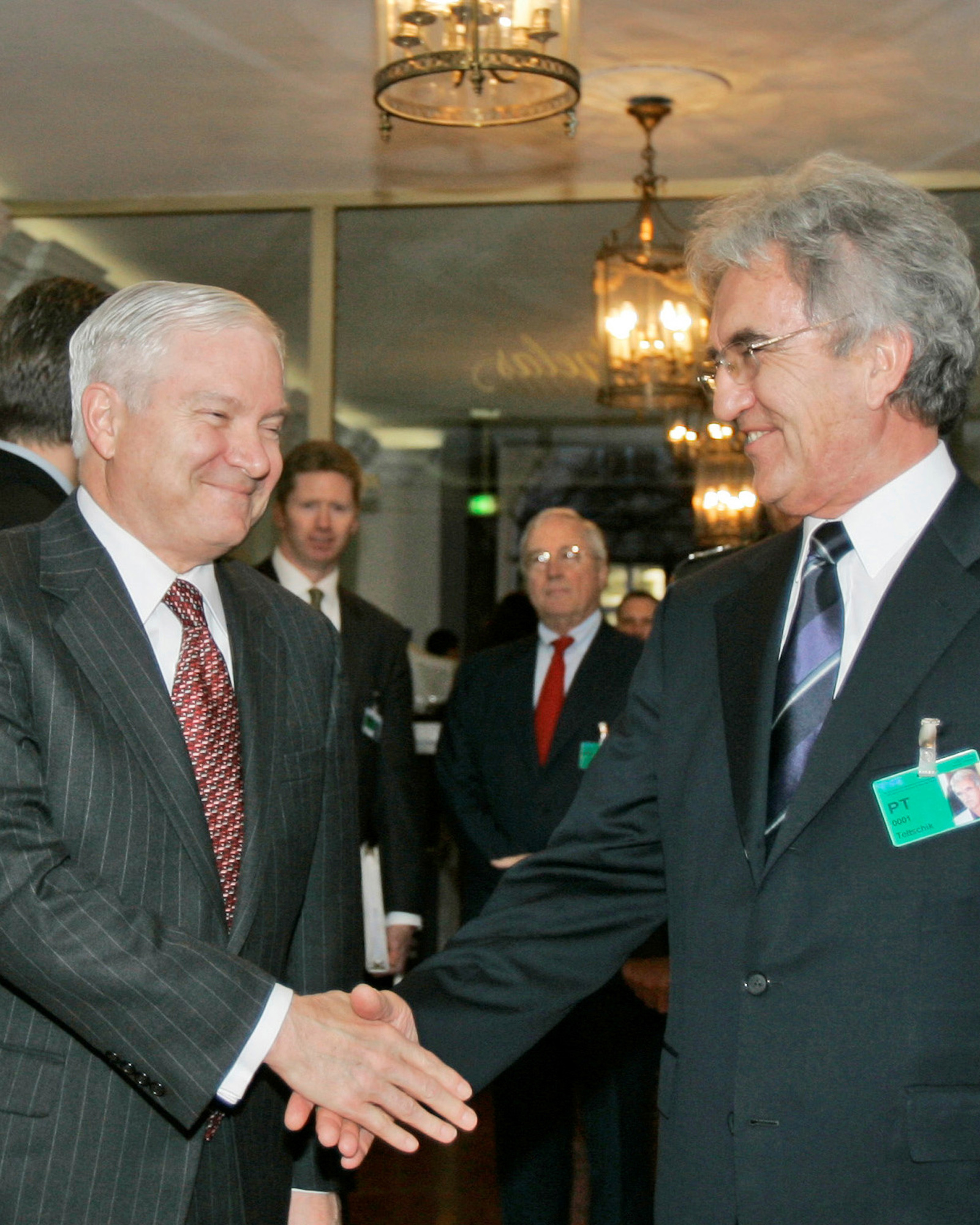
U.S. Defense Secretary Robert Gates, left, is welcomed by German conference leader Horst Teltschik on Friday before the Conference on Security Policy in Munich. Gates said Friday that anger in Europe over the U.S. invasion of Iraq is why some allies don't want to heed U.S. calls for more combat troops in Afghanistan.
Munich, Germany ? Lingering anger in Europe over the U.S. invasion of Iraq explains why some allies are reluctant to heed U.S. calls for more combat troops in Afghanistan, Defense Secretary Robert Gates said Friday. It was his first public acknowledgment of such a link to the Iraq war.
Gates said he would attempt in a speech here Sunday at an international security conference to decouple perceptions of the Iraq war, in which NATO has no fighting role, from views of Afghanistan, where NATO is in charge of the fighting but has fallen short on commanders’ requests for more troops.
On a flight to Munich from Vilnius, Lithuania, where he attended two days of NATO talks dominated by Afghanistan, Gates associated Iraq with what lay behind Europe’s general skepticism about fighting in Afghanistan.
“From our perspective, I worry that for many Europeans the missions in Iraq and Afghanistan are confused,” he told reporters traveling with him, implicitly acknowledging a political cost of the Iraq invasion.
“I think they combine the two,” he added. “Many of them I think have a problem with our involvement in Iraq and project that to Afghanistan and don’t understand the very different – for them – very different kind of threat” posed by al-Qaida in Afghanistan, as opposed to the militant group in Iraq that goes by the same name and is thought to be led by foreign terrorists linked to al-Qaida.
Germany, which is hosting the Munich conference and which has refused Gates’ explicit appeals to send combat forces to southern Afghanistan, and France were among the most vocal opponents of the Iraq invasion before the war. Britain has been the most supportive, and it has the second-largest number of troops in Afghanistan.
Despite earlier refusals, France now is considering sending troops to join the fight against the Taliban in southern Afghanistan after Canada’s appeal for 1,000 extra forces to support its beleaguered force in volatile Kandahar province. French officials cautioned that it was unlikely Paris would provide all the troops Canada is seeking and said a decision was unlikely before April, when NATO leaders meet for a summit in Bucharest, Romania.
Such a move could ease tensions in NATO, where a rift has emerged between nations such as the U.S., Canada and Britain who have troops in the south, and those like France, Germany and Italy, whose units operate in the relative safety of north and west Afghanistan.
The Bush administration was not expecting to see a dramatic increase in troop contributions by NATO members, said a senior administration official, who spoke on condition of anonymity to discuss internal deliberations. But the official said it’s possible that NATO members, perhaps before or at the April summit, would make valuable contributions in other ways, such as providing civilian police trainers.
NATO, through its International Security Assistance Force, is in charge of the war, although the top commander is an American, Army Gen. Daniel McNeill, and the United States is the biggest provider of troops. Of the 42,000 total troops, about 14,000 are American, plus the United States has another 13,000 operating separately in eastern Afghanistan hunting terrorists and training Afghan forces.
National
Unhealthy air quality in California city as huge warehouse fire burns for 3rd day
Judge orders Trump administration to restore National Park changes at sites that ‘disparaged’ US
Teens’ reading and math scores have stagnated, US test results show
WASHINGTON (AP) — Younger students have regained ground academically after the pandemic's disruptions while older ...
Lawyers for man accused of killing Charlie Kirk try to block death penalty

Trump’s name poised to come off Kennedy Center