Britney’s soap opera drives economy that surrounds her
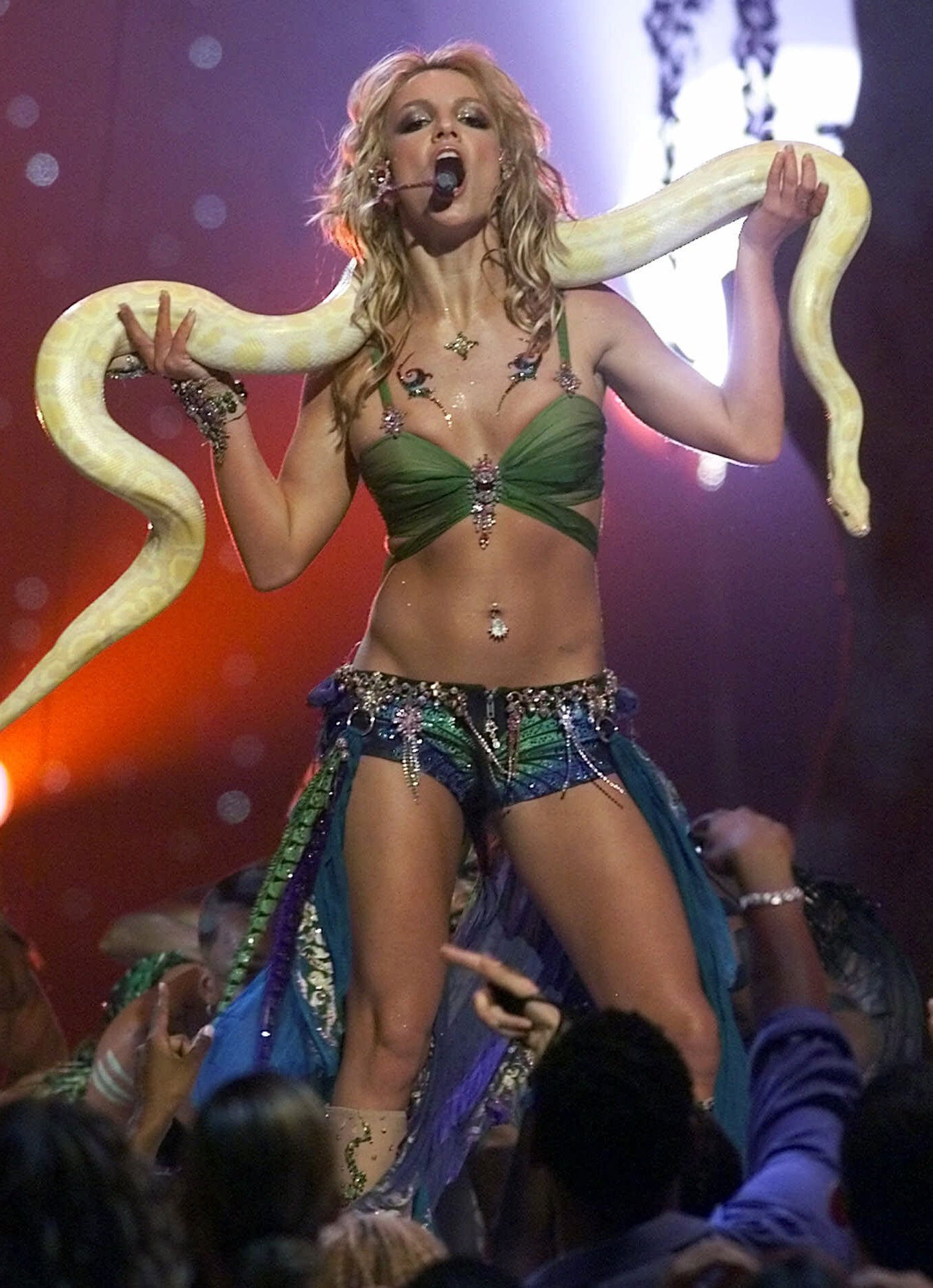
Britney Spears performs with a snake during the finale of the 2001 MTV Video Music Awards on Sept. 6, 2001, at New York's Metropolitan Opera House. Spears is just one of many stars driving the growing multibillion dollar celebrity news industry.
In the days after the Britney Spears soap opera rode a police-escorted gurney to its apex, celeb-mag sales spiked, traffic jammed gossip Web sites, tabloid TV ratings rose and paparazzi photo prices surged.
For a growing number of people and businesses, Britney’s saga is about money: Every time she sinks to new lows, cash flows. And these days, no one is above the fray.
When a custody dispute devolved into a three-hour standoff at Spears’ home Jan. 3, police officers and firefighters were pressed into duty. Television stations sent up helicopters, and cable news anchors reported the unfolding drama in real time. The Associated Press had two reporters working the story, with editors on both coasts updating it seven times throughout the night.
Spears is just one of many stars driving the growing multibillion dollar celebrity news industry. But the Spears story in particular, with a new twist nearly every week, has become a very profitable sub-sector unto itself.
“Britney is the most bankable celebrity out there right now, and she has been for the past year,” said Francois Navarre, founder of the paparazzi agency X17.
Spears became a can’t-miss tabloid topic after filing for divorce from second husband Kevin Federline in November 2006. Since then, she’s been in and out of rehab, shaved her head, revealed a bit too much above the hemline, was arrested after a traffic accident, and lost custody of her kids (and later her visitation rights).
“The product for the tabloid industry is the unusual, and Britney has been delivering that consistently,” said Dan Smith, dean of the Kelley School of Business at Indiana University.
At a time when advertising spending in traditional media is declining, celebrity gossip titles such as Star, Us Weekly and In Touch Weekly are growing. That helped overall newsstand sales for magazines edge 1 percent higher, to $2.39 billion, in the first half of 2007.
Any time a magazine can boost newsstand sales past its average, the revenue is booked nearly entirely as profit, Harrington said: “People prints 2.5 million copies and sells about an average of 1.5 million. If they have an issue that sells 2 million, the extra half million goes to the bottom line.”
People, which takes a broader and less sensational look at the entertainment industry, dominates the sector in circulation, but that hasn’t stopped such new titles as In Touch and Life & Style Weekly from elbowing in. Another newcomer, the U.S. version of Britain’s OK!, has taken particular interest in Spears, putting her picture on the cover 54 times in the 103 issues since January 2006.
US Weekly has been just as enamored of the star, putting Spears on nearly two-thirds of its covers last year, including each of the last 14. People has had Spears on the cover 10 times in the past 15 months.
X17’s Navarre said an exclusive shot of the star would sell for about $10,000 in the U.S. and generate thousands more in residuals.
Many of those images wind up on celebrity gossip Web sites, like TMZ and PerezHilton. The sites make money by delivering viewers to ads on their pages, typically receiving a fee for each 1,000 hits. Navarre said Spears boosts traffic to his Web site, X17online.com, more than any other star.
“During the ambulance incident, traffic doubled every hour,” he said, citing internal server data.
So far, Spears’ antics don’t appear to have hurt personal earnings, which, according to court papers released in November, are roughly $737,000 per month.
National

Unhealthy air quality in California city as huge warehouse fire burns for 3rd day
Judge orders Trump administration to restore National Park changes at sites that ‘disparaged’ US
Teens’ reading and math scores have stagnated, US test results show
WASHINGTON (AP) — Younger students have regained ground academically after the pandemic's disruptions while older ...
Lawyers for man accused of killing Charlie Kirk try to block death penalty

Trump’s name poised to come off Kennedy Center