Re-enactments to mark anniversary of Lincoln and Douglas debates
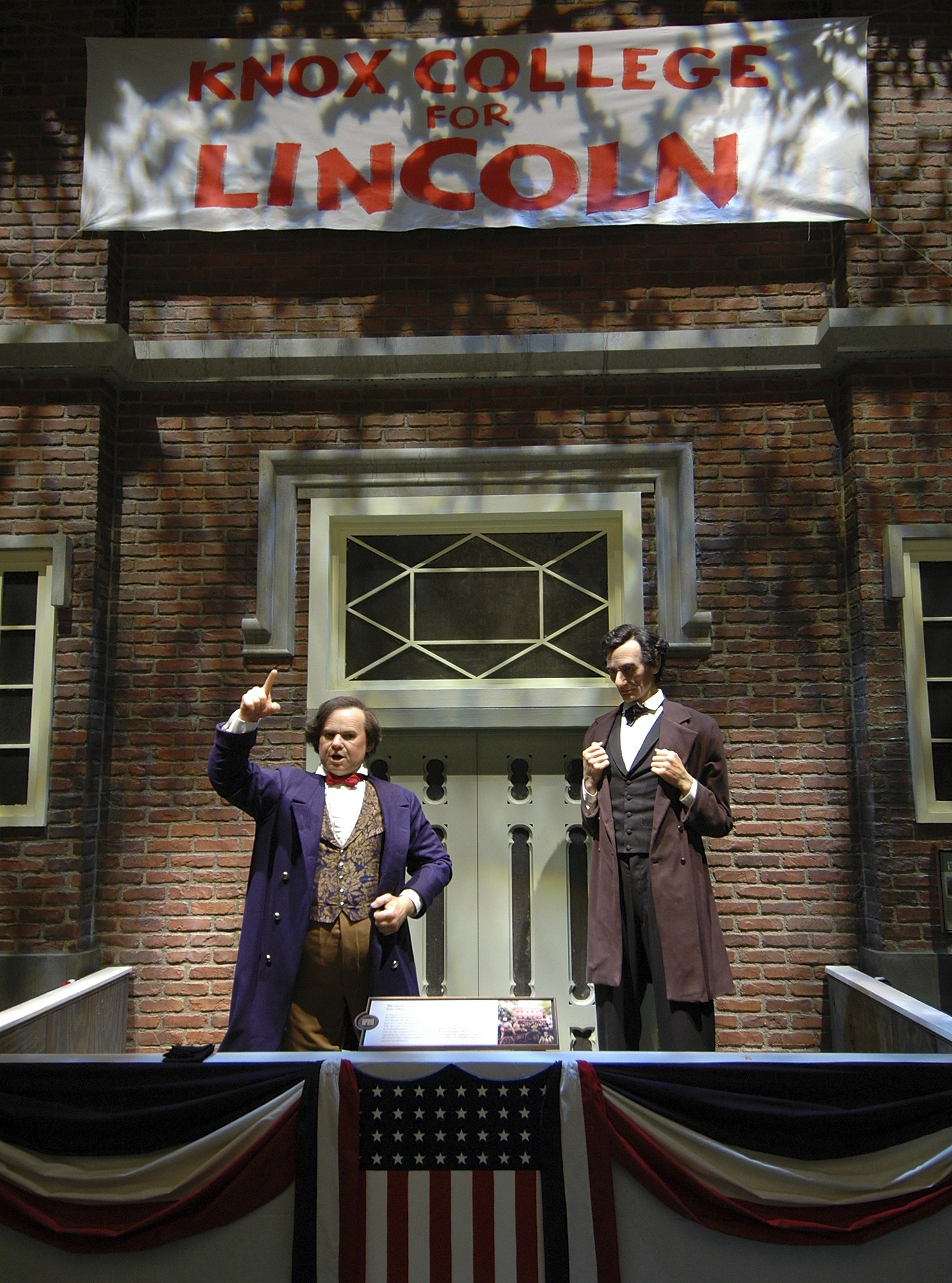
An exhibit at the Abraham Lincoln Presidential Museum in Springfield, Ill., re-created the debate 150 years ago between Stephen A. Douglas, left, and Abraham Lincoln, at Knox College in Galesburg, Ill.
Freeport, Ill. ? This is the “Pretzel City,” thanks to German bakers who settled here in the 1850s. It’s appropriate, given the way a lightweight named Abraham Lincoln twisted up a political colossus here and began cementing his place in American myth.
Lincoln, a longshot candidate for U.S. Senate, debated Stephen A. Douglas on the edge of the rolling northwestern Illinois hills 150 years ago this month, halting the Little Giant’s march to the White House and opening its door for the Railsplitter from Springfield.
The “Freeport Doctrine” that Douglas espoused on Aug. 27, 1858 – that states and territories could ban slavery despite a Supreme Court ruling suggesting otherwise – was not a new idea with Douglas, who beat Lincoln and returned to Congress.
But Lincoln forced Douglas to record it for a national audience, solidifying slaveholders’ opposition and splitting the Democrats. Add Lincoln’s stellar and unexpected performance in seven matchups across Illinois that fall, and influential eastern Republicans were convinced that Lincoln should be their man for president in 1860.
Now, as another U.S. senator from Illinois admired for his oratorical polish – Barack Obama – shoots for the presidency, Illinois is marking Lincoln’s rise to the national stage with a sesquicentennial commemoration of the David-and-Goliath showdowns. The festivities will take Lincoln and Douglas re-enactors to each debate site starting this month, with storytellers, parades, and dancing at period balls.
The debates played a role in “determining who we are as a people today,” said Edward Finch, a retired Freeport schoolteacher and chairman of “Reunion Tour ’08,” the statewide celebration.
Freeport certainly has never forgotten. The flavor that topped a local ice-cream parlor’s contest for a commemorative confection? “Lickin’ Douglas.”
Douglas wanted to push permission for slavery out of Congress and let states decide. To Lincoln, slavery itself was the issue. Blacks were people, not property.
Lincoln wasn’t alone in that belief, but it was radical to give it a national voice.
“Just that very basic principle of recognizing the humanity of blacks was huge,” Illinois state historian Thomas Schwartz said.
Douglas was legendary for helping fashion the last territorial compromise between slave and free states in 1850, seizing on the idea that voters should decide on slavery.
He thought “popular sovereignty” was his White House ticket, and 1854 legislation he ushered into law applied it to the vast, unsettled West. To the horror of anti-slavery northerners, it nullified a 30-year-old deal that kept slavery south of the Mason-Dixon line.
It also brought Lincoln out of political retirement. By 1858, he was the fledgling Illinois Republicans’ best hope against Douglas.
The underfunded Lincoln began tailing Douglas, letting the celebrity draw crowds that he addressed a day later. Douglas finally agreed to joint appearances in the seven congressional districts where the two hadn’t already given major speeches.
The Little Giant, so called because he stood just 5-foot-4, knew he’d have his hands full with Lincoln. With news reporters making verbatim transcripts, ensuring wide publication, Douglas started strong at Ottawa.
But Honest Abe recovered, refining his moral arguments in later debates until at Alton, Douglas had no real response.
Douglas had no qualms about playing to white supremacists’ fears, using the N-word liberally.
Lincoln wasn’t blameless on the subject. Pressured to respond to the race-baiting, at Charleston he dismissed the idea that blacks should have civil rights. He said a “physical difference” between the races precluded their living in equality with whites.
But as president, Lincoln set the stage for constitutional changes that ended slavery and eventually offered blacks civil rights.
National
Unhealthy air quality in California city as huge warehouse fire burns for 3rd day
Judge orders Trump administration to restore National Park changes at sites that ‘disparaged’ US
Teens’ reading and math scores have stagnated, US test results show
WASHINGTON (AP) — Younger students have regained ground academically after the pandemic's disruptions while older ...
Lawyers for man accused of killing Charlie Kirk try to block death penalty
Trump’s name poised to come off Kennedy Center