Town wrestles with ranch’s polygamous secret
Eldorado, Texas, works to balance civil liberties with family values
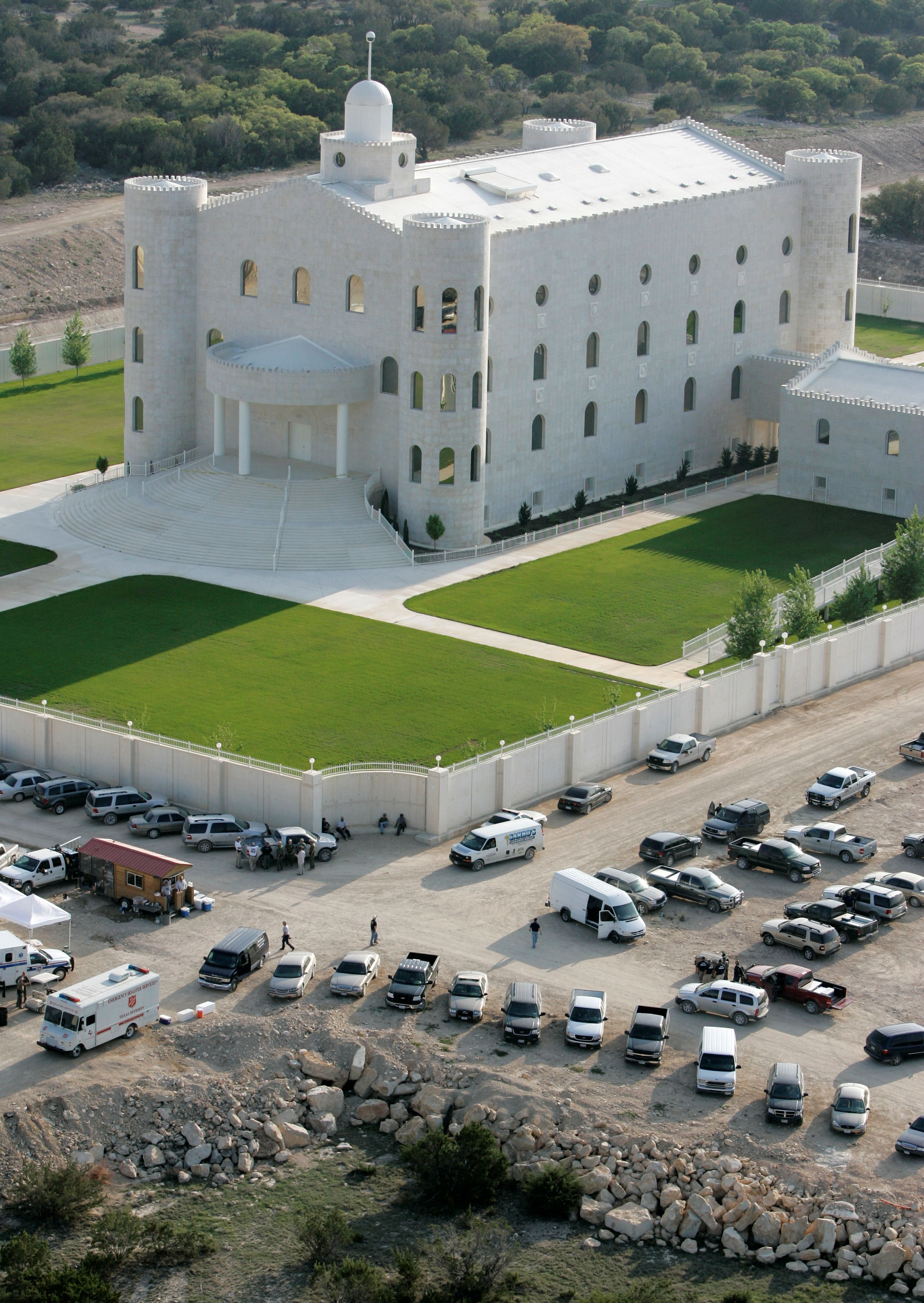
Members of law enforcement and their vehicles are shown outside the main temple wall in this April 8 photo at the Yearning for Zion ranch, home of the Fundamentalist Church of Jesus Christ of Latter Day Saints near Eldorado, Texas. On April 3, hundreds of officers including a SWAT team, FBI agents, Texas Rangers, San Angelo police, highway patrol and sheriff's deputies from four counties, raided the YFZ ranch.
Eldorado, Texas ? The guy didn’t look much like a hunter. He was beanpole tall – scarecrow-ish, some might say, with a high, collegiate forehead and a reluctant handshake. Even in a pearl-snap shirt and jeans, this cowboy somehow seemed better suited for a college lecture hall than a saddle.
Still, he wanted land – lots of it – for a corporate hunting retreat. Said he might build a lodge, to entice some big-roller clients of his in Vegas. North of town, the old Isaacs ranch – rocky and dotted as it was with rusty oil rigs, cactus and gnarled mesquite trees – caught his eye. It was plenty cheap, he said, and plenty remote.
But it didn’t take long for the sheriff and everyone else in Schleicher County to figure out that their new neighbor, David S. Allred, president of YFZ Land, LLC, had much more on his mind than the hunting of whitetail.
After the closing in November 2003, dozens of Allred’s associates arrived to make improvements on the property. Sunday to Sunday, day and night they toiled, completing three, three-story houses – each 10,000 square feet – within weeks. Soon, a cement plant shot up. Then fields of limestone were miraculously plowed into fertile farmland. And then, a superstructure unseen in these parts – a temple, masterfully clad with limestone quarried onsite – ascended into the west Texas sky.
And that, as it happened, was only the beginning.
The YFZ Ranch – which, as the townspeople would come to learn, stood for Yearning for Zion – would mushroom into a bustling, parallel city: a 1,691-acre, self-sustaining enclave carved, literally, into a rock pile for the innermost circle of the Fundamentalist Church of Jesus Christ of Latter Day Saints, FLDS, a 10,000-member sect that has continued to practice polygamy after it was banned by the Mormon Church in 1890.
Here, there would be enormous dormitories for enormous families, a cheese factory, a medical clinic, a grain silo, a commissary, a sewage treatment plant – and watchtowers with sentries, infrared night-vision cameras to monitor gated entrances, and 10-foot-high compound walls topped with spikes.
There would evolve a saga of “plural marriages,” racism, underage “celestial” brides and allegations of child abuse, turning Eldorado upside down with frightening tales, rumors, and a flood of reporters and investigators. A raid on the polygamists’ compound – the largest of its kind in more than a half century in the West, involving hundreds of law enforcement agents – would lead to the removal of 416 children and set up a child custody confrontation of unprecedented dimensions.
The episode would also fire up debate in the courts, and in this community of 1,951 residents, over the state’s duty to protect children from alleged abuse and over the limits of basic constitutional rights like religious liberty and freedom from unreasonable search and seizure.
In the end, the residents of Eldorado would lose a measure of their rural innocence and find themselves conflicted, caught between their love of traditional, family values and their powerful, west Texas beliefs in civil liberties.
‘It’s them’
On a chilly evening in January 2004, J.D. Doyle, a pilot, and his father, James, the local justice of the peace, climbed into their Piper twin-engine plane and took to the skies over Schleicher County to see if recent rains had greened the grazing fields owned by friends who were cattle ranchers.
But as they flew over the YFZ property four miles north of Eldorado, they noticed something different: Down below, jutting up between scatterings of cedar bushes and outcroppings of limestone, were three enormous, cabin-style barracks with enough room to accommodate two football teams.
What were those doing on a hunting retreat?
Later, they asked a friend, Joe Christian, a computer tech who lived adjacent to the YFZ ranch, what he made of it. Christian hadn’t a clue, actually. His new neighbors had been reclusive, leaving him to puzzle over all that nonstop building. We should take some aerial photographs, he suggested; the Doyles agreed.
The photos intrigued Randy and Kathy Mankin, who published the town’s weekly paper, The Eldorado Success, so they did a background check on the buyer, Allred. Initially, they saw no red flags: He was, as he’d claimed, a builder from Washington County, Utah. Still, why build such large residences on so remote a ranch?
Then, in late March, the paper got a call from Flora Jessop, an anti-polygamy activist from Utah who’d been raised in the FLDS and who, as a teenager, had run away from the sect. A polygamist group, she’d been told, was rumored to be establishing another enclave in west Texas.
In Randy Mankin’s mind, polygamy had already taken its place on history’s ash heap. But the caller wouldn’t stop asking questions. When Mankin finally relinquished the name of the buyer, he heard a silence on the line, then:
“Oh, my God … it’s them … “
The buzz in Eldorado
“Them,” Jessop went on to explain, was the FLDS, a renegade, splinter group of Mormons that by the 1930s were practicing polygamy (the ticket to heaven, followers believed) in secret ceremonies for “spiritual brides” that circumvented bigamy laws in the United States.
The March, 25, 2004, story atop the Success’ front page – “Corporate retreat or prophet’s refuge?” – sent shockwaves up and down Eldorado’s dusty streets. Everyone wanted to know: Were these outsiders like the Branch Davidians, whose compound near Waco was stormed in 1993, resulting in the deaths of 80 people?
Would they kidnap their sons and daughters? Brainwash them? Would they try to conquer Eldorado by ballot, voting as a bloc for judges, commissioners and school and hospital board members sympathetic to their ways?
At the local library, paperback, cassette and hardcover copies of “Under the Banner of Heaven,” an unsparing look at similar sects, suddenly were in demand. The local paper featured articles almost every week on the FLDS.
State Rep. Harvey Hilderbran became alarmed by reports from Eldorado, former sect members and the Utah attorney general. In 2005 he pushed into law a bill that raised the legal age of consent to marry in Texas from 14 to 16.
“Every now and then you’d hear something about alleged child abuse, but there was never any hard evidence of it,” says Randy Mankin, publisher of Eldorado’s local paper.
The raid
It came in late March, when a 16-year-old girl reportedly called a local domestic abuse hot line to report that a 49-year-old man had married her, impregnated her at 15, and beaten and choked her repeatedly, according to court documents.
On April 3, hundreds of agents – a SWAT team, FBI agents, Texas Rangers, San Angelo police, highway patrol, and sheriff’s department officers from four counties – raided the YFZ ranch, backed by an armored personnel carrier, K9 dog units and ambulances. For six days they searched the compound for evidence of child abuse and illegal marriages, hauling away a cache of computers, photographs, and birth and marriage records.
The sight of the confused, anxious faces of women and children gazing out the bus windows as they were transported to local churches, then mass shelters in San Angelo, was enough to shake Eldorado’s townfolk, and stir a debate over whether the authorities may have gone too far.
Some were uncomfortable that the 16-year-old who reportedly called the hotline wasn’t identified.
Others wondered if it was legal for the agents to keep the sect’s men in their homes the first 24 hours after the raid, without charges. Later, at the group shelter in San Angelo, authorities took the cell phones away from mothers who remained in contact with their husbands.
Since the women hadn’t been charged with a crime, folks asked, did the police have that right?
“A lot of people here are starting to ask those questions,” says Griffin, the oil dealer. “If those women weren’t under arrest, how could the police do that to them?”
Others were less bothered by it. “It’s about time they went in there and busted that thing up,” says Lisa Lopez, a 43-year-old homemaker. “I couldn’t understand how people in Eldorado could sit back and let them have sex with underage girls for so long.”
National
Unhealthy air quality in California city as huge warehouse fire burns for 3rd day

Judge orders Trump administration to restore National Park changes at sites that ‘disparaged’ US
Teens’ reading and math scores have stagnated, US test results show
WASHINGTON (AP) — Younger students have regained ground academically after the pandemic's disruptions while older ...
Lawyers for man accused of killing Charlie Kirk try to block death penalty

Trump’s name poised to come off Kennedy Center