Salmon collapse could lead to shutdown
Pacific fishery council likely to impose restrictions
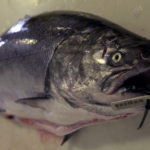
A bar code attached to the jaw of this chinook salmon, shown in a 2006 file photo, indicates that it was included in a genetic study where salmon from particular rivers are caught in the ocean. Researchers are faced with a shortage of fish because of probable restrictions on salmon fishing to protect weak stocks in California's Sacramento River.
San Francisco ? The stunning collapse of one of the West Coast’s biggest wild salmon runs has prompted even cash-strapped fishermen to call for an unprecedented shutdown of salmon fishing off the coasts of California and Oregon.
“There’s likely no fish, so what are you going to be fishing for?” asked Duncan MacLean, a fisherman from Half Moon Bay. “I have no problem sitting out to rebuild this resource if that’s what’s necessary.”
The Pacific Fishery Management Council meets in Seattle this week and likely will vote to impose the most severe restrictions ever on West Coast salmon fishing to protect California’s dwindling chinook stocks.
The Sacramento River chinook run is usually one of the most productive on the Pacific Coast, providing the bulk of the salmon caught by sport and commercial trollers off California and Oregon.
But only about 90,000 adult chinook returned to the Central Valley last fall – the second lowest number on record and well below the number needed to maintain a healthy fishery. That number is projected to fall to a record low of 58,000 this year. By contrast, 775,000 adults were counted in the Sacramento River and its tributaries as recently as 2002.
“This stock got off-the-charts bad very suddenly,” said Donald McIsaac, the council’s executive director. “It’s a very, very severe situation.”
The council, which regulates Pacific Coast fisheries, will choose between three management options: a total ban on salmon fishing off the coast of California and Oregon; extremely limited fishing in select areas; or catch-and-release fishing for scientific research.
The council’s final decision is expected Thursday. The National Marine Fisheries Service will then decide whether to implement the regulations by May 1.
The Central Valley collapse is a blow to fishermen, tackle shops, charter boat operators and other businesses that depend on commercial and recreational salmon fishing.
For consumers, it will be hard to find any chinook, also known as king salmon, which are prized by anglers, seafood connoisseurs and upscale restaurants. There should still be abundant supplies of farm-raised salmon and wild sockeye from Alaska, but prices could be higher.
Biologists and others are trying to figure out what caused the salmon collapse.
The council has asked state and federal scientists to research 46 possible causes, including water diversions, habitat destruction, dam operations, agricultural pollution, marine predators and ocean conditions.
National
Teens’ reading and math scores have stagnated, US test results show
WASHINGTON (AP) — Younger students have regained ground academically after the pandemic's disruptions while older ...

Lawyers for man accused of killing Charlie Kirk try to block death penalty

Trump’s name poised to come off Kennedy Center

Suspect in Texas shooting had fired at police days earlier, officials say

Man pleads guilty to killing a top Minnesota Democrat and her husband