Army lets married soldiers live together on Iraq bases
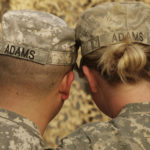
U.S. Army Sgt. Cameron Adams, 29, left, and his wife, Spc. Chelsea Adams, 26, right, are seen Thursday at Forward Operating Base Marez in Mosul, 225 miles northwest of Baghdad. The two, who married Sept. 11, 2004, are deployed together with the 3rd Armored Cavalry Regiment. The Army has begun allowing husband-and-wife soldiers to live and sleep together in the war zone.
Baghdad ? When American soldiers get off duty in Iraq, the men usually return to their quarters, the women to theirs. But Staff Sgt. Marvin Frazier gets to go back to a small trailer with two pushed-together single beds that he shares with his wife.
In a historic but little-noticed change in policy, the Army is allowing scores of husband-and-wife soldiers to live and sleep together in the war zone – a move aimed at preserving marriages, boosting morale and perhaps bolstering re-enlistment rates at a time when the military is struggling to fill its ranks five years into the fighting.
“It makes a lot of things easier,” said Frazier, 33, a helicopter maintenance supervisor in the 3rd Infantry Division. “It really adds a lot of stress, being separated. Now you can sit face-to-face and try to work out things and comfort each other.”
Long-standing Army rules barred soldiers of the opposite sex from sharing sleeping quarters in war zones. Even married troops lived only in all-male or all-female quarters and had no private living space.
But in May 2006, Army commanders in Iraq, with little fanfare, decided that it is in the military’s interest to promote wedded bliss. In other words: What God has joined together, let no manual put asunder.
“It’s better for the soldiers, which means overall it’s better for the Army,” said Command Sgt. Maj. Mark Thornton of the 3rd Infantry.
Military analysts said this is the first war in which the Army even gave the idea any serious consideration – a reflection not only of the large number of couples sent to war this time, but also of the way the fighting has dragged on and strained marriages with repeated 12- and 15-month tours of duty.
While some couples were also sent into the 1991 Gulf War, the fighting was over before their living arrangements became an issue, said Lory Manning, a retired Navy captain who studies how military policies affect women for the nonprofit Women’s Research and Education Institute.
More than 10,000 couples are in the Army. Exactly how many are serving in the war zone, and how many of those are living together, is not clear. The Army said it does not keep track.
But Frazier and his wife, Staff Sgt. Keisha Frazier, are among about 40 married Army couples living together on “Couples Row” at Camp Striker, which is on the outskirts of Baghdad and is one of more than 150 U.S. military camps in Iraq. Similarly, a Couples Row opened in October at nearby Camp Victory, though it has trailers for only seven of the many couples who have requested them.
After spending the first five months of their 15-month deployment on separate bases in tents with up to 15 other soldiers, all of the same sex, the Fraziers prize the small degree of privacy and intimacy they gained after moving in together in October.
Husbands and wives are still prohibited from public displays of affection, under the same strict regulations that govern unmarried men and women in uniform. Holding hands and kissing, whether on duty or in the chow hall, are against the rules.
“It’s rough on marriages when, over the course of years, you don’t see each other,” Manning said. “It would make sense, certainly from a morale perspective and for the Army, to try to preserve marriages.”
The only downside of married soldiers sharing sleeping quarters, she said, would be an increased risk of pregnancies.
John Pike, director of the military think tank Globalsecurity.org., said: “I think they are looking under the sofa cushions for anything they can do to improve retention. They spend a lot of money getting these people trained up.”
National
Unhealthy air quality in California city as huge warehouse fire burns for 3rd day

Judge orders Trump administration to restore National Park changes at sites that ‘disparaged’ US
Teens’ reading and math scores have stagnated, US test results show
WASHINGTON (AP) — Younger students have regained ground academically after the pandemic's disruptions while older ...

Lawyers for man accused of killing Charlie Kirk try to block death penalty

Trump’s name poised to come off Kennedy Center