

‘Sympathy for the Devil’ looks at convergence of art, rock
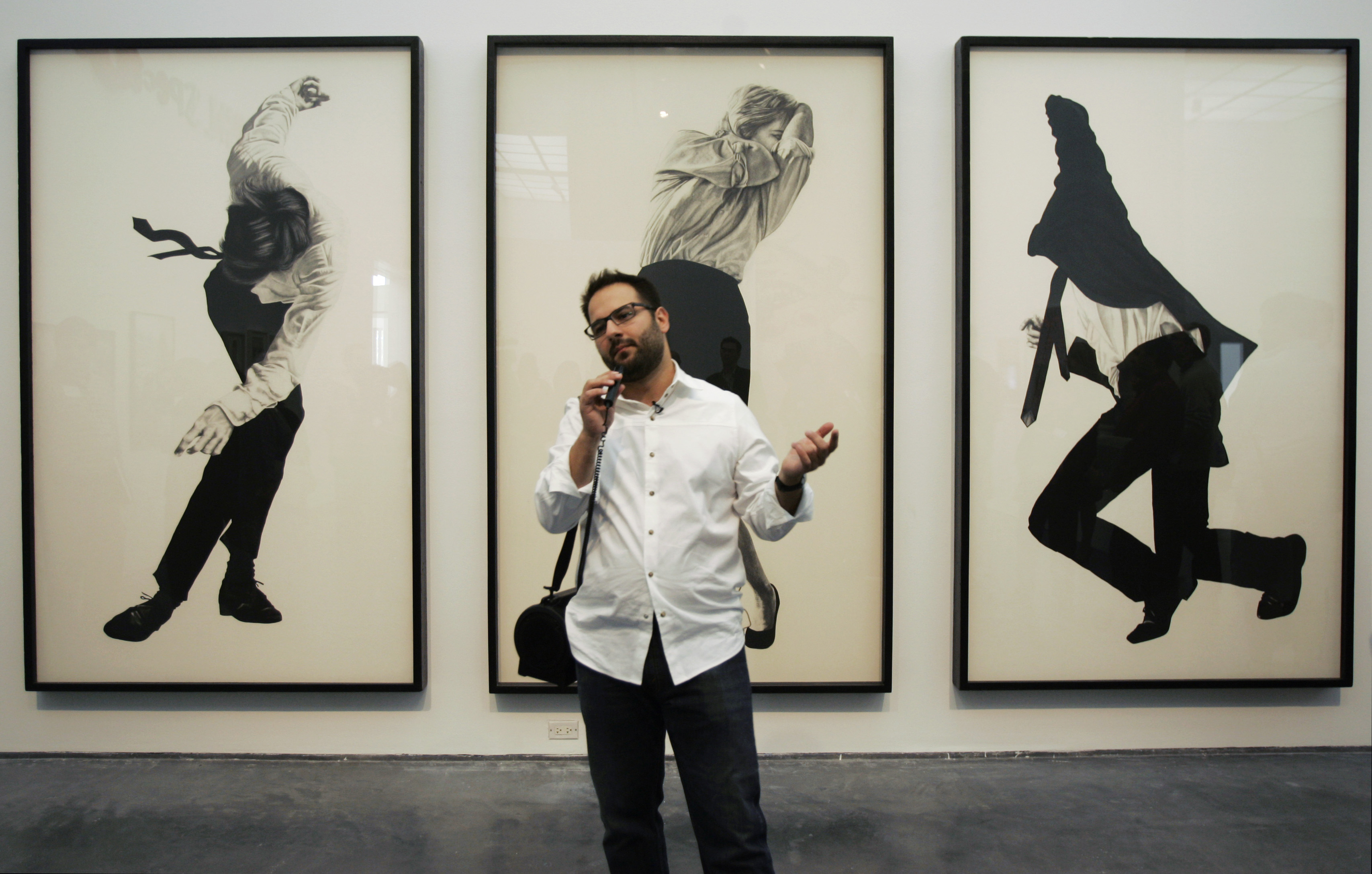
Dominic Molon, curator of Sympathy
Chicago ? The peek of platinum blond hair would be instantly recognizable to Madonna fans – it’s from the portrait on the cover of her self-titled 1983 album.
But the face belongs to a young man, and the torso to a woman wearing a bikini. Meanwhile, the legs encased in skintight black leather pants are from “Too Fast for Love,” a 1982 album from heavy-metal hair band Motley Crue.
The result is a collage of album covers that create one bizarre-looking rock star.
Part of a series called “Body Mix” by Christian Marclay, the artwork is featured in “Sympathy for the Devil: Art and Rock and Roll Since 1967,” which opened Saturday at the Museum of Contemporary Art.
The exhibit seeks to examine the ways contemporary art and rock music have converged over the past 40 years, using paintings, photos, drawings, installations, film, music and video.
Forty happens to be a meaningful number for the museum right now. This fall, it is celebrating its 40th anniversary by offering free admission and special programming from Saturday to Nov. 14.
For his part, curator Dominic Molon chose 1967 as the exhibit’s starting point because it’s the year of the release of legendary albums such as the Beatles’ “Sgt. Pepper’s Lonely Hearts Club Band” and “Are You Experienced” by the Jimi Hendrix Experience.
That’s the year, Molon believes, that rock ‘n’ roll became more than just music that teens listened to at parties, but instead “an art form to be taken seriously.”
The exhibit is loosely arranged geographically, with sections devoted to how art and music have interacted in New York, the West Coast, the broader United States, the United Kingdom, Europe and the rest of the world.
The New York section kicks off the exhibit, detailing how Andy Warhol collaborated with musical artists who were part of the underground music scene, most famously The Velvet Underground.
But artist Douglas Gordon has slowed down the film significantly, encouraging viewers to contemplate the way the bands interact with the crowd. Cramps’ lead singer Lux Interior is taunting and confrontational, for example, while The Smith’s Morrissey is playful with his worshipful fans.
Other highlights include:
¢ A floor comprised of vinyl albums, including records made by Pat Benatar, Fleetwood Mac, Iggy Pop and Grand Funk Railroad.
¢ A life-sized recording studio, which museum visitors can book and use to record a demo tape.
¢ A newspaper-sized collage by artist Richard Hamilton, entitled “Swingeing London,” comprised of articles and headlines detailing drug-related legal troubles members of the Rolling Stones had in 1967-68.
Of course, the Stones’ song “Sympathy for the Devil” provides the theme for the show.
Molon likes using “Sympathy for the Devil” as a theme because it implies the “Faustian bargain” that he feels has been struck between rock music and the avant-garde art scene when the two worlds collide.
Arts and Entertainment

Photos: Lawrence begins World Cup festivities with downtown block party
Watkins Museum to open special exhibit detailing how Douglas County celebrated America’s Bicentennial

Go, See, Do: Kaw River Roots Festival, markets and more

Soccer gear honoring Lawrence history’s all-star team is now on sale as part of city’s public art exhibition

Nominations, call for artists open for Lawrence’s 2026 Phoenix Awards