Suicide bomber strikes reconciliation meeting
15 killed at assembly of Shiite, Sunni tribal sheiks
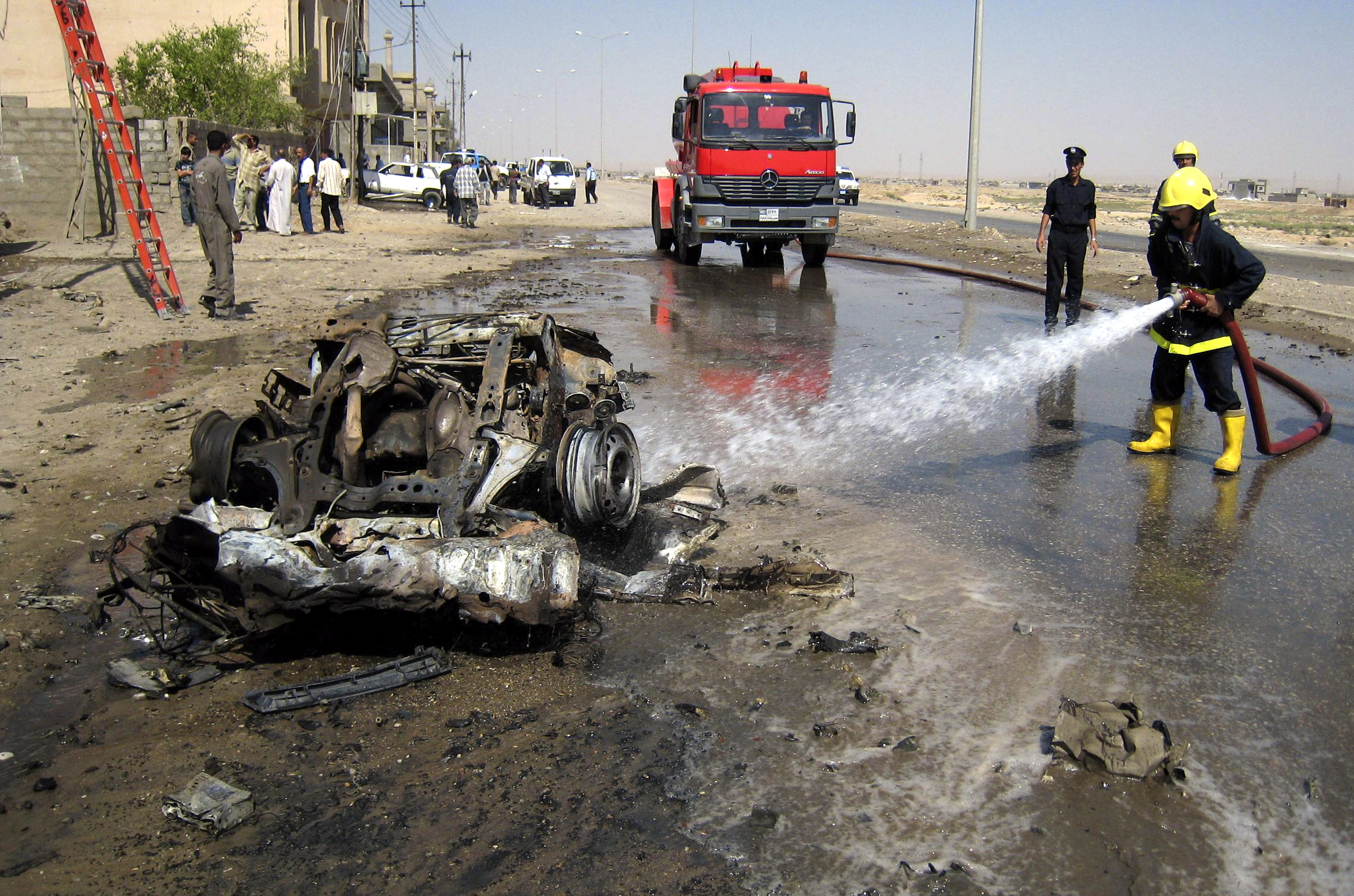
A fireman extinguishes the remains of a car bomb Monday in Kirkuk, Iraq, 180 miles north of Baghdad. An Iraqi security guard was killed and three others were wounded when a car bomb exploded near the convoy of a local security official near the northern city of Kirkuk, police Brig. Gen. Sarhat Qadir said.
U.S. deaths
As of Monday, at least 3,798 members of the U.S. military have died since the beginning of the Iraq war in March 2003, according to an Associated Press count.
Baqouba, Iraq ? A suicide bomber struck a U.S.-promoted reconciliation meeting of Shiite and Sunni tribal sheiks as they were washing their hands or sipping tea Monday, killing at least 15 people, including the city’s police chief, and wounding about 30 others.
Two U.S. soldiers were also wounded in the 8:30 p.m. blast at a Shiite mosque in Baqouba, a former al-Qaida in Iraq stronghold about 35 miles northeast of Baghdad, according to U.S. and Iraqi officials, who gave the overall casualty toll.
The brazen attack, which bore the hallmarks of al-Qaida in Iraq, represented a major challenge to U.S. efforts to bring together Shiites and Sunnis here in Diyala province, scene of some of the bitterest fighting in Iraq.
About two hours after the blast, U.S. soldiers at nearby Camp Warhorse fired artillery rounds at suspected insurgent positions near Baqouba. There were no reports of damage or casualties.
Witnesses and officials said the bomber struck when most of the victims were in the mosque courtyard cleaning their hands or drinking tea during Iftar, the daily meal in which Muslims break their sunrise-to-sunset fast during the holy month of Ramadan.
Security guards approached a man after noticing him walking rapidly through the courtyard. As the guards challenged him, the man detonated an explosive belt, setting off the devastating blast, said police Maj. Salah al-Jurani.
Al-Jurani said he believed provincial Gov. Raad Rashid al-Tamimi was the intended target. The governor was wounded and his driver was killed, al-Jurani said.
The dead also included Baqouba’s police chief, Brig. Gen. Ali Dalyan, and the Diyala provincial operations chief, Brig. Gen. Najib al-Taie, according to security officials. They spoke on condition of anonymity because they were not supposed to release the information.
Also wounded was the governor’s brother, Sheik Mazin Rashid al-Tamimi, who has spearheaded Sunni-Shiite reconciliation efforts in the province.
“We’ve tried to persuade the tribes to oust terrorists from their areas because it’s a disaster when the tribes cooperate with and provide refuge to al-Qaida,” Sheik Mazin told The Associated Press last weekend.
U.S. officials have accelerated efforts to reconcile Sunni and Shiite tribes in Diyala after American soldiers gained control of Baqouba, the provincial capital, in fighting last summer. Al-Qaida had declared Baqouba the capital of its Islamic State of Iraq.
The U.S. announced this month that top leaders of 19 of the 25 major tribes in Diyala – 13 Sunni and six Shiite – had agreed to end sectarian violence and support the government, although the province remains one of the most dangerous in the country with frequent kidnappings and armed clashes.
The effort is loosely modeled on an alliance of Sunni tribes that banded together last year to fight al-Qaida in Anbar province. The leader of that effort, Sheik Abdul-Sattar Abu Risha, was killed in a bombing Sept. 13.
Also Monday, an American soldier was killed by hostile fire in Salahuddin province north of Baghdad, the U.S. military said. No further details were released.
To the north, Iran shut down five major border crossing points into Kurdish areas Monday to protest the U.S. arrest and detention of an Iranian official accused by the U.S. military of links to an elite force smuggling weapons into this country to kill Americans.
Crossing points elsewhere along the 900-mile border were operating normally.
Iran’s semiofficial Mehr news agency said the closures were to protest the arrest last Thursday of Mahmudi Farhadi, an Iranian regional official who was detained by American troops at a hotel in Sulaimaniyah, a Kurdish city 160 miles northeast of Baghdad.
The border stations will remain shut until Farhadi’s unconditional release, the Mehr agency quoted Ismail Najjar, general governor of the Iranian Kurdistan province, as saying.
U.S. officials said Farhadi was a member of the Quds force of the Iranian Revolutionary Guards that smuggles weapons to Shiite extremists in Iraq. But Iraqi officials say he was here legally and should be set free.
National
Unhealthy air quality in California city as huge warehouse fire burns for 3rd day
Judge orders Trump administration to restore National Park changes at sites that ‘disparaged’ US
Teens’ reading and math scores have stagnated, US test results show
WASHINGTON (AP) — Younger students have regained ground academically after the pandemic's disruptions while older ...
Lawyers for man accused of killing Charlie Kirk try to block death penalty
Trump’s name poised to come off Kennedy Center