U.S. copes with possible loss of security firms
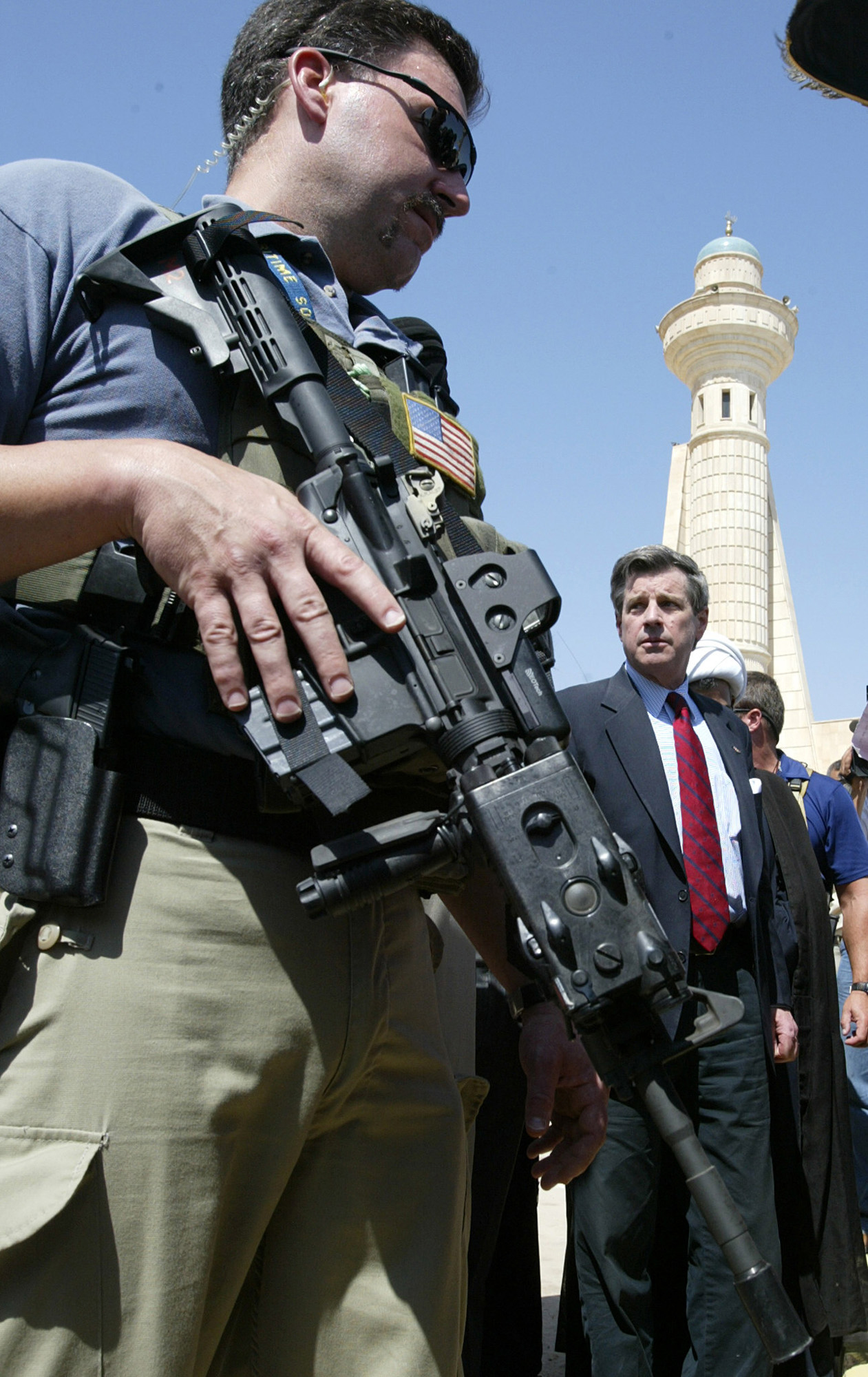
Paul Bremer, a U.S. administrator in Iraq, stands at the compound of the University for Humanities, Science and Theological Studies in Hillah, south of Baghdad, protected by one of his private security guards, in this June 27, 2004, file photo. Iraq's decision to temporarily ban Blackwater USA after a fatal shooting of civilians in Baghdad reveals a growing web of rules governing weapons-bearing contractors but few signs U.S. agencies are enforcing them.
U.S. deaths
As of Tuesday, at least 3,786 members of the U.S. military have died since the beginning of the Iraq war in March 2003, according to an Associated Press count.
Baghdad ? The United States on Tuesday suspended all land travel by U.S. diplomats and other civilian officials in Iraq outside Baghdad’s heavily fortified Green Zone, amid mounting public outrage over the alleged killing of civilians by the U.S. Embassy’s security provider Blackwater USA.
The move came even as the Iraqi government appeared to back down from statements Monday that it had permanently revoked Blackwater’s license and would order its 1,000 personnel to leave the country – depriving American diplomats of security protection essential to operating in Baghdad.
“We are not intending to stop them and revoke their license indefinitely but we do need them to respect the law and the regulation here in Iraq,” government spokesman Ali al-Dabbagh told CNN.
Details of the weekend shootings haven’t been released, but the New York Times reported late Tuesday that a preliminary review by Iraq’s Ministry of Interior found that violence erupted as Blackwater security guards fired at a car when it did not heed a policeman’s call to stop, killing a couple and their infant.
According to the story on the Times Web site, the report said that Blackwater helicopters had also fired. The Iraqi Ministry of Defense said that 20 Iraqis were killed, higher than the 11 dead reported before.
The newspaper said the report was presented to the Iraqi cabinet and, though unverified, seemed to contradict an account offered by Blackwater that the guards were responding to militants who had opened fire on State Department personnel. Iraqi police have said a car bomb exploded near a State Department convoy and that Blackwater guards began shooting.
“There was not shooting against the convoy,” the Times quoted al-Dabbagh as saying. He said the convoy initiated the shooting when a “small car did not stop. It was moving very slowly. They shot against the couple and their child. They started shooting randomly.”
Unlike many deaths blamed on foreign contractors, Sunday’s shootings took place in a crowded area in downtown Baghdad with dozens of witnesses.
State Department Edgar Vasquez said he had not seen the Iraqi report, reiterating that the department was investigating.
“Let’s let these folks do their job and get all the facts. If State Department procedures have not been followed, then at that point we’ll assess what actions to take,” Vasquez said..
The U.S. order confines most American officials to a 3.5-square-mile area in the center of the city, meaning they can’t visit U.S.-funded construction sites or Iraqi officials elsewhere in the country except by helicopter. The notice did not say when the suspension expires.
The Iraqi Cabinet decided Tuesday to review the status of all foreign security companies. Still, it was unclear how the dispute would play out, given the government’s need to appear resolute in defending national sovereignty while maintaining its relationship with Washington at a time when U.S. public support for the mission is faltering.
Polls show Gen. David Petraeus’ report to Congress and President Bush’s nationally televised address have had little impact on Americans’ distaste for the Iraq war and their desire to withdraw U.S. troops.
Petraeus, America’s top commander in Iraq, and Ryan Crocker, the top U.S. diplomat here, briefed the British government Tuesday on their recommendations to keep troop levels high.
Also Tuesday, three U.S. soldiers were killed following an explosion near their patrol northeast of Baghdad, the military said. Another soldier was killed in a vehicle accident in the northern province of Ninevah.
Exploiting public rage over the killings of what police said were civilians by Blackwater guards, anti-American cleric Muqtada al-Sadr demanded that the government ban all 48,000 foreign security contractors.
Al-Sadr’s office in Najaf said the government should nullify contracts of all foreign security companies, branding them “criminal and intelligence firms.”
“This aggression would not have happened had it not been for the presence of the occupiers who brought these companies, most of whose members are criminals and ex-convicts in American and Western prisons,” the firebrand cleric said in a statement.
National

Lawyers for man accused of killing Charlie Kirk try to block death penalty
Trump’s name poised to come off Kennedy Center

Suspect in Texas shooting had fired at police days earlier, officials say
Man pleads guilty to killing a top Minnesota Democrat and her husband
New tornadoes outside Chicago as severe storms pummel the Midwest