Scientists aim to eradicate rats on island
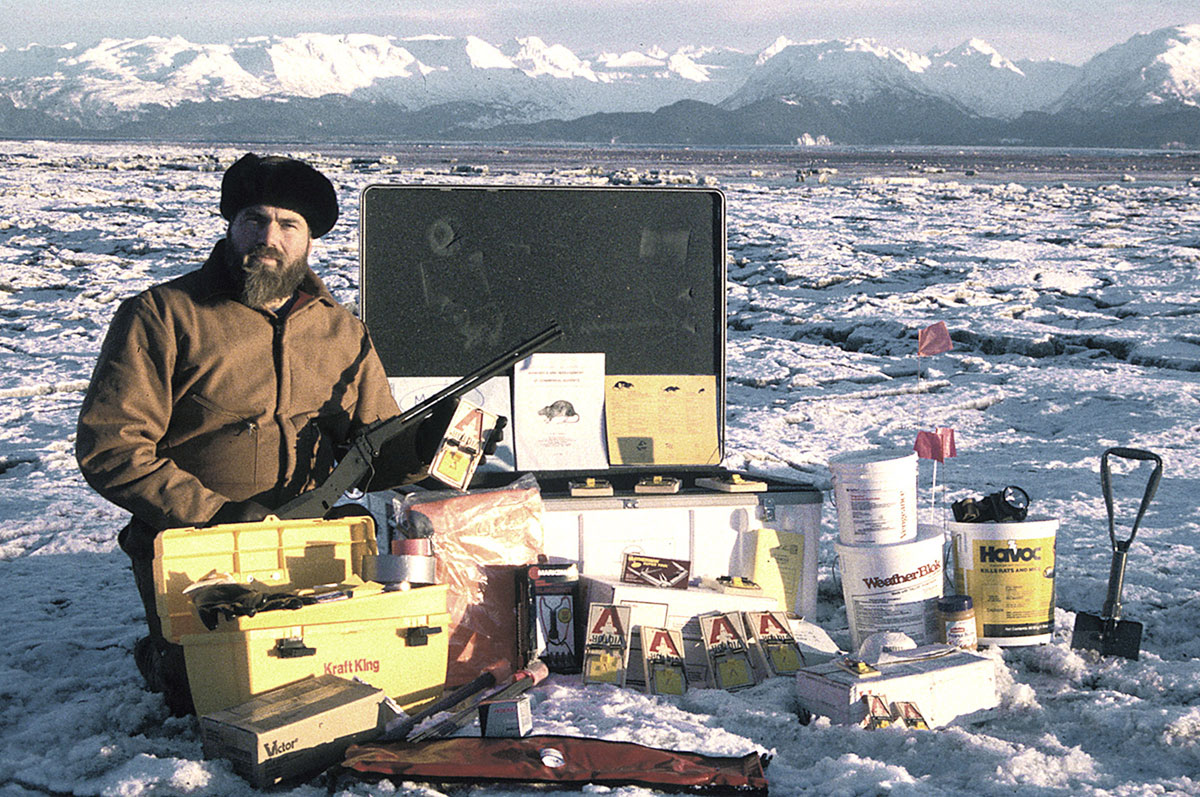
Steve Ebbert, a wildlife biologist for the Alaska Maritime National Wildlife Refuge, poses with a rat response kit on one of Alaska's Aleutian Islands. Rats on the islands prey on adult seabirds and their eggs and chicks. Alaska is joining forces with federal wildlife biologists in a multipronged attack to drive the rats from the islands - in particular, Rat Island. Read the complete story on page 10A.
Anchorage, Alaska ? More than 200 years ago, rats jumped ship for Rat Island.
The muscular Norway rat climbed ashore on the rugged, uninhabited island in far southwestern Alaska in 1780 after a rodent-infested Japanese ship ran aground. It was the first time rats had made it to Alaska.
Since then, Rat Island, as the piece of rock was dubbed by a sea captain in the 1800s, has gone eerily silent. The sounds of birds are missing.
That is because the rats feed on eggs, chicks and adult seabirds, which come to the mostly treeless island to nest on the ground or in crevices in the volcanic rock.
“As far as bird life, it is a dead zone,” said Steve Ebbert, a biologist at the Alaska Maritime National Wildlife Refuge, whose 2,500 mostly uninhabited islands include the Aleutian chain, of which Rat Island is a part.
State and federal wildlife biologists are gearing up for an assault on the rats of still-uninhabited Rat Island, hoping to exterminate them with rat poison dropped from helicopters.
If they succeed, the birds will sing again on Rat Island. And it will be the third-largest island in the world to be made rat-free.
A visitor to the island 1,700 miles from Anchorage doesn’t have to look far to find evidence of vermin. The landscape is riddled with rat burrows, rat trails, rat droppings and chewed vegetation. Certain plants are all but gone.
“You go to Rat Island and there are hardly any chocolate lilies,” said Jeff Williams, another refuge biologist.
The same for songbirds and seabirds.
Rats have all but wiped out the seabirds on about a dozen large islands and many smaller islands in the refuge, which is home to an estimated 40 million nesting seabirds. Puffins, auklets and storm petrels are most at risk because they leave their eggs and young for extended periods while foraging.
The rats jumped ship beginning in the late 1700s, a problem that worsened in the 1800s when Russian merchant vessels plied the islands, and grew even more serious in the 1940s, when hundreds of military ships visited the Aleutian Islands during World War II.
Now, the islands are vulnerable to “rat spills” from freighters traveling the quickest route from the West Coast to Asia. The Aleutians receive about 400 port calls from vessels each year.
Rats have been the scourge of islands worldwide. According to the California-based group Island Conservation, rats are to blame for between 40 percent and 60 percent of all seabird and reptile extinctions, with 90 percent of those occurring on islands.
“Rats are one of the worst invasive species around,” said Gregg Howald, program manager for Island Conservation, which is working with the U.S. government on a plan for Rat Island.
The state is joining forces with federal wildlife biologists in a multipronged attack to drive the rats from Alaska.
State regulations went into effect this fall requiring mariners to check for rats and try to eradicate them if found. Violators face a year in jail and a $10,000 fine. Corporations could be fined up to $200,000.
The state also is mailing out 15,000 “Stop Rats!” brochures to educate mariners on how to control rats aboard boats and keep them from going ashore.
The brochure tells mariners to kill every rat on board, have traps set at all times, keep trash and food in rat-proof containers, use line guards – funnel-shaped devices that go around mooring lines – to keep rats from getting off or coming aboard, and never throw a live rat over the side. Rats are excellent swimmers.
National

Lawyers for man accused of killing Charlie Kirk try to block death penalty

Trump’s name poised to come off Kennedy Center

Suspect in Texas shooting had fired at police days earlier, officials say

Man pleads guilty to killing a top Minnesota Democrat and her husband
New tornadoes outside Chicago as severe storms pummel the Midwest