

The price of consumerism
Local documentary with local ties asks, "What Would Jesus Buy?"

Reverend
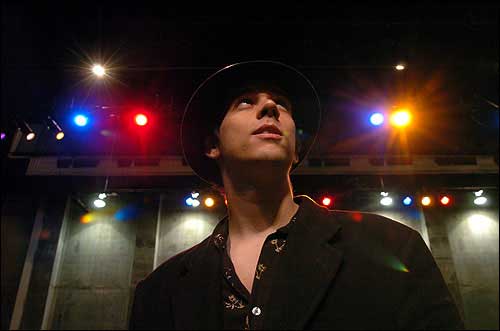
Jeremy Osbern, a Kansas University film graduate, filmed several scenes in What
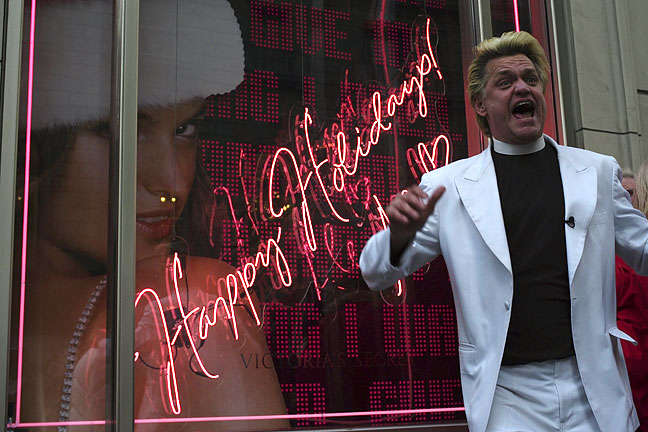
What
What Would Jesus Buy?
Yesterday was Black Friday, the busiest shopping day of the year.
There was TV footage of stampedes at the early-morning openings of chain stores. No doubt there were a few arguments over who was first to claim a limited good deal on the hottest product.
Rob VanAlkemade stops to wonder: Did anyone ask the question “what would Jesus buy?”
He’s spent a lot of time pondering that question over the last three years.
VanAlkemade is director of the new documentary “What Would Jesus Buy?” which takes its name from a question posed by Topeka pastor and author Charles Sheldon (“What Would Jesus Do?”).
Even though a lot of focus has been put on global warming and environmentally friendly business practices in the past year, VanAlkemade thinks the documentary has been needed for a long time.
“It’s always probably been a good time since the late 1800s to come out with a message that, ‘Hey, Christmas is being commercialized. Why don’t we slow down, recheck our priorities and find whatever the real Christmas is for us back at home,'” he says.
The movie – which included a Lawrence filmmaker and scenes shot in Lawrence – has opened in limited art houses across the country. It will come to Lawrence Dec. 16, when it screens at Liberty Hall, 642 Mass.
The message
Much of the documentary, which was produced by Morgan Spurlock (“Super Size Me”), focuses on Bill Talen, who goes by the performance name “Rev. Billy.”
Talen, based in New York City, is “pastor” of the “Church of Stop Shopping” and brings along a choir for his appearances. His public performance art, in which he mimics an evangelical preacher, includes marches against commercialism and exorcisms of cash registers.
But VanAlkemade says Talen and his crew are more than entertainment.
“I realized nobody was in this for self-promotion or any other trickery,” VanAlkemade says. “It was very much a genuine group, with a lot of very grounded goals and philosophies.”
Talen himself says in the documentary that he doesn’t have all the answers, just many of the questions, for ending our nation’s consumer-driven mindset. VanAlkemade says those questions include: Where did that thing you bought come from? Did you really need it? Where will it go when you’re done with it? Did you need to buy it to show your love to someone?
The remainder of the documentary – the parts that aren’t following Talen on his crusade against the likes of Wal-Mart and Starbucks – is filled with experts and families talking about spending and the holidays in particular. But VanAlkemade says 45 of the 57 “specialists” they interviewed ended up on the cutting room floor as the editors opted to focus more on the entertainment value of the “Church of Stop Shopping.”
“We decided to err on the side of moving you personally in a simple way,” VanAlkemade says, “over being a conclusive corporation-type documentary.”
Lawrence connection
Two years ago, Rev. Billy stopped in Lawrence as part of the filming of the documentary.
He led Kansas University theater students in a conga line on Black Friday at the Wal-Mart in Lawrence. He also did shopping “confessionals” at a booth set up downtown.
Jeremy Osbern was there to film the festivities. He’s a KU graduate and Lawrence-based cinematographer; his company is called Through A Glass Productions.
He calls the time filming at Wal-Mart a reconnaissance mission and admits, “I got very close to kicked out.”
The Wal-Mart portion of the movie filmed in Lawrence made the final cut, Osbern says. But other portions, including interviews with local business owners who talk about how they’ve survived despite having a Wal-Mart in their town, did not. VanAlkemade says Lawrence’s “downtown survival” story may make a DVD extra someday.
Osbern says he was sold on the concept of the film.
“I actually was really excited to be a part of it; I haven’t shopped in Wal-Mart in five years,” he says. “Especially living in Kansas, having friends from smaller towns, and seeing these smaller towns dry up economically as soon as Wal-Mart arrives, I’m very much about supporting local business. Shopping in Wal-Mart seems counterproductive to that.”
DVD challenge
VanAlkemade came to believe in that cause, too – in a very practical way.
While in a tour bus with the Church of Stop Shopping choir, the bus was rear-ended by a semi. VanAlkemade was in intensive care for two weeks with broken ribs and a punctured liver.
“We all renewed our commitment to that trip right away,” VanAlkemade says. “It never occurred to even the most rattled of us to stop what we were doing. You’re forced to ask yourself is it worth dying, if absolutely necessary, for what I’m doing right now? Is this how I want to live my life?”
Spurlock’s “Super Size Me,” in which he spent a month eating nothing but food from McDonald’s and suffered the health consequences, may have encouraged the fast-food chain to retool its menu and the way it offers those larger-sized portions.
VanAlkemade says “What Would Jesus Buy?” may not have that same direct purpose. But he says if corporations decide to put a focus on greener or sustainable practices, that would be great.
Getting the message out, considering Wal-Mart is a major player in the DVD sales arena, may be difficult. Several distributors already have said no to the film, and VanAlkemade isn’t expecting Wal-Mart to stock the movie.
“They might get some good publicity for it,” he says. “I’m not tremendously concerned about it. … I’m pretty sure we’ll be able to find some outlets that will work out.”
VanAlkemade says the movie’s title was “Morgan’s epiphany” (referring to Spurlock), though the director wasn’t entirely sold on it at first. But over time, he says, it’s working to the film’s advantage. Despite the title, he says the movie isn’t religiously based, adding Christians and non-Christians alike can find common ground through it.
“I was afraid we might offend people, and that people might misunderstand and assume it was either a pushy religious movie or a pushy nonreligious movie,” VanAlkemade says. “But I haven’t heard that feedback from any circles, actually.
“It’s at least 70 percent positive (feedback). We get calls and e-mails all from over the place from people who have seen the film and are definitely changed this holiday, and throughout the year.”
Arts and Entertainment
Photos: Lawrence begins World Cup festivities with downtown block party
Watkins Museum to open special exhibit detailing how Douglas County celebrated America’s Bicentennial

Go, See, Do: Kaw River Roots Festival, markets and more
Soccer gear honoring Lawrence history’s all-star team is now on sale as part of city’s public art exhibition

Nominations, call for artists open for Lawrence’s 2026 Phoenix Awards