AP challenges long detention of its photographer in Iraq
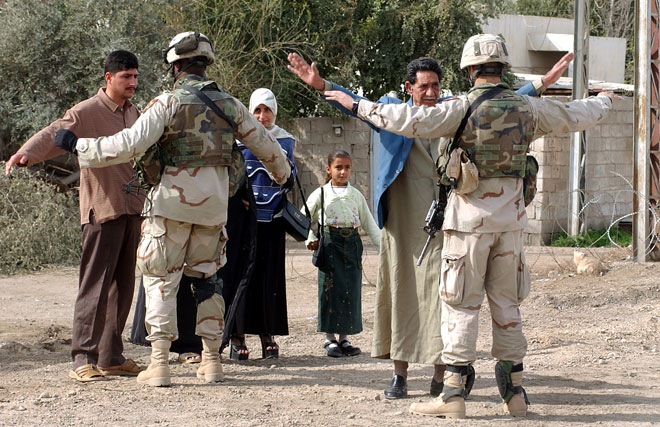
An Iraqi family is searched near a U.S. checkpoint in Ramadi, Iraq in this Feb. 22, 2005, file photo taken by Associated Press photographer Bilal Hussein. The U.S. military plans to seek a criminal case in an Iraqi court against Hussein, who has already been imprisoned without charges for more than 19 months.
New York ? A series of accusations raised by the U.S. military against an Associated Press photographer detained for 19 months in Iraq are false or meaningless, according to an intensive AP investigation of the case made public Wednesday.
Evidence and testimony collected by the AP show no support for allegations that Bilal Hussein took part in insurgent activities or bomb-making, and few of the images he provided dealt directly with Iraqi insurgents.
“Despite the fact that Hussein has not been interrogated since May 2006, allegations have been dropped or modified over time, and new claims added, all without any explanation,” said the nearly 50-page report compiled last spring by lawyer and former federal prosecutor Paul Gardephe.
The report, along with copious exhibits and other findings, were provided to U.S. and Iraqi officials in late June but have never been publicly released by the AP.
“The best evidence of how Hussein conducted himself as a journalist working for AP is the extensive photographic record,” Gardephe wrote. “There is no evidence – in nearly a thousand photographs taken over the 20-month period – that his activities ever strayed from those of a legitimate journalist.”
The U.S. military notified the AP last weekend that it intended to submit a complaint against Hussein that would bring the case into the Iraqi justice system as early as Nov. 29. Under Iraqi codes, an investigative magistrate will decide whether there are grounds to try Hussein, who was seized in the western Iraqi city of Ramadi on April 12, 2006. The AP has retained Gardephe to defend Hussein before the Iraqi court.
Terror links alleged
Military officials have alleged that Hussein, 36, had links to terrorist groups but are refusing to disclose what evidence or accusations would be presented. Previously, the military suggested an array of possible lines of investigation, including claims that Hussein offered to provide false identification to a sniper seeking to evade U.S.-led forces, that he possessed bomb-making equipment, and that he took photographs that were synchronized with insurgent blasts.
Most of Gardephe’s report is based on a two-week visit to Iraq in March. He inspected hundreds of photographs taken by Hussein and interviewed him in custody for more than 40 hours along with a wide range of co-workers, relatives and friends.
The report addresses points raised by the military in both private conversations and public statements, but Gardephe said he was hampered by the lack of specific information about what the military intends to present in court.
Despite U.S. military claims that insurgents granted Hussein “unusual access,” the overwhelming majority of his photographs showed scenes readily visible to any passer-by, such as bombed-out buildings, injured civilians and funerals, Gardephe said. He reviewed all of the nearly 1,000 photo images submitted by Hussein while he was working for the AP, of which only 420 were distributed. Fewer than 10 percent of those 420 show either known or possible insurgents.
His report found no photographs synchronized with an explosion or other attack, and no other photographic evidence that he was ever tipped off to insurgent activity.
Photo of opportunity
Only on one day during the most intense fighting over Fallujah in November 2004 did he photograph insurgents actually engaged in combat against coalition forces, while other photos during his employment showed the aftermath of attacks in areas he was covering.
Gardephe cited Hussein’s photos of a Red Crescent ambulance damaged by insurgent mortars; of relatives weeping over the body of an Iraqi soldier killed by insurgents; of the bodies of 19 fisherman killed by insurgents for no apparent reason; and of civilians hurt by suicide car bombs.
“These and other such images are inconsistent with the notion that Hussein was ‘plugged-into’ the insurgency or an insurgent propagandist,” the report said.
One of the photos of insurgents in combat – taken in Fallujah on Nov. 8, 2004 – was part of a Pulitzer Prize-winning submission by the AP. It shows one insurgent firing a machine gun, while another holds an ammunition belt and a third apparently had just fired a mortar. According to the AP report, Hussein took this photo from a nearby furniture store, and the insurgents were not aware of his presence.
National
Unhealthy air quality in California city as huge warehouse fire burns for 3rd day
Judge orders Trump administration to restore National Park changes at sites that ‘disparaged’ US
Teens’ reading and math scores have stagnated, US test results show
WASHINGTON (AP) — Younger students have regained ground academically after the pandemic's disruptions while older ...
Lawyers for man accused of killing Charlie Kirk try to block death penalty
Trump’s name poised to come off Kennedy Center