

Bush, Merkel committed to using diplomacy with Iran
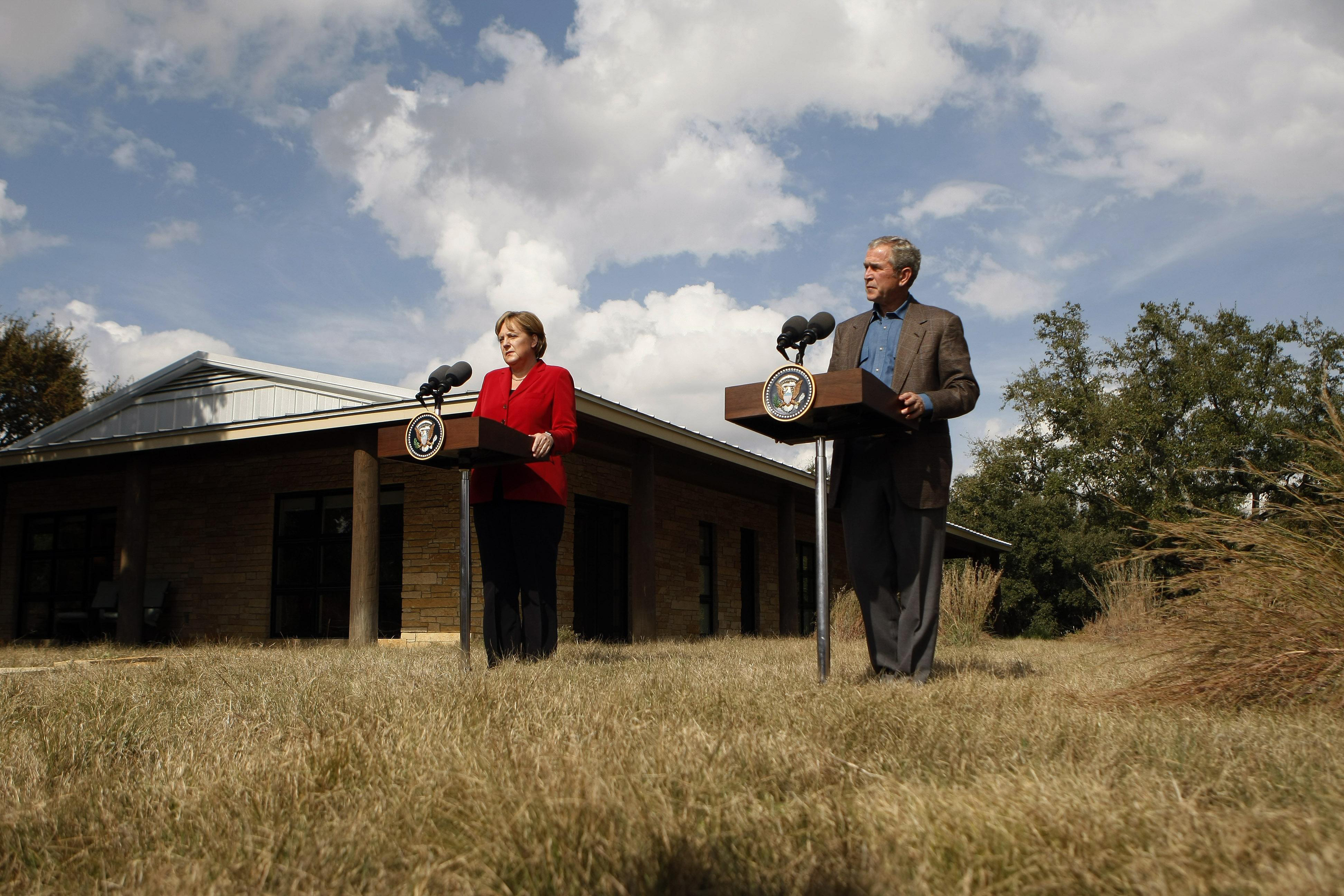
President Bush and German Chancellor Angela Merkel talk to the media Saturday at the Bush ranch in Crawford, Texas. Bush and Merkel agree that diplomacy is needed when dealing with Iran.
Crawford, Texas ? President Bush sought Saturday to reassure skeptical Europeans and critics at home that he remains committed to using diplomacy in dealing with Iran.
With Europeans increasingly concerned that he intends to attack Iran before he leaves office next year, Bush said the United States and its allies “will continue to work together to solve this problem diplomatically.”
He spoke at a news conference on a patch of dried grass outside his office at his ranch here, with German Chancellor Angela Merkel at his side as they completed two days of formal meetings and informal conversation.
Discussion of Iran occupied a large part of their time together, White House National Security Adviser Stephen J. Hadley said. The Bush administration has been looking for ways to step up pressure on the government of Iranian President Mahmoud Ahmadinejad to back off from what the Iranians say is a program intended to develop civilian nuclear power but which the United States contends is aimed at producing nuclear weapons.
In pledging to seek a diplomatic solution, Bush repeated many of his recent comments on the issue. But blunt warnings from the administration, accompanied by reminders that no option is off the table, have fueled concerns that the White House is not fully committed to a diplomatic course.
The issue has grown in intensity, particularly in Europe, with new Bush administration sanctions aimed at the Quds Force, a powerful Iranian military unit, and with Bush’s suggestion last month that a nuclear-armed Iran could be a tipping point for World War III.
Critics charge the administration is following the same path of sanctions and U.N. resolutions that it did before invading Iraq.
In coming weeks, the U.N.’s nuclear watchdog, the International Atomic Energy Agency, is expected to report on Iranian violations of nuclear safeguards and its past nuclear activities.
At the same time, the Bush administration is moving toward seeking a third set of sanctions as part of a U.N. Security Council resolution intended to increase the diplomatic and financial pressure on Iran to suspend its enrichment of uranium – a key step in fueling a nuclear warhead.
Ahmadinejad has said that Iran was operating 3,000 centrifuges in a uranium enrichment program.
Merkel said she and Bush “were at one” in agreeing on the seriousness of the threat posed by a nuclear-armed Iran, that they shared a reliance on diplomacy to counter the Iranian program, and that both believed a third U.N. Security Council resolution was the next step if the so-far-unsuccessful talks between Iran and the European Union do not advance.
She said U.N.-backed sanctions would be more effective as a message than “individual countries,” an apparent reference to the unilateral U.S. sanctions Bush imposed.
German companies have come under increasing pressure to curtail their business in Iran, and Merkel on Saturday held out the possibility of stepping up that pressure. There have been indications that some of the companies have reduced their presence there.
Saying she favored stepping up financial pressures through a new U.N. resolution, Merkel added, “I’m deeply convinced that the diplomatic possibilities have not yet been exhausted.”
Hadley said, “There’s been a dialogue between the United States and Germany for some time” regarding German banks that support trade with Iran.
National

Suspect in Texas shooting had fired at police days earlier, officials say

Man pleads guilty to killing a top Minnesota Democrat and her husband
New tornadoes outside Chicago as severe storms pummel the Midwest

Feds won’t seek death penalty in plea deal with man accused of killing top Minnesota Democrat

NASA unveils astronauts to test tech for future moon landing
Social Security’ fund faces shortfall one year earlier than expected
WASHINGTON (AP) — Social Security 's retirement trust fund is projected to face a funding shortfall in 2032, a ...