Vibrant art among pieces for new Haitian museum
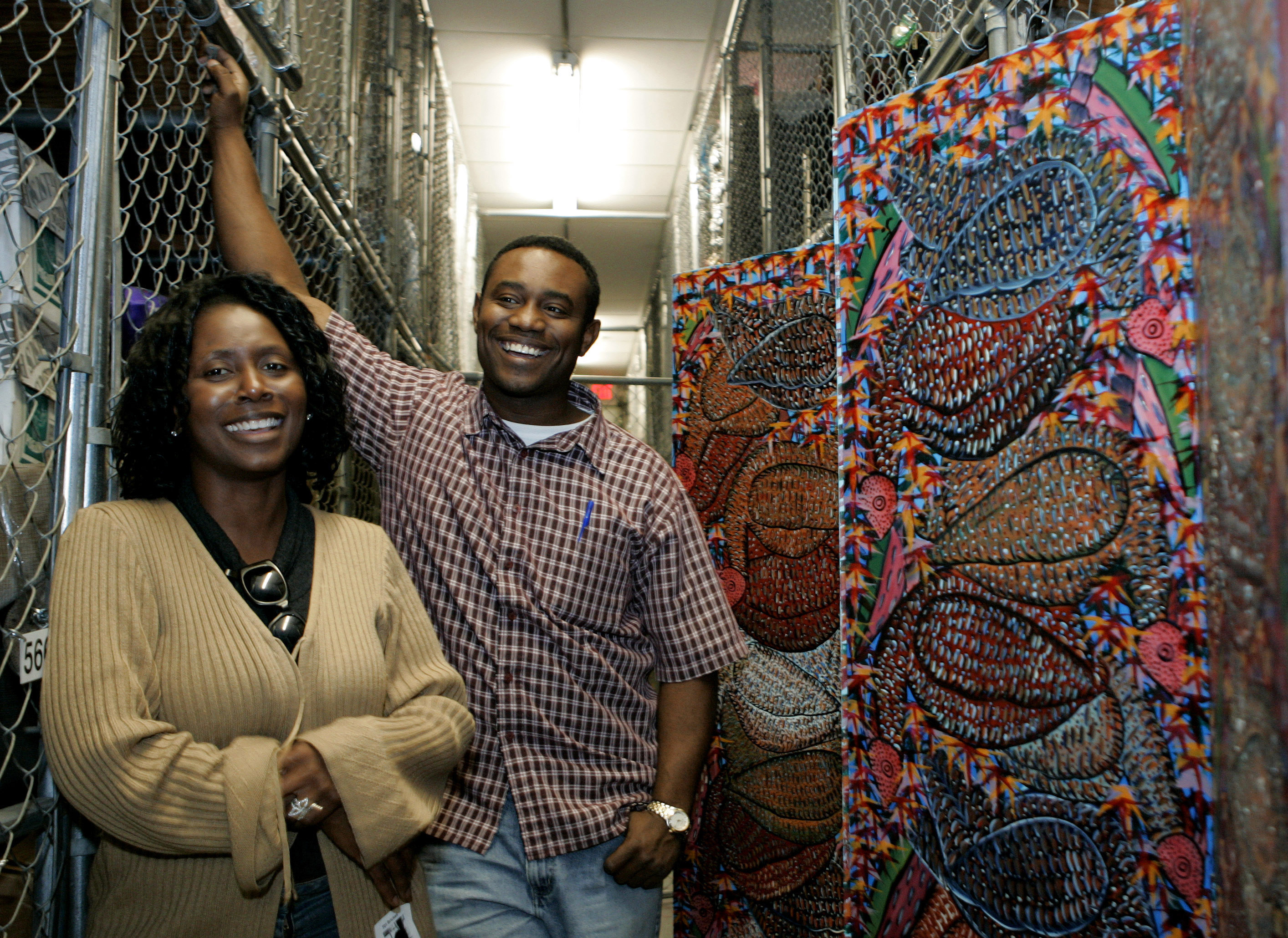
Eveline Pierre, left, and Serge Rodrigue, inside a climate-controlled storage area in Miami, stand next to an array of Haitian artwork and historical documents that ultimately will be the basis for the Haitian heritage Museum in the city's Little Haiti section.
Miami ? The Haitian Heritage Museum is, for now, boxed in antioxidant cardboard in a climate-controlled storage locker.
It includes 20 vibrant paintings and pieces of hand-carved folk art that will one day hang in a 25,000-square-foot building scheduled to break ground in Miami’s Little Haiti neighborhood later this year.
Eveline Pierre and Serge Rodrigue, the museum’s founders and only full-time staff, hope to build a permanent collection of about 1,000 items chronicling the Haitian Diaspora, especially in the United States, and the traditions they brought to new homes.
The two are of Haitian descent, having lived most of their lives in south Florida. Pierre is in arts and entertainment management and Rodrigue is in construction management. They worked together in 2003 on plans to commemorate Haiti’s Bicentennial in the Miami area the following year, and both felt something was missing from the celebration.
“There was no monumental symbol of Haitian history and culture, no readily accessible public record or storehouse of the contributions of Haitian people to society,” Rodrigue said.
The museum project developed from there.
The two have largely sought new acquisitions through word of mouth, and at speaking engagements and fundraisers. To date, they have raised about $180,000 for the museum and haven’t specified an ultimate fundraising goal.
They estimate the value of the artwork they have already collected at $25,000 to $30,000, they said. As they seek more artifacts, they find that some issues get lost in migration – efforts at proper preservation and documentation proving authenticity among them.
“A lot of the history of the country really lives with the inhabitants of this country. They take it with them,” Rodrigue said. “These things go down through the generations. Grandmothers put it in a paper bag and, because they know the value of these things, pass it down to their kids.”
The museum’s nascent collection includes a wooden bust of a woman in African dress with wire earrings; bright, Voodoo-themed paintings by Andre Pierre, considered one of Haiti’s greatest painters; a painted wooden screen that was commissioned for a Miami department store window display in the 1970s; and artwork painted on boards used in home construction that Haitian artists work with when they couldn’t afford canvases, Pierre said.
Also promised, Pierre said, are pieces of a wooden freighter that ran aground on Key Biscayne in 2002 with more than 200 Haitians aboard.
The museum also seeks books, film footage, stamps and military memorabilia.
Briefly unpacking the artwork on a recent afternoon, Pierre and Rodrigue recalled some of the items they wish they had – letters written by Haitian soldiers overthrowing their French colonial masters, and documents signed by Toussaint L’Ouverture, one of the leaders of the slave rebellion that led to Haiti’s independence in 1804. The would-be donor broke contact when asked to prove their authenticity.
“I’m pretty sure they were authentic with my personal eye, with the training I’ve gotten. They were truly deteriorating, but had the actual signature that appeared to match other signatures on record,” Pierre said.
“In Haiti, there’s been a lot of coups d’etat, a lot of buildings ransacked and valuables stolen,” she said. “We don’t want to run into a Spielberg situation. We want to make sure we start off on the right foot. If you can’t tell us or prove the authenticity of the item, we’d rather not deal with that.”
The FBI recently disclosed that filmmaker Steven Spielberg had a stolen Norman Rockwell painting in his collection. Spielberg had bought it from a legitimate art dealer in 1989 without knowing it had been taken from a gallery more than a decade earlier.
By weeding out artifacts looted or traded on the black market during Haiti’s many changes of government, the Haitian Heritage Museum hopes to avoid having to return items once their true histories become known.
National

Unhealthy air quality in California city as huge warehouse fire burns for 3rd day
Judge orders Trump administration to restore National Park changes at sites that ‘disparaged’ US
Teens’ reading and math scores have stagnated, US test results show
WASHINGTON (AP) — Younger students have regained ground academically after the pandemic's disruptions while older ...

Lawyers for man accused of killing Charlie Kirk try to block death penalty

Trump’s name poised to come off Kennedy Center