

Unit to help make ‘an important piece of history’
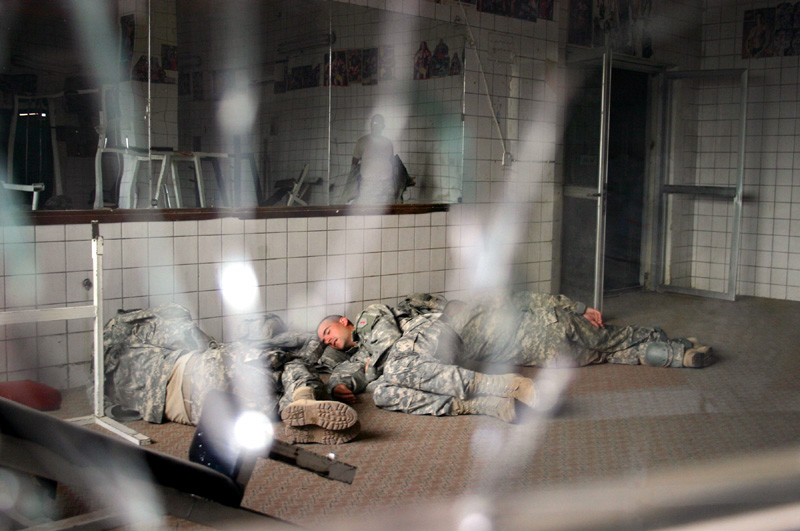
U.S. troops sleep after setting up a combat outpost, one of 100 slated for the capital, in an abandoned gym in Baghdad.
Baghdad, Iraq ? The soldiers crept into the abandoned gymnasium shortly before midnight.
Flashlights provided the only light. Commanders whispered their orders.
A few dozen of the additional U.S. troops President Bush has sent to Iraq were moving in with utmost stealth to set up a small combat outpost in western Baghdad.
“Within 72 hours there’s going to be some form of attack,” Maj. Erik Overby, one of their commanders, had predicted hours earlier as the soldiers readied their long convoy of armored trucks and vehicles to head to a neighborhood called Amel. When its residents wake up, he’d said, “they’re going to realize an American Army unit has moved in.”
The soldiers huddled near their vehicles before they set out, as the habitual thunder of artillery rounds made the ground shake. A group of them, including some just a few months out of high school, giggled nervously. Some took long drags on cigarettes, anticipating the risks ahead. Roadside bombs could be hidden in the mounds of garbage strewn on the streets leading to the gym. Word of the Americans’ arrival could have reached insurgents. A bloody surprise might be in store.
‘Important piece of history’
Still, the soldiers said, their incursion into one of Baghdad’s meanest neighborhoods was their moment to make history. They could return home as the guys who turned the war around. But they could also turn out to be among the last soldiers dispatched to a lost war.
“A year from now, five years from now, when they write the history books, there are going to be two things: the fall of Baghdad and the surge,” Overby said. “Win or lose, it’s going to be an important piece of history.”
The Abu Jafar al-Mansour Sports Club, the site of one of roughly 100 new combat outposts the U.S. military is setting up in the capital, had been abandoned for about four months. Hundreds of Sunni families had fled as Shiite militias moved into the neighborhood. U.S. military officials say the Sunni insurgent group al-Qaida in Iraq is active in the area. But flags and religious banners emblematic of support for the Mahdi Army, a Shiite militia, are everywhere.
Homeowners have blocked off most streets using chunks of concrete, mounds of garbage and trunks of date palms.
As the American soldiers moved into the gym that Friday night, they mistakenly cut the phone line of the neighboring building, an Iraqi police station.
Fort Riley soldiers
The 130 or so soldiers in the company assigned to the gym belong to the 4th Brigade’s 1st Battalion, 28th Infantry Regiment, out of Fort Riley, Kan. Their brigade is the second of five being deployed to Iraq as part of the troop increase.
The brigade, essentially built from scratch during the past 15 months, had been expected to provide logistical support for convoys and security for the large, citylike bases that the U.S. military has until recently used as its main operational centers in Iraq.
That mission changed Jan. 10 when Bush announced that he intended to send thousands of additional troops to Iraq to help implement a U.S. and Iraqi plan to pacify the capital and other parts of the country. Word trickled down the ranks of the Black Lions, as the 1st Battalion’s members are known. At least two-thirds of the unit’s soldiers are fresh out of basic training.
“I went home and said to my wife, ‘The president talked about the surge to Baghdad,'” said Overby, the 1st Battalion’s second in command. “How often do you get to be a part of what the president says? We were happy. It was better than escorting trucks through the desert.”
It would also be far more dangerous, the battalion’s soldiers recognized. Their commanders told them their mission was to secure a part of Baghdad by winning the confidence of residents, disarming militant groups and bringing criminals to justice.
But to do that, they will have to navigate streets where sniper attacks and bombings are common. And they will operate in densely populated areas where allies and enemies are often indistinguishable.
Cpl. Jon Dorsey, 20, of Sun Prairie, Wis., sitting on his cot in the gym’s main hall, said he couldn’t wait to go out on patrol.
“We’ve been staring at maps for months,” he said.
His friend Cpl. Lee Taylor, of Oklahoma City, jumped in: “We’re going to meet and greet people, win the hearts and minds.”
They felt adequately prepared, they agreed, albeit scared. Taylor found out two weeks before traveling to Iraq that his wife was pregnant. That night the couple celebrated by eating at Chili’s, where they avoided talking about the dangers he would soon face.
“I have a lot to live for,” he said. “I want to come home.”
But the veterans in the group, some of whom were in Iraq for the third time, spoke less enthusiastically about the plan.
“I think everything is worth trying,” said Staff Sgt. Brian Mancini, 28, of Phoenix. But he added wryly, “If I die in Iraq this time, I don’t have to worry about coming back again.”
State Government
State legislators push back against federal energy regulators ending competitive bids
TOPEKA — Two Kansas legislators asked federal energy regulators to ensure competitive bidding occurs on ...
Senate confirms 1st of 3 Kansas nominees to U.S. District Court
Corporate income tax collections falling sharply in Kansas; Republican, Democratic leaders disagree on what it means
TOPEKA — Corporate income tax collections in Kansas have almost halved since last year, while other sources trend ...
Candidate’s campaign manager created website with documents used to attack rival
TOPEKA — Kansas U.S. Senate candidate Patrick Schmidt’s campaign manager left his digital footprint on ...
GOP secretary of state files to run for governor
