

Girls with guitars
Industry amped up over more female strummers

Amy Trompeter, 15, of Lawrence, practices in her bedroom on her Fender Stratocaster electric guitar. Trompeter has been playing the guitar for more than two years and joins a growing trend of girls learning to play the instrument. One of Trompeter's favorite guitarists is David Gilmour, who also is a vocalist with rock band Pink Floyd.
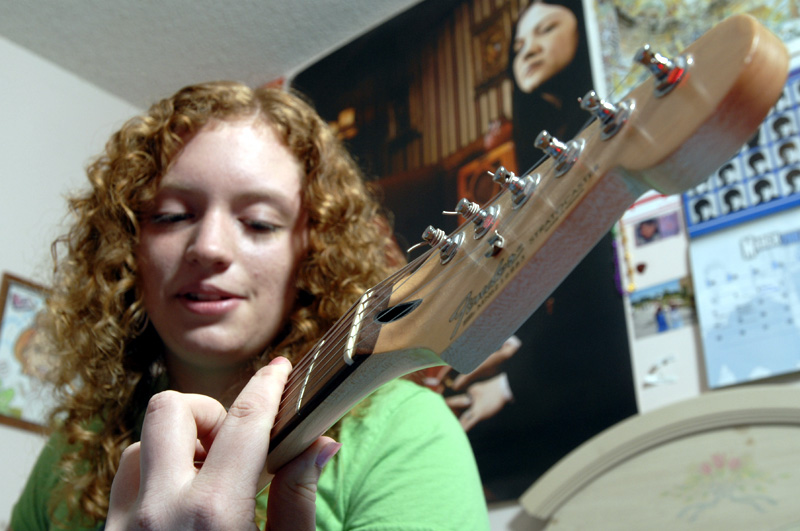
Amy Trompeter, 15, of Lawrence, practices in her bedroom on her Fender Stratocaster electric guitar.

Daisy Rock Guitars' colorful and smaller-sized guitars for girls and women have gained worldwide popularity in the last several years.
When Amy Trompeter started listening to Pink Floyd, she knew she had to play like guitarist David Gilmour.
She decided to take lessons. Two years and three guitars later, she still gets strange looks when people learn she plays.
“When people find out you play guitar,” she says, “they don’t expect much of you because you’re a girl.”
The 15-year-old student at Southwest Junior High School is trying to prove them wrong.
She and a growing number of girls are learning to strum rhythms and pick out melodies – and guitar-makers are starting to cater more to them.
“I think it’s a matter of socialization,” says Spencer Goertz-Giffen, a guitar teacher and guitarist for local band Kinetiks. “They haven’t seen other girls playing guitar. I don’t really feel like I’ve felt any barriers – maybe just surprise when I get up on stage, and afterward guys come up to me and say, ‘Wow, you can really rip.'”
She’s been playing acoustic guitar for 10 years, since she was 16. She added electric to her arsenal three years ago.
Though rock and pop stars including Joan Jett, Bonnie Raitt, Sheryl Crow, Courtney Love and even Madonna have strapped on guitars, most revered guitar gods have been men.
“The reason I picked up the electric guitar is I didn’t feel like there were a lot of role models out there for girls,” Goertz-Giffen says. “I wanted to inspire more girls to do that.”
Female-friendly
Guitar manufacturers are hoping to cash in on the trend.
“The industry is looking for growth opportunities given the overall slump in guitar sales,” says Wall Street analyst Rick Nelson, who covers the music industry. “Guitars catering to women is one area that we understand is showing some signs of strength.”
Daisy Rock is a company that manufactures guitars specifically for girls. It was founded in 2000, and its designs include guitars shaped like butterflies, hearts and daisies. It also offers standard guitars in a variety of colors, including glossy red, black, purple and pink. They range in price from $279 to $699.
Since Daisy Rock’s founding, the country’s top two guitar retailers, Gibson Guitar Corp. and Fender Musical Instruments Corp., each have debuted lines with a girl/woman-friendly focus.
Gibson makes Les Paul Vixen and Les Paul Goddess guitars, which are smaller and lighter weight than its traditional models. They go for roughly $1,429 for the Vixen and $2,499 for the Goddess.
And Fender’s Hello Kitty guitars, with the iconic cat splashed across the bodies, retail for $333.
“Ten years ago, statistics showed that 96 percent of the instruments purchased were for men,” says Gibson Chairman and CEO Henry Juszkiewicz. “The guitar is now becoming more a part of society in general.”
Even though Fender offers two new female-friendly models, it doesn’t pretend those are the only ones girls and women will want to play.
“We have 12,000 skews of guitars,” says Richard McDonald, Fender’s vice president of global marketing. “To say to the female marketplace, ‘Here are the three models that are right for you …’ – it’s an attitude that we refuse to take.'”
Bucking the trend
Not all girls are drawn to guitars marketed specifically to them.
Jessica Booth, who, like Trompeter, is 15 and a student at Southwest Junior High, says she wouldn’t consider buying a pink guitar or one with Hello Kitty on it. She’s been playing an acoustic guitar for about a year.
“I just have a pretty plain guitar,” she says. “I’m not really interested in the girlie, froufrou ones. After everybody worked so hard on that whole feminist thing, there’s no point in me broadcasting it.”
John Flynn, operations manager at Mass Street Music, 1347 Mass., says the store carries the Hello Kitty guitar but has yet to sell one.
“More guys have been interested in it than girls,” he says. “There’s an indie rock thing about that.”
Flynn says he would carry the Daisy Rock guitars or others that cater to girls and women if there were a demand.
“We sell a lot of guitars to girls, but they haven’t asked about these other instruments,” he says. “There’s been a gradual increase (in sales to girls) over the last five years, maybe longer. Obviously, there’s no stereotype anymore.”
Striking a chord
Thom Alexander, who directs Americana Music Academy, 1419 Mass., says he’s seeing more girls sign up for lessons than in the past.
“More girls want to be involved,” he says, “and the more competition they give the guys, the better.”
Recently, Alexander says, girls have been inspired by Serbian guitar phenom Ana Popovic.
“The guys are all about muscle, loudness, power and speed,” Alexander says. “The girls have some more finesse.”
Trompeter, who hopes to join a band and would like to one day make music a career, says she’d rather not be seen as a girl playing the guitar. She’d rather just be a guitarist.
“I guess it’s impressive if you’re a girl and you can play guitar,” she says. “It’s different than it was 20 years ago. A lot more girl guitarists are breaking out.”
– The Associated Press contributed to this story.
Arts and Entertainment
Photos: Lawrence begins World Cup festivities with downtown block party

Watkins Museum to open special exhibit detailing how Douglas County celebrated America’s Bicentennial

Go, See, Do: Kaw River Roots Festival, markets and more
Soccer gear honoring Lawrence history’s all-star team is now on sale as part of city’s public art exhibition
Nominations, call for artists open for Lawrence’s 2026 Phoenix Awards