Anger, apologies await answers
Congressional panel drills Walter Reed hospital officials
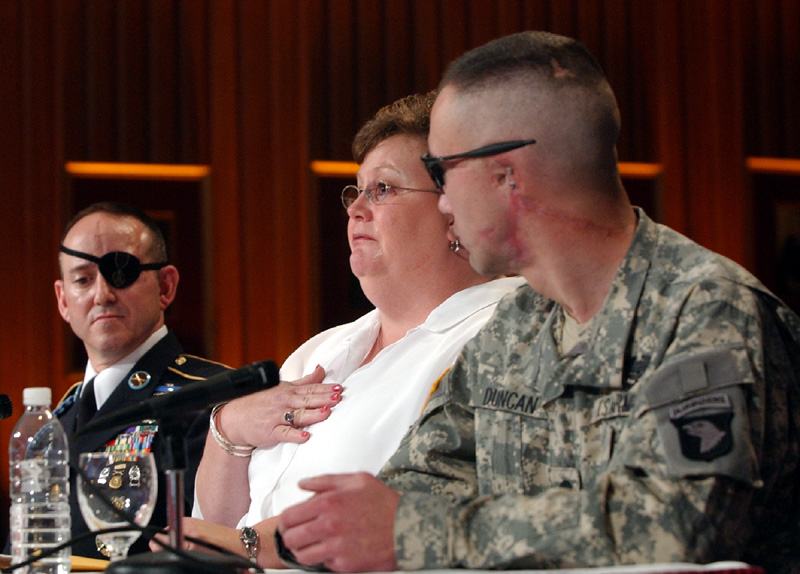
Annette McLeod, wife of Spc. Wendell McLeod, center, flanked by Staff Sgt. John Shannon, left, and Spc. Jeremy Duncan, testifies before a House Oversight and Government Reform subcommittee hearing at Walter Reed Army Medical Center in Washington. Shannon, Duncan and McLeod on Monday discussed care and conditions of wounded soldiers at the hospital.
Washington ? Top Army officials faced an angry Congress during an emotional hearing about shoddy medical treatment and living conditions at Walter Reed Army Medical Center, acknowledging Monday that they have failed in the care of wounded veterans.
Calling the scandal at Walter Reed “the tip of the iceberg of what is going on all around the country,” Rep. Henry Waxman, D-Calif., chairman of the Oversight and Government Reform Committee, said veterans and their families are “flooding us with complaints” about the burgeoning scandal.
Citing a litany of news stories and congressional reports that exposed the problems over the past two years, Waxman cast doubt on claims by Army higher-ups that they were surprised by recent disclosures about soldiers who returned from Iraq and Afghanistan and were treated shabbily.
“We get officials who say they just didn’t know things were happening,” Waxman said. “I have a long list, a stack of reports and articles that sounded the alarm bells about what was going on here and around the country.”
Maj. Gen. George W. Weightman, fired as commander of the hospital complex last week, took personal responsibility for a failure of leadership.
“I failed,” he said. “We can’t fail one of these soldiers or their families, not one. And we did.”
Turning away from the congressional panel to face one veteran and his family, Weightman expressed regret for a bureaucratic maze that forced the soldier’s wife to do battle with the Army to get her husband needed medical treatment. “I’d just like to apologize for not meeting their expectations,” he said.
A scapegoat
Several lawmakers accused Army brass of making Weightman the scapegoat for problems at the medical center. Veterans groups have complained that Weightman, who was Walter Reed’s commander for only six months, made progress in reducing the ratio of case managers to patients and in spotlighting post-traumatic stress disorder.
Army Secretary Francis J. Harvey was forced to resign over the scandal last week. Weightman’s predecessors – retired Maj. Gen. Kenneth L. Farmer Jr., who commanded the hospital complex for two years until August, and Lt. Gen. Kevin Kiley, who ran the complex from 2002 to 2004 – have not been disciplined. Kiley, the Army’s surgeon general, was removed last week after serving a day as interim commander at Walter Reed but retains his primary post.
“Tell me why he (Weightman) got the ax and why the others walk on the earth today,” asked Rep. John Tierney, D-Mass., chairman of the subcommittee that held the Monday hearings. “Where has all the brass been?”
Gen. Peter J. Schoomaker, the Army’s chief of staff, exploded in anger.
“I’ve got a daughter and a son-in-law that are on the way to combat,” said Schoomaker, whose younger brother Maj. Gen. Eric B. Schoomaker has been named to run Walter Reed. “This is not something about people (who) don’t care, and I am not going to sit here and have anybody tell me that we don’t care.”
“Nobody said anything about people not caring,” Tierney shot back, calling Schoomaker’s response a “red herring.”
More hearings to come
Like the federal government’s flawed response to Hurricane Katrina, the burgeoning scandal over medical treatment for returning soldiers is exposing major weaknesses. Members of Congress promised more hearings on the maze of red tape that forces wounded soldiers to battle bureaucracy.
“You’ve been fighting a war,” said Rep. Chris Van Hollen, D-Md., addressing veterans. “You shouldn’t have to come back here and fight a system.”
Schoomaker vowed to address the problems. “I couldn’t be madder and I couldn’t be more embarrassed and ashamed,” he said.
Lawmakers questioned the policy under which maintenance and operations functions at Walter Reed were outsourced to IAP Worldwide Services, a Florida company run by a former Haliburton official who reduced Walter Reed’s staff from 300 to 100.
“We’ve contracted out so much in this war,” Waxman said. “We have mercenaries instead of U.S. military. … We are, in Iraq, overpaying for the work of the contractors and here we’re under-serving our military.”
Soldiers’ stories
The subcommittee made the unusual decision of moving the hearing away from Capitol Hill to a wood-paneled auditorium at Walter Reed.
As soldiers in camouflage fatigues and sand-colored boots roamed the scrubbed hallways outside, lawmakers squeezed onto a dais at the front of the auditorium.
Lawmakers listened intently to the impassioned testimony of two injured soldiers and the wife of a third. All recounted problems and hurdles they faced at the hospital – stories that first captured public attention in articles last month in the Washington Post.
Staff Sgt. John Daniel Shannon, waiting for the plastic surgery that would allow him to wear a prosthetic eye, expressed anger that Army Secretary Harvey was allowed to resign.
“I don’t know how things work in Washington, D.C., but in combat, we don’t get to resign when bullets are flying and people are dying,” Shannon said.
His advice to Army officials: “Pull themselves up by their bootstraps like any sergeant would do, admit to their mistakes and work to fix them until they’re fixed.”
Spec. Jeremy Duncan, injured in a roadside bomb in Iraq, lost sight in one eye, suffered a fractured neck and almost lost his left arm. He was housed in now-infamous Building 18.
“It wasn’t fit for anybody to live in a room like that,” he said, describing holes in the wall and black mold.
Duncan said that despite repeated reports and complaints, nothing ever got fixed. “That’s when I contacted the Washington Post,” he said. After the newspaper reported the squalid conditions, “I was immediately moved from that room, and the next day they were renovating the room.”
Annette McLeod, whose husband suffered a brain injury when he was hit by a steel door in Iraq, said the Army tried to blame his mental problems on the fact that he needed extra help with math and reading while in grammar school.
The hospital kept putting up roadblocks to his treatment, she said. On his test for traumatic brain injury, they said “he didn’t try hard enough,” McLeod said.
“This is how we treat our soldiers,” she said angrily, her voice breaking. “They’re good enough to sacrifice their lives, but we give them nothing.”
McLeod said the Army never told her that her husband, Spc. Wendell McLeod, was injured while he was taking inventory on a food transport truck in Iraq. She learned about it from him.
She became his advocate: “I was very persistent. I went to generals, anybody who would listen to me.”
Still, she said, “My life was ripped apart the day that my husband was injured.”
National

Unhealthy air quality in California city as huge warehouse fire burns for 3rd day
Judge orders Trump administration to restore National Park changes at sites that ‘disparaged’ US
Teens’ reading and math scores have stagnated, US test results show
WASHINGTON (AP) — Younger students have regained ground academically after the pandemic's disruptions while older ...
Lawyers for man accused of killing Charlie Kirk try to block death penalty

Trump’s name poised to come off Kennedy Center