

Museum shares American images
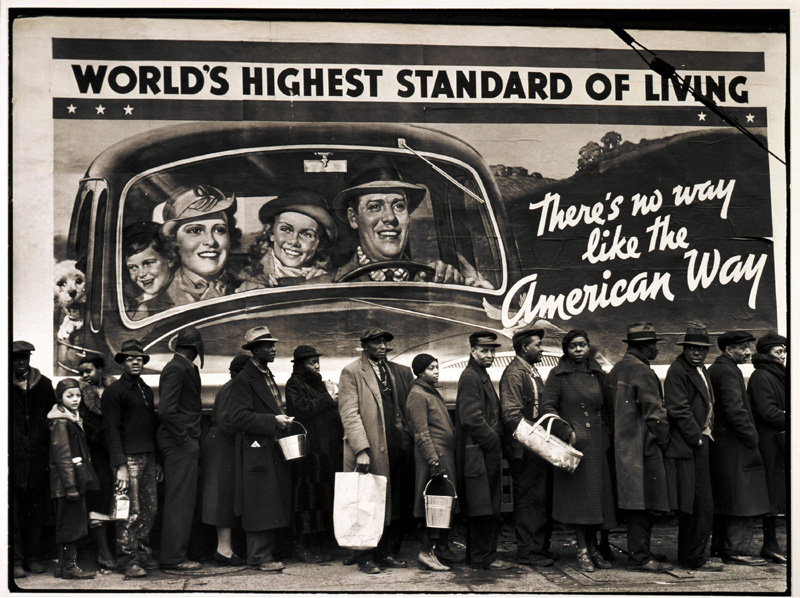
This 1937 photo by Margaret Bourke-White, provided by the George Eastman House Collection, shows black flood victims in Louisville, Ky., standing in a bread line. It is among the vintage photographs that Eastman House is sending on a three-year exhibition tour of America that includes a 2009 stop in Tulsa, Okla.
ROCHESTER, N.Y. ? Marilyn Monroe leans against a wall, her shoulders bared in a sexy dress. Babe Ruth, bat in hand, sits alone in the dugout. Angela Davis peers from a “Wanted by the FBI” poster.
To look some of America’s cultural icons in the eye, take a trip to Zanesville in Ohio’s Appalachian foothills. Or try Hanceville, population 2,900, in rural Alabama.
A treasured collection of vintage photographs usually ensconced in the climate-controlled vaults of George Eastman House, the world’s oldest photography museum, is shipping out on a three-year tour of the nation’s hinterland.
The government-funded impulse? Share the best of America’s heritage with communities outside the major arts centers. The outlook? Next to painting, dance and even musical theater, photography is sure to draw some of the biggest crowds.
“Photographs look like the truth and they feel like memory,” said Alison Nordstrom, the museum’s photography curator. “I do think that for a lot of people, looking face to face into the eyes of Babe Ruth, there is that magic. It’s as though you and he were alive at the same time.”
The exhibition “Seeing Ourselves: Masterpieces of American Photography” will spend two to four months at a time in 10 small cities and towns in the next three years. It opened Friday in Pensacola, Fla.
It will wend its way from east to west and back again this year, hitting Monterey, Calif., in late May and Columbia, S.C., in mid-September. It will journey next year from Zanesville in the spring down to Jackson, Miss., Hanceville and Lafayette, La., and spend 2009 in Tulsa, Okla., Oshkosh, Wis., and Fort Wayne, Ind.
“We could serve quite a wide audience in sort of the Appalachian area of southeastern Ohio and West Virginia,” said Susan Talbot-Stanaway, director of the Zanesville Art Center, which usually draws about 30,000 visitors a year.
“I would be surprised if we don’t get 20,000 for this (two-month) show,” she added, including many people who aren’t regular museum patrons and “think of art as being an urban phenomenon.”
The 156-photo show is part of a project supported by $5.5 million in grants from the National Endowment for the Arts to send world-class visual arts, dance, literature, choral music and musical theater to more than 150 somewhat-out-of-the-way places, from Bozeman, Mont., to Savannah, Ga., to Portland, Maine.
Other participants in “American Masterpieces: Three Centuries of Artistic Genius” include the Kansas City Repertory Theatre, Dallas Museum of Art, New York’s Museum of Arts & Design and Virginia Symphony.
The biggest grant of $200,000 went to Eastman House, a museum in the colonial revival mansion of Kodak founder George Eastman where more than 400,000 highly valued photographs have been gathered since 1949.
Photography might be a highly accessible art form, but devotees know that seeing original images, some dating to the early days of photography, is incomparable even as reproductions become ubiquitous.
“I’ve visited museum after museum around the world. I love art and photography, so I know how different it is to see it in a book than in person,” said Kristen Holmes, who helped lure the exhibition to George C. Wallace State Community College in Hanceville, 40 miles north of Birmingham.
“It’s kind of the same way with a musical performance. It’s much different to hear it on the radio than it is to attend a live performance,” she said. “This is something I’d like to see museums do more of, expose people to art in a way they wouldn’t ordinarily experience.”
National
Unhealthy air quality in California city as huge warehouse fire burns for 3rd day
Judge orders Trump administration to restore National Park changes at sites that ‘disparaged’ US
Teens’ reading and math scores have stagnated, US test results show
WASHINGTON (AP) — Younger students have regained ground academically after the pandemic's disruptions while older ...

Lawyers for man accused of killing Charlie Kirk try to block death penalty
Trump’s name poised to come off Kennedy Center
