Green Zone among bombing sites
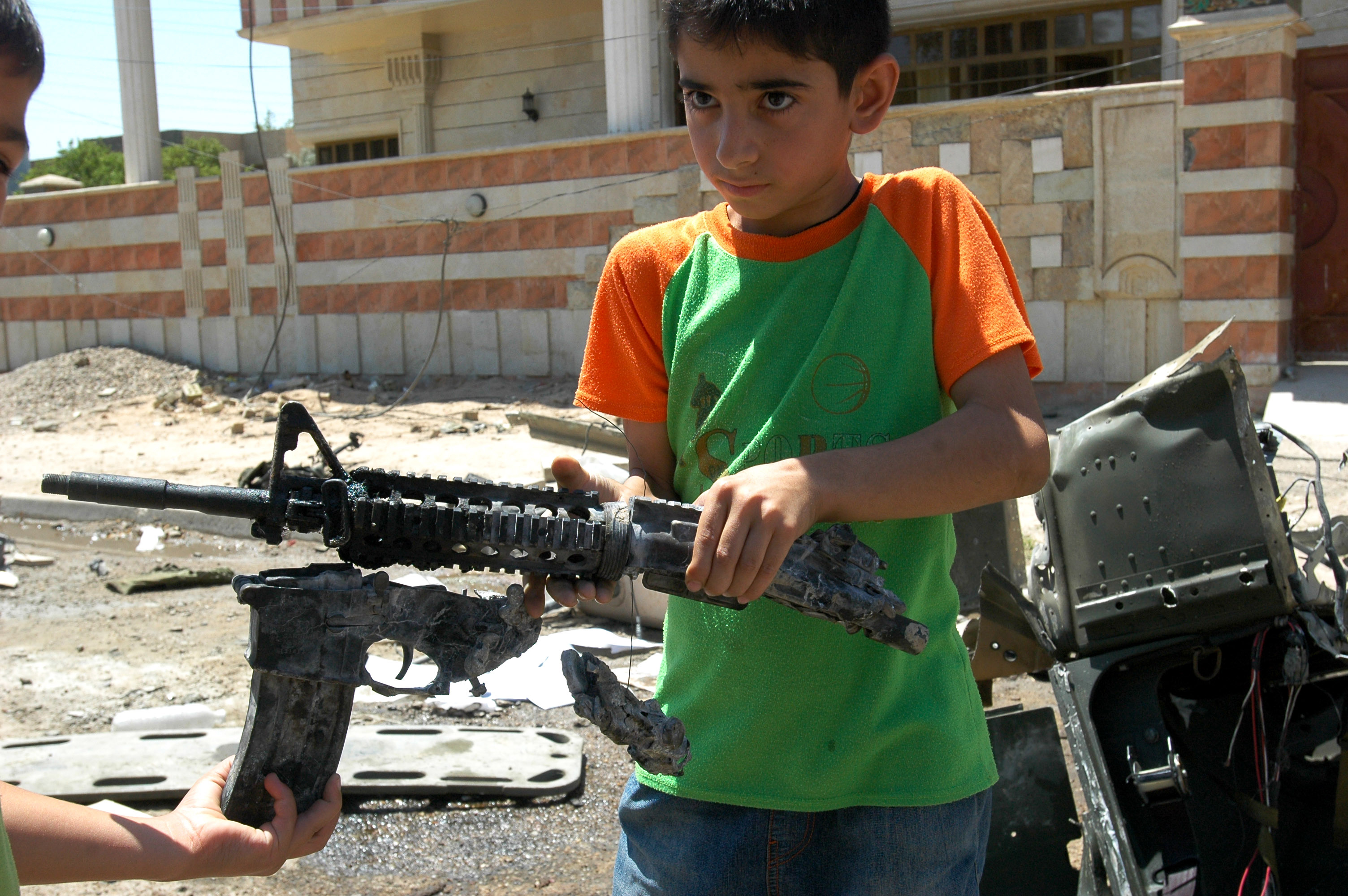
An Iraqi boy holds a melted American M-16 assault rifle after a roadside bomb struck a U.S. military convoy in al-Jamiah area in western Baghdad. One Humvee was destroyed in Thursday's blast, but there were no reports on the casualties.
U.S. deaths
As of Thursday, at least 3,545 members of the U.S. military have died since the beginning of the Iraq war in March 2003, according to an Associated Press count.
Baghdad ? The U.S. command announced Thursday the deaths of 14 more American troops, most killed in powerful roadside bombs in Baghdad. Thick, black smoke rose from the heavily fortified Green Zone after a mortar barrage as militants struck back despite a massive military offensive.
But as always, attacks claimed far more Iraqi lives.
A suicide truck bombing outside the Sulaiman Bek city hall in a predominantly Sunni area of northern Iraq killed at least 17 people, including the mayor, and wounded 66, officials said. Blame fell on al-Qaida, which has targeted government officials it accuses of collaborating with U.S. forces and the Iraqi government by participating in the political process.
“The enemy’s going to push back, he’s going to try and make us look unsuccessful,” military spokesman Lt. Col. Christopher Garver said. “We have said it’s going to be a long, tough fight over the summer. This is part of that long, tough fight.”
At least 15 servicemen have been killed since Tuesday, including 12 in a series of attacks beginning Wednesday. The military previously had announced one of the deaths.
The deadliest attack was a roadside bomb that struck a convoy Thursday in northeastern Baghdad, killing five U.S. soldiers, three Iraqi civilians and one Iraqi interpreter, the military said. About 12:30 p.m. the same day, a rocket-propelled grenade struck a vehicle in northern Baghdad, killing one soldier and wounding three others.
The U.S. military has sought to seize the momentum against al-Qaida and other militants with the arrival in Iraq of some 30,000 additional troops. It has launched several large-scale operations.
But the military also has faced a series of recent attacks on U.S. forces who are more vulnerable as they increasingly take to the streets and remote outposts, and the bombs appear to be growing more powerful. Some U.S. soldiers have reported a recent increase in the use of rocket-propelled grenades.
Garver said one of the aims of the latest offensives was to deprive militants of their safe havens where they have been able to assemble huge quantities of explosives.
“We have seen in some instances the enemy having the ability to build a bigger bomb in the areas that we have not habitually operated in because they’ve got more time to do that,” he said. “We’re looking to take that ability to build a bigger bomb away from the enemy.”
National
Lawyers for man accused of killing Charlie Kirk try to block death penalty
Trump’s name poised to come off Kennedy Center
Suspect in Texas shooting had fired at police days earlier, officials say

Man pleads guilty to killing a top Minnesota Democrat and her husband
New tornadoes outside Chicago as severe storms pummel the Midwest