Room with a view: Glass house open to public
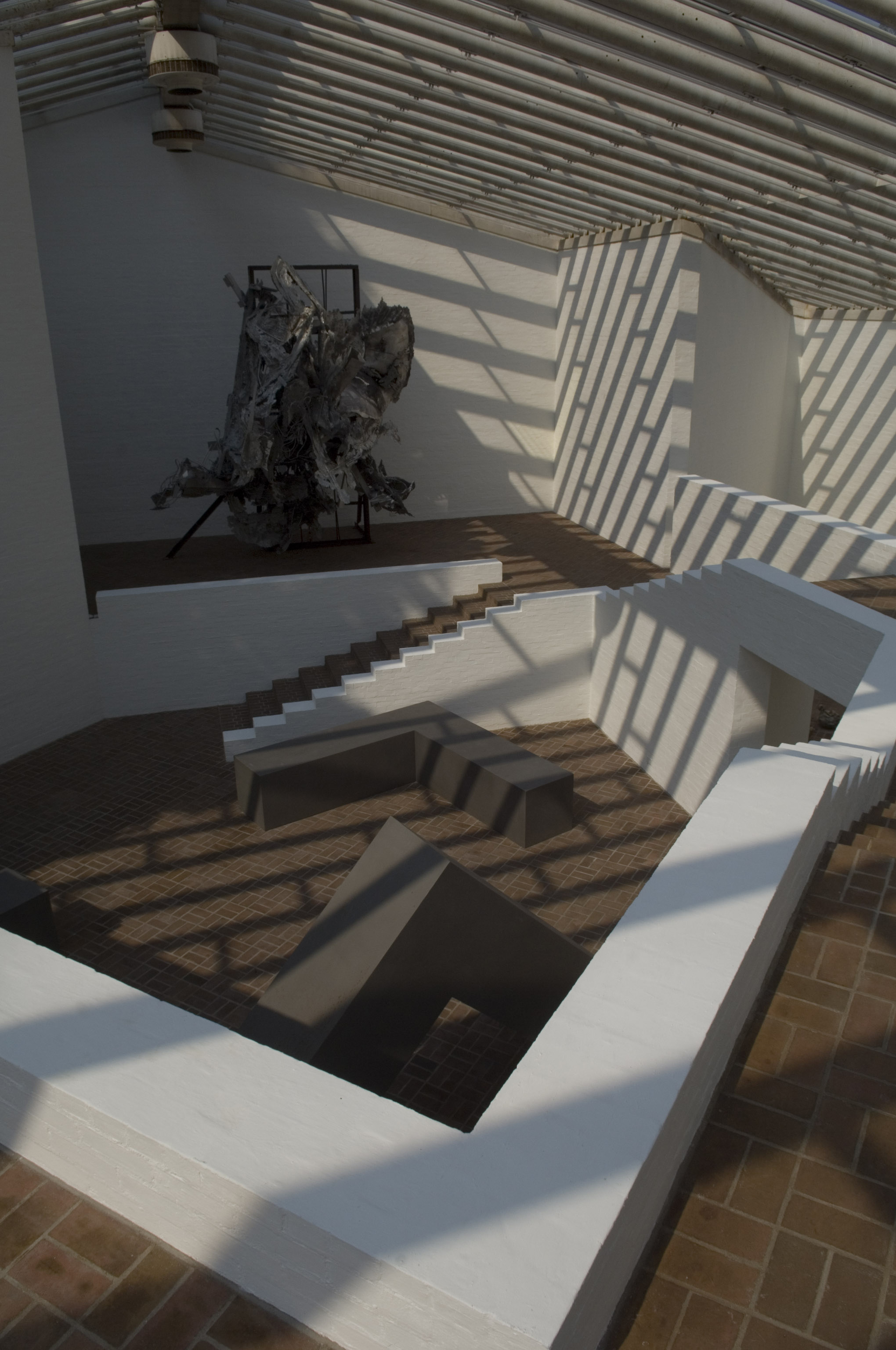
The Sculpture Gallery was built in 1970 by Philip Johnson. It is among buildings, including Johnson's famous Glass House, that are being opened to public tours of the late architect's estate in New Canaan, Conn., this month. At top is a sculpture by Frank Stella, and at bottom is a work by Robert Morris.
New Canaan, Conn. ? By design, Philip Johnson’s iconic Glass House evokes openness and accessibility.
For decades, however, only the late architect’s friends and guests could visit the famed 1949 home and explore the surrounding 47 acres of New England countryside.
That changed when invitation-only tours of the Glass House began this spring, and the structure deemed a harbinger of U.S. modernist design opens to the public starting June 23.
The tours also include many of the property’s 13 other structures – several of which are architectural showpieces in their own right – and acres of ponds, landscaped hills and walkways.
Most of the 2007 season tour tickets, ranging from $25 to $40, sold out right away, and potential visitors are already seeking spots for the 2008 season. The enthusiasm is considered a testament to the site’s cultural importance and to Johnson, winner of his profession’s top awards and designer of several of the most notable structures nationwide, including the AT&T Building in New York, the soaring glass Crystal Cathedral in Garden Grove, Calif., and the 56-story pink granite Bank of America building in Houston.
Johnson won the prestigious Silver Medal from the Architectural League of New York for the Glass House, yet always considered the transparent cube much more than a professional triumph. It was also his muse, showcase for art and the emotional refuge he shared with his longtime partner, art collector David Whitney.
Johnson died in the Glass House in January 2005 at age 98 while the 66-year-old Whitney died five months later of cancer in New York. The National Trust for Historic Preservation acquired the property under a 1986 agreement with Johnson, and both men endowed money for its preservation and operation as a museum.
The tours start at a new visitor center in downtown New Canaan, where a shuttle takes guests for a short ride to the property.
Johnson, a master of “the reveal” long before television makeover shows embraced the concept, lined his property’s main walkway with white pines to obscure the view ahead. With a few steps around a curve, the full effect of “the reveal” strikes visitors with their first look at the Glass House.
Approached at an intentional angle, the rectangular home sits surrounded by a natural vista of hills and greenery – a view that Johnson affectionately called his “very expensive wallpaper.”
Containing just the minimal trappings of daily life, only clear panes separate people inside from the scenes of pastoral New England.
A brick cylinder hides a fireplace on one side and a bathroom on the other. Simple modernist furnishings by designer Ludwig Mies van der Rohe provide lounging spots, and an austere marble-topped dining table at one end of the home is balanced by a leather-topped desk at the other.
Accommodations were made for pragmatism, such as the inclusion of a system to radiate heat from the floor and ceiling. It made the structure livable even in the depths of winter, although even Johnson – whose professional success and family wealth shielded him from money woes – acknowledged the bills were exorbitant.
A few steps away from the Glass House, a 1949 structure known as the Brick House offers in solitude what the transparent cube provides in openness. With silk-covered wall panes to block the light from its circular windows, it was often Johnson’s refuge for naps or contemplation.
The nearby Sculpture Gallery, built in 1970 and home to an eclectic collection of art forms and themes, was another favorite contemplation spot for Johnson and Whitney. Today, guests are limited to viewing the expansive interior from a site just inside the entry rather than traversing the series of stairs that jut at 45-degree angles from the walls.
The tour concludes at the 990-square-foot, black and red modernist structure that Johnson completed in 1995 and deemed, “Da Monsta.” Built in what he called the “structured warp,” it is inspired by Stella’s work and intended to resemble a sculpture with uneven forms and no continuity to the angles.
National

Lawyers for man accused of killing Charlie Kirk try to block death penalty

Trump’s name poised to come off Kennedy Center

Suspect in Texas shooting had fired at police days earlier, officials say
Man pleads guilty to killing a top Minnesota Democrat and her husband

New tornadoes outside Chicago as severe storms pummel the Midwest