Al-Sadr reasserts authority over Shiite militia movement
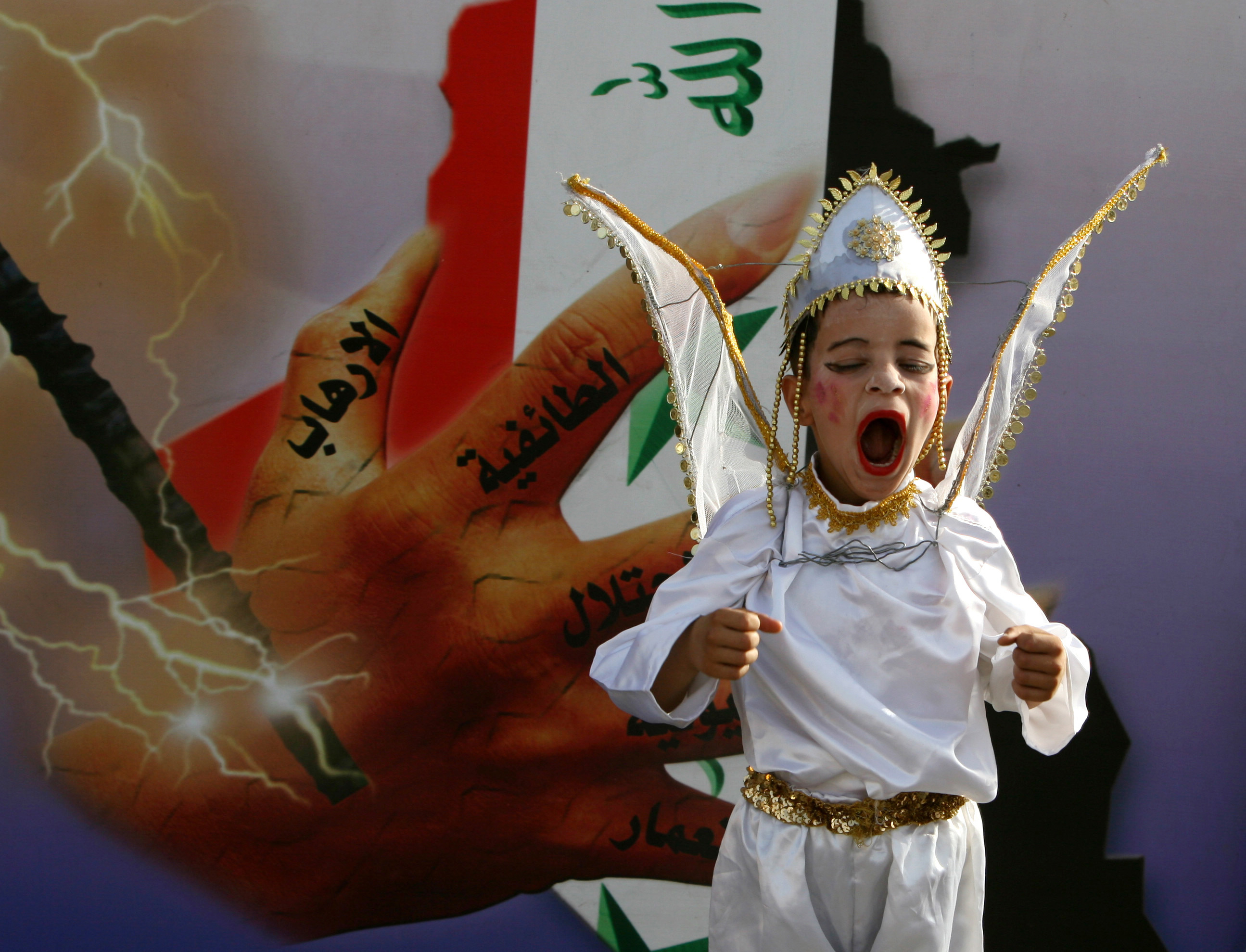
An Iraqi child, dressed as a white dove symbolizing peace, performs during a fourth anniversary celebration of Iraq's most powerful militia, the Mahdi Army, in the Shiite enclave of Sadr City in Baghdad. The writing on the fingers on the poster in the back reads, from top, terrorism, sectarianism, occupation.
Baghdad ? The anti-American Shiite Muslim cleric Muqtada al-Sadr is reasserting authority over his movement after disappearing from public view for three months.
A top Sadr aide, Salah al-Obaidi, said Monday that since Sadr had reappeared during religious services two weeks ago at a shrine in Kufa, he’d replaced 11 local leaders of his movement, including two in Baghdad.
Obaidi, who speaks to Sadr regularly and is considered his spokesman, also disavowed what appears to be a final push by Sadr’s militia, the Mahdi Army, to seize control of contested neighborhoods in south and west Baghdad, where Shiite forces are pressing a campaign to push out Sunni Muslims. He said local leaders in the Bayaa and Amil neighborhoods had acted without orders from Sadr.
“Sayed Muqtada refuses all kinds of violence and he refuses to answer violence with violence,” Obaidi said. “Sayed” is an honorific used for descendants of the Prophet Muhammad.
Where Sadr went during the months he dropped from sight is still debated. U.S. officials said that the young cleric – he’s thought to be in his early 30s, though his precise age hasn’t been publicized – had fled to Iran in February as the U.S. began building up troops to stanch sectarian violence in Baghdad. His supporters say he never left Iraq.
What isn’t contested, however, is the impact of his absence. U.S. and Sadr officials say the movement fragmented while he was away.
“We have seen a fracturing of Jaysh al-Mahdi in the last few months. We see elements acting on their own,” U.S. military spokesman Lt. Col. Chris Garver said, using the Arabic for Mahdi Army. “He may be trying to prevent that. It could be a positive thing for Iraq, the coalition and the Iraqi people or it could be a negative thing, depending on how these new leaders are going to behave.”
Obaidi acknowledged that there’d been “complaints” that some of the replaced leaders had been involved in kidnapping and killing Sunni men and that some of the leaders had “committed mistakes.” He denied, however, that that was the reason for the overhaul. He declined to be specific about what mistakes the leaders had made.
Other Sadr loyalists said some local officials had taken actions that Sadr hadn’t approved.
“Many of the people in the Sadr trend are not real Sadrists and they don’t have a real belonging to the Sadr front,” said Sheik Abdul Hadi al-Mohammadawi, the head of the Sadr office in Karbala, a major Sadr stronghold. “They corrupted the reputation of the Sadr office.”
News of the purge comes amid other signs that Sadr intends not only to assert primacy over Shiite politics but also to claim the leadership of a Sunni-Shiite coalition to oppose a continued U.S. presence in Iraq. The move comes as the government of Prime Minister Nouri al-Maliki appears incapable of major action and the parliament is in turmoil.
Parliament has yet to discuss any of the legislation necessary to meet benchmarks that U.S. officials have set. On Monday, the parliament speaker, Mahmoud al-Mashhadani, a Sunni, was forced to resign after his guards manhandled a member of the Shiite United Iraqi Alliance, Firyad Mohammed Omar.
National
Unhealthy air quality in California city as huge warehouse fire burns for 3rd day
Judge orders Trump administration to restore National Park changes at sites that ‘disparaged’ US
Teens’ reading and math scores have stagnated, US test results show
WASHINGTON (AP) — Younger students have regained ground academically after the pandemic's disruptions while older ...
Lawyers for man accused of killing Charlie Kirk try to block death penalty
Trump’s name poised to come off Kennedy Center