

Was life on Mars found, destroyed?
Researcher thinks alien microbes may not have been recognized in 1970s
Washington ? Two NASA space probes that visited Mars 30 years ago may have stumbled upon alien microbes on the Red Planet and inadvertently killed them, a scientist theorizes in a paper released Sunday.
The problem was the Viking space probes of 1976-77 were looking for the wrong kind of life and didn’t recognize it, the researcher said in a paper presented at a meeting of the American Astronomical Society in Seattle.
This new report, based on a more expansive view of where life can take root, may have NASA looking for a different type of Martian life form when its next Mars spacecraft is launched later this year, one of the space agency’s top scientists told The Associated Press.
Last month, scientists excitedly reported that new photographs of Mars showed geologic changes that suggest water occasionally flows there – the most tantalizing sign that Mars is hospitable to life.
In the ’70s, the Viking mission found no signs of life. But it was looking for Earth-like life, in which salt water is the internal liquid of living cells. Given the cold dry conditions of Mars, that life could have evolved on Mars with the key internal fluid consisting of a mix of water and hydrogen peroxide, said Dirk Schulze-Makuch, author of the new research.
That’s because a water-hydrogen peroxide mix stays liquid at very low temperatures (-68 degrees Fahrenheit), doesn’t destroy cells when it freezes, and can suck scarce water vapor out of the air.
The Viking experiments of the ’70s wouldn’t have noticed alien hydrogen peroxide-based life and, in fact, would have killed it by drowning and overheating the microbes, said Schulze-Makuch, a geology professor at Washington State University.
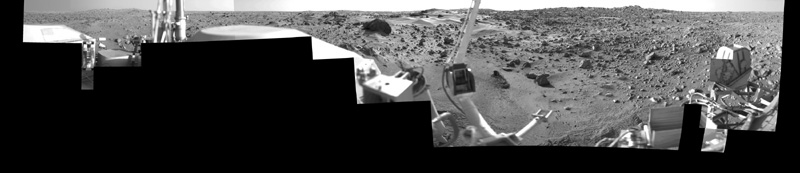
This photo mosaic provided by NASA shows Chryse Planitia, a smooth circular plain in the northern equatorial region of the planet Mars, and was created using frames taken by the Viking 1 Camera 1 on Aug. 8, 1975. A scientist theorizes in a paper released Sunday that NASA probes, including the Viking probes, that visited Mars 30 years ago may have stumbled upon alien microbes on the Red Planet and inadvertently killed them.
“The problem was that they didn’t have any clue about the environment on Mars at that time,” Schulze-Makuch said. “This kind of adaptation makes sense from a biochemical viewpoint.”
In recent years, scientists have found life on Earth in conditions that were once thought too harsh, such as an ultra-acidic river in Spain and ice-covered lakes in Antarctica.
Schulze-Makuch’s research coincides with work being completed by a National Research Council panel nicknamed the “weird life” committee. The group worries that scientists may be too Earth-centric when looking for extraterrestrial life. The problem for scientists is that “you only find what you’re looking for,” said Penn State University geosciences professor Katherine Freeman, a reviewer of the NRC work.
Arts and Entertainment

Photos: Lawrence begins World Cup festivities with downtown block party

Watkins Museum to open special exhibit detailing how Douglas County celebrated America’s Bicentennial

Go, See, Do: Kaw River Roots Festival, markets and more

Soccer gear honoring Lawrence history’s all-star team is now on sale as part of city’s public art exhibition

Nominations, call for artists open for Lawrence’s 2026 Phoenix Awards