‘Finger-shaped’ growth pattern urged for city
Consultant says green space should be included
Lawrence should not grow like a fried egg.
Most cities, like eggs dropped in a frying pan, are designed to grow in ever enlarging circles that eat up whatever is in their path, Nathan Norris, a planning consultant hired by city commissioners, told city leaders Friday.
Instead, Lawrence and other cities should start writing codes that allow cities to expand outward in nodes or narrow fingers that would be connected by green space and agriculture.
“People want to be able to step into nature and then step back into their city,” Norris said.
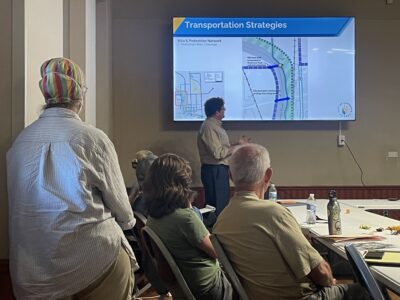
City leaders and community residents soon will have plenty of chances to discuss whether that’s how Lawrence wants to grow. Norris was in town Friday preparing for a weeklong community workshop that will run from Jan. 31 to Feb. 6. At the end of the workshop, city commissioners will have a set of draft codes that could be used by developers to create new mixed-use districts of residential, retail, office and park space that are difficult to build with the city’s existing regulations.
The workshop will include about 20 planning experts from across the country who will be taking public comment and working with developers, neighborhood leaders and city staff members on how to design the new regulations, which would have to be adopted by the City Commission before becoming effective.
“We think this will help Lawrence grow in a little more traditional pattern, in a pattern that allows areas of town to be connected a little bit better,” said Dan Warner, the city’s long-range planner who is overseeing the workshop.
Whether the ideas will be accepted by developers and the community is one of the key questions the consultants hope to find out at the workshop. Norris insisted the new codes wouldn’t be about stifling development, but rather would give developers more options.
But he did say city commissioners could create zones where certain types of development would be prohibited. For example, he said well-planned communities create clear separations between the areas of town that will develop in an urban style versus those that will develop in a suburban or rural style. Each zone would have different types of design guidelines to ensure that suburban style development didn’t end up in an urban area or vice versa.
“I don’t think you would have to say no to many things,” Norris said. “Instead, you would just be saying ‘no, not here.'”
Ultimately, Norris said he thought the process could create less conflict in the planning and development arena.
“You have leadership here, who instead of playing catch up all the time, wants to agree up front about how the community is going to grow,” Norris said. “It will eliminate a lot of conflict if you can agree on issues up front.”
The consultants will make an opening presentation to the community at 6:30 p.m. Jan. 31 at City Hall. They’ll also be hosting daily listening sessions with community members Feb. 1-4 at the SpringHill Suites by Marriott, 1 Riverfront Plaza.
City commissioners in November unanimously agreed to pay the consulting firm, PlaceMakers Inc., $251,500 to conduct the workshop and create the new codes.
New city planning process
City Government
Developer seeks incentive from City of Lawrence to build 131 units of housing near Wakarusa and Queens

Lawrence city leaders will consider whether to keep Community Building open, make 2 other rec centers free to access
A STAR Bond application raises questions for city leaders about Costco and housing west of the SLT

Soccer gear honoring Lawrence history’s all-star team is now on sale as part of city’s public art exhibition
To honor public servants, Lawrence’s July 4 celebration will have a whole gallery of their photos on display; submissions open now