Drawn to the desert
Stillman uncovers a brighter side of 'Palms'
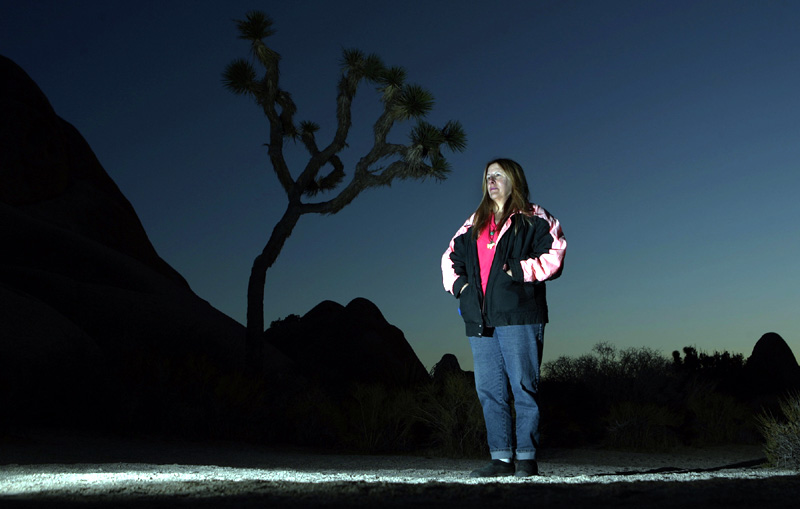
Author Deanne Stillman's first book was an account of the rape and murder of two girls in Twentynine Palms, Calif., and a disquieting look at the town's link to the Marine base nearby.
The last time Los Angeles writer Deanne Stillman published a book on Southern California’s desert region, she was met with angry editorials in a local paper, a bitter letter-writing campaign and complaints from locals. Some desert-dwellers said her dark view of the place would drain the area of its lifeblood: tourism.
That book, “Twentynine Palms,” a tense best-seller, recounted the 1991 rape and murder of two local teenage girls by a Persian Gulf War veteran stationed at the world’s largest U.S. Marine Corps base. The book’s characterization of the military presence, such as her description of “the never-ending Marine war against female civilians,” also drew protests.
Six years later, on a recent evening, Stillman returned to the desert for a low-key event at the 29 Palms Inn and the welcome was warmer.
“She nailed Twentynine Palms with that book,” whispered Bruce Miller, an environmental engineer who once worked on the base. “I was surprised to hear she was coming here tonight. Very happy to be able to meet her.”
As Stillman read from her new book, “Joshua Tree: Desolation Tango,” making frequent asides about Joshua Tree National Park and threats to its flora and fauna, she was greeted like a hometown hero. Afterward, a local man announced that he found the new book “an enchanting piece of poetry about a personal journey.” A high school friend of Mandi Scott, one of the slain girls, went up to shake the author’s hand.
The reading’s sponsor, Steve Brown, who publishes the Twentynine Palms-based Sun Runner magazine, said Stillman was uncomfortable when he asked her to be part of the magazine’s literary series.
“She was a little hesitant about what kind of welcome she’d receive in Twentynine Palms,” said Brown, who added that the magazine was flooded with e-mails objecting to the visit.
“They’re very protective of the town out here,” Brown said. “There are a lot of hard feelings.”
Praising the misfits
Stillman’s new book takes a friendlier look at the desert region. Part of the University of Arizona’s “Desert Places” series, the book is a hybrid – part paean to the desert, part personal meditation, part essay. The writing may be uneven, but it’s clear that Stillman has become one of the region’s leading literary voices.
The morning after the reading, Stillman hiked through the area called “Wonderland of Rocks,” with its dramatic outcroppings of wind-sculpted stones. She recounted the forces that drew her to the desert, thousands of miles from the Cleveland of her birth, where, she said, “I never felt at home, I never liked the climate. I never liked ice fishing.”
As a girl, “I would send away for seeds and little plants from Cactus Jack’s mail order, and put them up on the windowsill. And I’d watch them against the glass during these East Ohio blizzards coming off the lake. They just always made me happy: They conjured up this land of escape.”
Stillman had reason to want to escape: She lived for a time with her lawyer father and sculptor mother in a comfortable part of the city, but their divorce sent the family to a less genteel area near the local racetrack, where her mother worked.
“We would hang out at the track when we were kids and meet all of these great characters – classic misfits – Appalachian jockeys, grooms from the South – all sorts of people who didn’t fit in anywhere but the track. And our move rendered us social pariahs. Even some of our own relatives wouldn’t speak to us.”
Stillman uses “misfits” as a term of praise, applying it not only to herself but to the desert’s plants and animals, some of which don’t exist anywhere else but the park.
“I’ve always been simpatico with people who are not conventional. And I’ve always had a deep identification with people who’ve had turmoil and trouble in their lives,” she said.
Honesty and obstinacy
Some of this sensibility drew her to Mandi Scott and Rosalie Ortega, the two working-class girls whose murders formed the basis for “Twentynine Palms.”
While researching that book showed her the town’s dark side, its world of drugs, drinking, violence and early sex, she’s most interested these days in the park – the 1,200 square miles where the Mojave and Colorado deserts come together.
“Look at what trees have to do in order to live,” said Stillman, who’s known in L.A. literary circles for determination verging on obstinacy. “They have to burst through the rocks. I get a lot of inspiration from all the things that endure out here. If they can last through these conditions – I’m talking about our own personal storms, not just literally bad weather.”
She also praises the desert’s honesty.
“In the desert there’s more of a direct route to things: There’s not velvet rope you have to cross,” she said. “There’s not much guile in the desert, which doesn’t mean there’s no sophistication. But there’s less concern with idiotic L.A. concerns – ‘I can’t let the valet see my car’ – none of that stuff matters out here.”
What matters in the desert, for Stillman, is the parched, millenniums-old land: It looms larger than personality or sociology.
Driving much of Stillman’s writing – she’s also a widely published journalist, having written for the Los Angeles Times, Slate and Rolling Stone, with books coming on the Antelope Valley and the disappearance of wild horses from the American West – is what she calls “the power of place.”
She learned it from the essays of Wallace Stegner (who called the West “the geography of hope”), as well as her old professor Tony Hillerman, and other writers of the Western canon, including Black Elk and Mary Austen.
“To me, landscape and geography determine everything – about the people who live there, and even in some cases, about people who don’t,” Stillman said. “Landscape and space are what define the American character.”
Powerful landscape
Some critics found this deterministic approach – almost a throwback to 19th-century Naturalism – a problem in the otherwise well-reviewed “Twentynine Palms.” There, for instance, she referred to the Mojave as the “dry, baptismal font of national consciousness, mythological birthplace of America,” but she didn’t stop there. The desert, she wrote, “demands a blood sacrifice.”
Her own life has shown how powerfully shaping the landscape is. Even the American notions of individualism and personal rights come out of desert spaces and the cultures that settle there.
“Everybody from Jesus Christ to Timothy McVeigh to (19th-century frontiersman and horse thief Joseph) ‘Pegleg’ Smith has wandered through the desert and come out with ideas,” she said. “And all of those people have changed the world, one way or the other. … The desert says that’s all OK, for better or for worse.”
Arts and Entertainment

Watkins Museum to open special exhibit detailing how Douglas County celebrated America’s Bicentennial
Go, See, Do: Kaw River Roots Festival, markets and more
Soccer gear honoring Lawrence history’s all-star team is now on sale as part of city’s public art exhibition

Nominations, call for artists open for Lawrence’s 2026 Phoenix Awards
Go, See, Do: ‘Addams Family’, PRIDE parade and a host of library events among offerings