Report: Al-Qaida in Iraq leader injured; aide killed
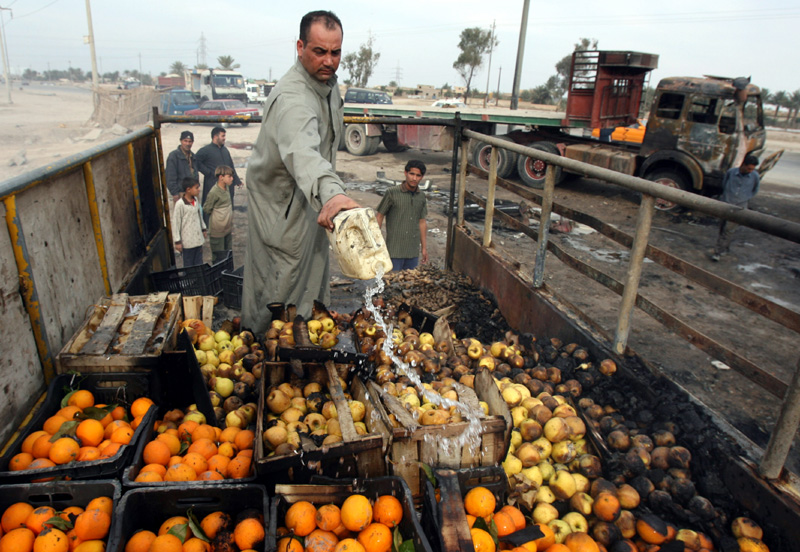
An Iraqi pours water over half-burned fruit while standing in his truck that was damaged in a car bomb blast Thursday in Baghdad, Iraq. Two parked car bombs struck the southern Baghdad Dora neighborhood, killing at least four civilians and wounding 15, police said.
U.S. Deaths
As of Thursday, at least 3,133 members of the U.S. military have died since the beginning of the Iraq war in March 2003, according to an Associated Press count.
Baghdad, Iraq ? U.S. and Iraqi forces pushed deeper Thursday into Sunni militant strongholds in Baghdad – where cars rigged with explosives greeted their advance – while British-led teams in southern Iraq used shipping containers to block suspected weapon smuggling routes from Iran.
Early today, a spokesman for the Interior Ministry said the leader of al-Qaida in Iraq, Abu Ayyub al-Masri, was wounded and an aide was killed in a clash the previous day with Iraqi forces north of Baghdad. However, the deputy interior minister said he had no information about such a clash, and two U.S. officials could not immediately confirm the report.
The series of car bomb blasts, which killed at least seven civilians, touched all corners of Baghdad. But it did little to disrupt a security sweep seeking to weaken militia groups’ ability to fight U.S.-allied forces – and each other – as Iraq slips further into factional bloodshed.
The attacks, however, pointed to the critical struggle to gain the upper hand on Baghdad’s streets. The Pentagon hopes its current campaign of arrests and arms seizures will convince average Iraqis that militiamen are losing ground. Yet each explosion is another reminder of the militants’ resources and resolve.
Most of the latest resistance has come from Sunni factions, which perceive their Saddam Hussein-era influence slipping away as the majority Shiites extend their political muscle and bolster ties to powerful Iran.
In Baghdad’s Dora neighborhood – a longtime Sunni militant hotbed – two parked cars wired with explosives were triggered as a joint U.S.-Iraqi patrol rolled past. The convoy was unharmed, but the blast killed at least four civilians and wounded 15.
Two other car bomb blasts came as security forces moved through the capital, killing at least three civilians.
Outside Baghdad, troops also faced Sunni ambushes. In Buhriz, about 30 miles northeast of the capital, Sunni gunmen and soldiers from the 1st Squadron, 12th Cavalry Regiment engaged in a 20-minute firefight.
U.S. Bradley fighting vehicles fired 25 mm rounds into homes shielding the gunmen, said an Associated Press reporter traveling with the unit.
No U.S. casualties were reported, and the militant toll was not known. Separately, however, a U.S. Marine was killed in combat in Iraq’s western Anbar province, a Sunni militant stronghold.
The announcement about the wounding of al-Masri, the al-Qaida in Iraq leader, came from Brig. Gen. Abdul-Karim Khalaf, an Interior Ministry spokesman. He said the clash occurred near Balad, a major U.S. base about 50 miles north of the capital, and identified the dead aide as Abu Abdullah al-Majemaai.
Al-Masri took over the leadership of al-Qaida in Iraq after its charismatic leader, Abu Musab al-Zarqawi, was killed in a U.S. airstrike in June in Diyala province northeast of Baghdad. In October, false reports surfaced that al-Masri was killed in a raid, and the U.S. military performed DNA tests on a slain militant to see if he was the al-Qaida leader.
National
Unhealthy air quality in California city as huge warehouse fire burns for 3rd day
Judge orders Trump administration to restore National Park changes at sites that ‘disparaged’ US
Teens’ reading and math scores have stagnated, US test results show
WASHINGTON (AP) — Younger students have regained ground academically after the pandemic's disruptions while older ...
Lawyers for man accused of killing Charlie Kirk try to block death penalty
Trump’s name poised to come off Kennedy Center