

Hundreds of vets interviewed for project
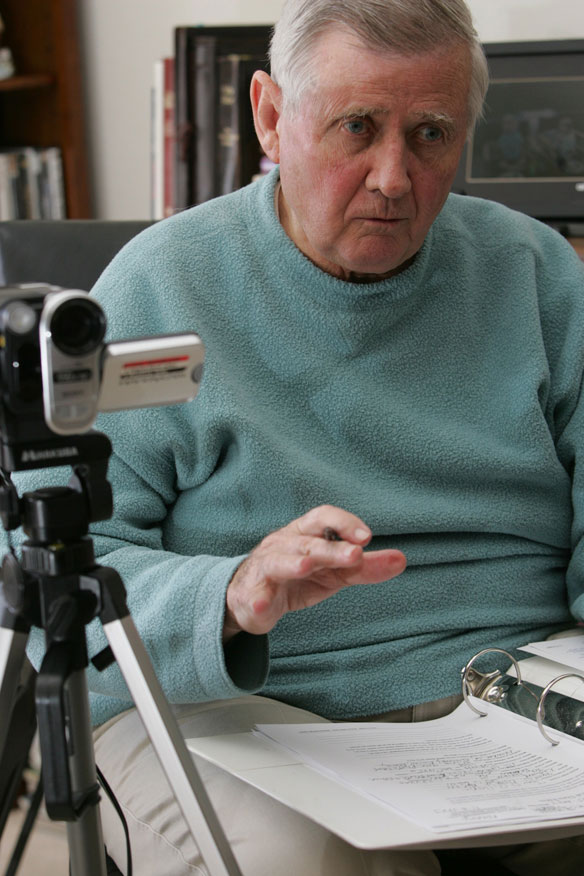
Gary Swanson conducts a videotaped interview of veteran John Gillespie for the Library of Congress on Nov. 15 in Leawood. Swanson, a 73-year-old retired marketing executive, volunteers for the Veterans History Project.
Leawood ? It’s quite possible that Gary Swanson has interviewed more World War II veterans than anyone in the world.
But it’s certain that the Leawood man is after quality, not quantity, when he collects war stories for the Library of Congress.
An interview is good, he says, when a veteran – most are in their 80s – reveals something he’s never disclosed to anyone.
That happens a lot these days, Swanson says.
Swanson is nearly a stranger when he arrives on a veteran’s doorstep, but quickly he becomes a confidant.
Veterans have shared images of corpses, stacked like cord wood, along roads in Europe. Memories of stuffing body bags at Normandy. Of seeing a buddy, standing right next to him, get hit with a sniper’s bullet or a mortar shell.
“They’ve become more willing to talk in the last five years than ever before,” Swanson said.
Swanson, a 73-year-old retired marketing executive, volunteers for the Veterans History Project, established in 2000 and operated by the Library of Congress in Washington.
So far, Swanson has videotaped more than 800 interviews in the Kansas City area. He spends his own money and time, and has logged 23,000 miles on a year-old car.
“There’s no question” that Swanson has done more interviews for the project than any of the 20,000-plus volunteers recruited so far, says Peter Bartis, a senior program officer for the Veterans History Project.
“I wouldn’t be surprised if he has done more than anyone” in the world, Bartis says.
Some volunteers have done 200 or 300 interviews, he adds, but that’s rare.
Swanson, who was never in the military, started interviewing veterans five years ago. He says he was looking for something meaningful to do.
“I was retired,” he says, “but wanted to wear out instead of rust out.”
Swanson makes two videotapes of each interview: one for the history project, the other for the vet’s family.
What drives Swanson is preserving the veterans’ memories for their relatives.
“The great-great-grandchildren of these men and women would never know their contribution to our country if I didn’t record their stories,” Swanson says.
The project collects stories from all modern wars. But because few World War I veterans are alive and more than 1,000 World War II veterans die every day, Swanson’s labors are particularly valuable.
He’s backed up for weeks with scheduled interviews. Often, it’s a wife or daughter who calls him.
In interviews, Swanson is not interested in the details, the history-book fodder. He’s after the emotions, the strong memories.
“The war was very important to these guys, but it’s only three out of 87 years in their life. They had a life before that and after that,” Swanson explains.
Swanson interviews women, too, nurses and service pilots among them.
This is how most interviews go: Swanson arrives at the veteran’s home. He records rank, time of service, medals earned and so on.
With formalities completed, Swanson places his camera on a tripod and takes a seat across from his subject.
“Everybody’s got a story,” he tells the vet, “so we’re going to get one from you today.”
The camera’s tiny red light blinks on, and the interview begins.
He tries to keep the focus away from politics or war strategy or the current war in Iraq, but sometimes the veterans address those issues.
“Generally speaking, the veterans are against the war,” Swanson says. “Anybody who’s seen war doesn’t want to see it again.”
State Government
State legislators push back against federal energy regulators ending competitive bids
TOPEKA — Two Kansas legislators asked federal energy regulators to ensure competitive bidding occurs on ...
Senate confirms 1st of 3 Kansas nominees to U.S. District Court
Corporate income tax collections falling sharply in Kansas; Republican, Democratic leaders disagree on what it means
TOPEKA — Corporate income tax collections in Kansas have almost halved since last year, while other sources trend ...
Candidate’s campaign manager created website with documents used to attack rival
TOPEKA — Kansas U.S. Senate candidate Patrick Schmidt’s campaign manager left his digital footprint on ...
GOP secretary of state files to run for governor
