Archive for Wednesday, August 29, 2007
Katrina amplifies troubles that exist in all towns
August 29, 2007
Advertisement
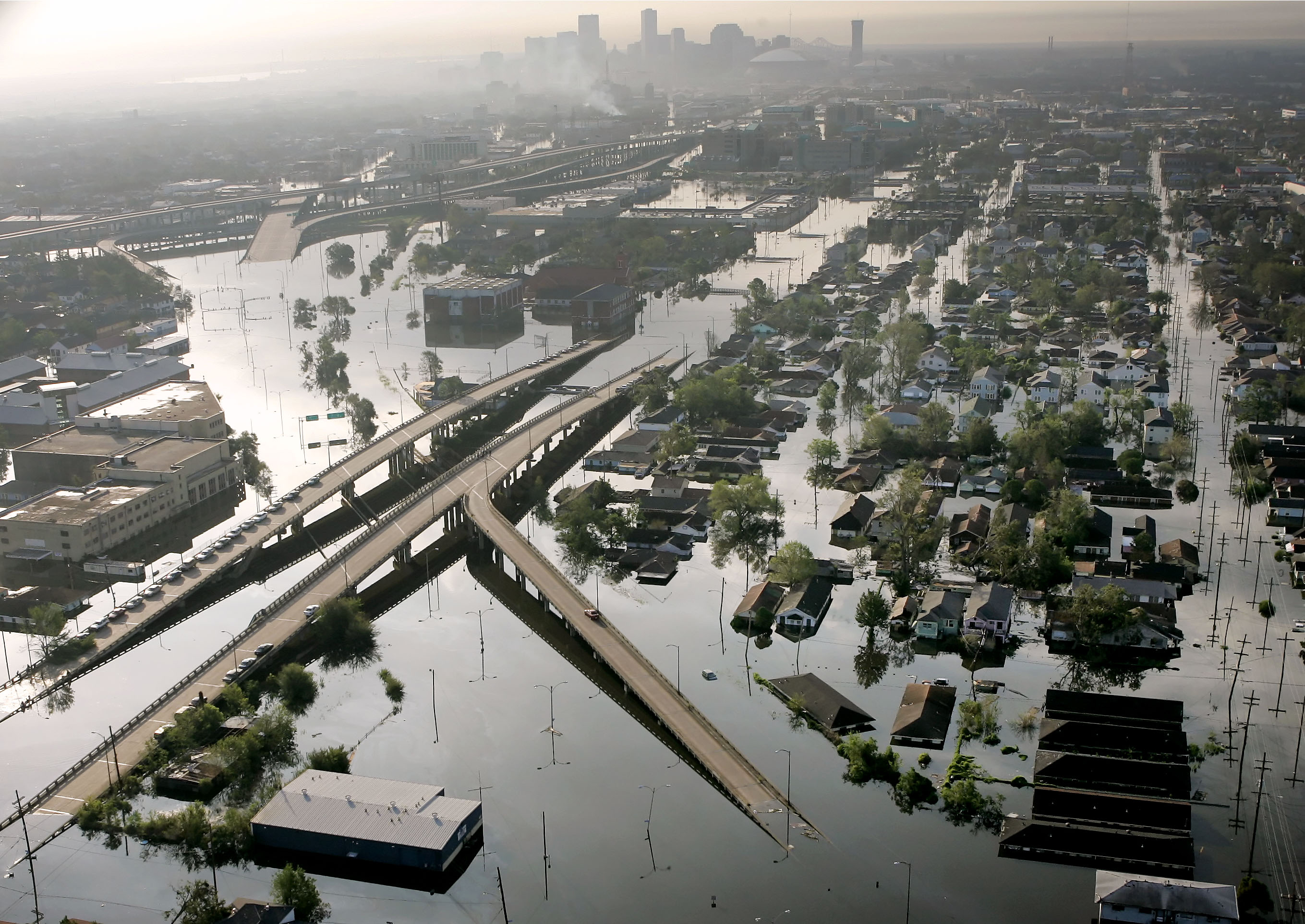
Floodwaters from Hurricane Katrina fill the streets near downtown New Orleans in this Aug. 30, 2005, file photo. Despite billions of dollars in aid, recovery programs with catchy names and an outpouring of volunteer effort, New Orleans is barely recovering from Hurricane Katrina two years later.
New Orleans Katrina is old news, right? New Orleans - who cares? It's just another big city with big problems, bad luck and bad weather. Get over it.
Actually, please don't.
Don't ever get over the tragedy of New Orleans. It's your tragedy, too.
What happened to this historic city two years ago is more than the obvious cautionary tale of what might befall your community after a natural disaster or a terrorist strike. It's also a sad reflection of what's happening now - today, in your hometown and across an anxious and ailing nation.
Inadequate health care.
A housing crisis.
Crumbling infrastructure.
Racial division.
Poor schools.
And at the core of these and other problems threatening our way of life: a pernicious failure of leadership.
Katrina did more than claim lives and property. It ripped away the glitzy veneer that made New Orleans' reputation and exposed a festering brew of problems lingering beneath - problems endemic to the rest of the nation, begging for attention, if we only had the guts to look.
If this country can't help New Orleans rebound - if we and our leaders break the promises made to its residents - what are the odds your health care will ever get cheaper? Your bridges safer? Your schools better?
"If you study what's going on in New Orleans, it's just an exaggerated version of what's hitting us in many areas of the country," said historian Douglas Brinkley, author of "The Great Deluge," a book about Katrina. "Just pick your topic."
OK, let's start from the top.
For your health
Katrina made a bleak health-care system worse in New Orleans. The death rate jumped 47 percent after Katrina as a city of 270,000 mostly poor and middle-class people lost seven of 22 hospitals and more than half of its hospital beds. Nearly 4,500 doctors were displaced from three New Orleans parishes.
The lack of space for mental patients has caused problems for police departments, who have complained of having to use officers' time to drive from hospital to hospital looking for vacant beds.
Dr. Atul Gawande, a local surgeon and author, said the city's medical system is in a "death spiral" that is more rapid - but no less certain - than the crash course the rest of the nation is on.
It goes like this:
People rely on employers for health insurance. They lose their jobs. They lose their insurance. They can't afford their pills. They put off doctors' visits. Minor illnesses become major. They go to the emergency room. The emergency overflows with uninsured patients. The hospital loses money. Insurance rates skyrocket. The hospital shuts its emergency room. Uninsured patients crowd other ERs. Doctors leave town. Businesses leave town. Jobs are lost. Repeat.
New Orleans is just one city in a country with more than 43 million uninsured, a figure that increased 2 million from 2005 to 2006, according to the Centers for Disease Control and Prevention. Nearly 20 percent of working-age Americans did not have health insurance in 2006.
The percentage of uninsured among the 20 largest states ranged from 7.7 percent in Michigan to 23.8 percent in Texas.
"What you see in New Orleans is the extreme of what happens when you live in a flawed health care system. And all of us do," said Gawande, author of "Better," a book about the system's failures. "It's a slow-motion train wreck."
No roads home
The homeless population of New Orleans has nearly doubled since before Hurricane Katrina. Many of the poor, mentally ill and drug-addicted are squatting in the city's estimated 80,000 vacant dwellings.
Tens of thousands of other people are a bit luckier, living in badly damaged homes, government trailers and out-of-state apartments.
The state and federal governments are in a petty fight over how to fund the Road Home program, which is supposed to help people repair and rebuild houses.
With 183,000 people applying for the aid, the Road Home program's needs exceed its budget by about $5 billion.
Nationally, ill winds are stirring up a crisis that sharp eyes saw coming. The combination of higher interest rates and weaker home values has clobbered homeowners, especially those with higher-risk subprime mortgages.
Hundreds of thousands, maybe millions of borrowers, stand to lose their homes while Washington and the media obsess over the impact on Wall Street.
Bridges falling down
The New Orleans levees were not built to withstand a sizable hurricane, a historic lapse of judgment and competence topped only by this: The levees are still not ready for the next serious storm.
The city's 3,200-mile system of water and sewer lines were old, leaky and in need of repair long before the hurricane. The crush of pipe-corroding salt water made things worse.
Miles of New Orleans streets were destroyed or damaged by the storm, and remain in disrepair because the city failed to give the federal government a to-do list.
This can't be much comfort to the people of Minnesota, where the collapse of an Interstate 35W bridge killed at least 13. President Bush toured the site, promising to cut red tape and rebuild.
Just as he toured New Orleans, making promises to be broken.
From New York to California, cities are raising utility rates and issuing bonds in hopes of modernizing public works systems straining under increasing populations. The American Society of Civil Engineers estimates that $1.6 trillion is needed over a five-year period to bring the nation's water systems, runways, dams and roads and bridges to a good condition.
Government agencies have set aside just $1 trillion for infrastructure improvements in the next five years, and those budgets are historically raided for other purposes.
Black and white
For many blacks, Katrina is their generation's epic reminder of how far the nation is from true racial equality. The hurricane had a predominantly black toll, and many blacks felt the fatally inept response was tinged by racism.
Whites were less likely to think so.
"You have to go back to slavery, or the burning of black towns, to find a comparable event that has affected black people this way," Darnell M. Hunt, a sociologist and head of the African American studies department at UCLA, said days after the storm.
ABCs
Of the students in New Orleans high schools taken over by the state after Katrina, two-thirds flunked the state graduation exam. At least 40 percent of the city's fourth-graders and one-third of the eighth-graders in those schools failed promotion exams. Many flood-ravaged schools remain closed.
Most New Orleans schools performed poorly long before Katrina and the school system was riddled with corruption, mismanagement and poor bookkeeping.
Nationally, nearly 40 percent of high school seniors score below the basic level on national math tests. More than a quarter of seniors fail to reach the basic level on the reading test.
Three decades ago, the U.S. had 30 percent of the world's population of college students. That has fallen to 14 percent.
Who's in charge?
Nobody. At least that's the prevailing view of most Americans.
Katrina showed governments failing to prevent a crises, moving sluggishly to respond to it and refusing to be accountable. Charities, churches and other institutions couldn't fill the vacuum.
We live in an era of failed leadership. Corrupt and incompetent politicians. Thieving CEOs. Priests as pedophiles. Media monopolies. A president's unpopular, intractable war.
A recent Gallup Poll shows that the public is losing confidence with the institutions that make up the fragile fabric of society. The military, police, churches, banks, the U.S. Supreme Court, public schools, the medical system, the presidency, TV news, newspapers, the criminal justice system, organized labor and Congress - all lost ground from 2006 to 2007 in terms of the public's confidence.
More than 7 of 10 Americans think their country is headed in the wrong direction.
Katrina is old news, right? New Orleans - who cares?
You should.
More like this
- Study: Health-care clinic for uninsured saving LMH millions November 20, 2002
- Population gains on pre-Katrina level November 7, 2007
- New Orleans schools selling flooded buses on eBay March 29, 2006
- Katrina's toll mounts September 15, 2005
- Engineers study work on levees August 26, 2006
Top ads RSS
Marketplace
Arts & Entertainment · Bars · Theatres · Restaurants · Coffeehouses · Libraries · Antiques · Services
- Blog: Tasering Your Preteen: Can You Imagine? November 24, 2009 · 66 comments
- Turbine manufacturer passes on Lawrence site November 24, 2009 · 66 comments
- Stay or leave? It's business as usual for Mangino in wake of probe November 25, 2009 · 33 comments
- Dropping home values may not accurately reflect market November 25, 2009 · 30 comments
- Former KU Chancellor Laurence Chalmers dies November 25, 2009 · 2 comments
- Quiet revolution taking place in America November 25, 2009 · 88 comments
- Federal government seeking easement on 1 million acres of Flint Hills November 25, 2009 · 10 comments
- Blog: How Has Obama's Stimulus Helped You? November 21, 2009 · 38 comments
- Lambert performance causes stir November 25, 2009 · 32 comments
- Haskell freshman dies in Montana jail November 24, 2009 · 23 comments
- Lawrence likely to land distribution center November 24, 2009
- Budget cuts lead to plans to close 18 National Guard armories November 25, 2009
- Stay or leave? It's business as usual for Mangino in wake of probe November 25, 2009
- Cornish hens: a special little meal November 25, 2009
- Dropping home values may not accurately reflect market November 25, 2009
- Haskell freshman dies in Montana jail November 24, 2009
- Research: Giving thanks brings health, happiness November 25, 2009
- Message warns students at Perry-Lecompton not to attend class today April 20, 2007
- Former OU basketball coach Billy Tubbs to speak at Lawrence Chamber of Commerce meeting November 24, 2009
- KU says student didn't follow proper lab procedures before exposure to toxic chemical November 25, 2009


29 August 2007
at 1:44 a.m.
Suggest removal
Permalink
Ragingbear (Anonymous) says…
I wish people would just shut up about Katrina already. They have milked it almost as much as 9-11. It's just being used as a tool to serve other agendas.
29 August 2007
at 6:26 p.m.
Suggest removal
Permalink
godjilla (Jill Ensley) says…
MILKED it? What, is it a movie you didn't like? A song you've heard way too many times? Last time I checked, people didn't die and lose everything they owned when Rush Hour 3 came out. And what other agendas? The one where we get good schools, healthcare, and leaders that actually lead? What? That one? Yeah, bastards. How dare they want a decent place to live and a government that listens. The nerve. You'd think the good people of the Gulf Coast would just forget their dead, their still crumbled homes, and stop whining about their lack of assistance in rebuilding their lives.
You, sir, have the attention span of a gnat and the heart of a mayfly.
Hugs n' kisses.
29 August 2007
at 6:53 p.m.
Suggest removal
Permalink
Ragingbear (Anonymous) says…
I was a victim of the Boardwalk Apartment fire. The worst fire in Lawrence history in terms to property damage. Yet everyone forgot about it within 3 months of the entire incident.
Greenburg was almost completely destroyed less than 6 months ago, yet you rarely hear about it now.
8 years ago there was an F5 tornado that cut right through Oklahoma city, destroying everything in a half mile wide swath through a densely packed area.
How about the big Tsunami? Or the recent earthquakes in China that have left thousands dead?
Hurricane Katrina was a catastrophe. So were many other things. Our government failed the people then, and still are. But every time a politician wants to get in the spot light, they bring up either 9-11 or Katrina. People run around saying “But there are still houses that are flooded in New Orleans and people can't move into their house.” Well, it's been 2 years. Why these houses are still there is beyond idiotic. I would also challenge many so-called reports on the current state of NOLA. In case you don't know, but most of the buildings in that town were on the verge of being condemned, or were actually condemned. Crime was rampant, corruption was so widespread that when I was there, they were cleaning out over half of the trash collecting department due to severe corruption that ran up to the Deputy Mayor. That people claim that things are somehow worse now just don't know what it was like before.
Look beyond the French Quarter. Less than 12 blocks of new and pristine buildings that are shown as a shining example of a place that was founded as a smuggling depot and slave trading post. The rest of it was so nasty and disgusting that in some ways, Katrina left it off in better condition than it was. So shut up about Katrina already. Start addressing more pressing matters, like the people in Greenburg that are still waiting for assistance from charities that promised help long ago.
30 August 2007
at 11:18 a.m.
Suggest removal
Permalink
matt (Matt Armstrong) says…
Why did I read Ragingbear's comments?!? My eyes! The goggles, they do nothing!!
FAIL.
30 August 2007
at 2:37 p.m.
Suggest removal
Permalink
justthefacts (Anonymous) says…
Facts - What became the Lower 9th Ward did not become distinct from the parts of the 9th Ward just upriver until the Industrial Canal was dredged at the start of the 1920s, bisecting the 9th Ward. At this time, people started referring to the area “above” (up river) from the Canal as the “Upper” 9th Ward, and this area as the “Lower”. The population of the lower 9th ward is mostly African American, with the majority of the non-African American minority in the section of the neighborhood closer to the river. Although mostly working class, about 60% of the homes in the Lower Ninth Ward were owner occupied. As late as the 1870s the area behind St. Claude was still mostly small farms with scattered residences, and the area on the “woods” (away from the river) side of Claiborne mostly undeveloped cypress swamp. Concusion - This area is largely SWAMP land - and always has been - and that made it cheaper to build homes there. And it made/makes the homes built there much more vulnerable to hurricanes.
Facts - In 1965, Hurricane Betsy hit New Orleans. A levee on the Industrial Canal collapsed, flooding much of the Lower 9th Ward. President Lyndon B. Johnson visited the devastated flooded area shortly after the storm, and ordered aid for the storm victims. That year, 1965, Congress gave the US Army Corps of Engineers sole authority for the design and construction of the flood protection in the New Orleans metropolitan area in the Pontchartrain Hurricane Protection Project. The local municipalities were charged with maintenance once the projects were completed. When authorized, this mandate was projected to take 13 years to complete. When Katrina made landfall in 2005, the project was between 60-90% complete with a projected date of completion estimated for 2015, nearly 50 years after it first gained authorization. The levees that were (not) built after that were (and stayed) inadequate to truly protect those properties and people in the lower 9th ward. Still, they came and stayed. Often because (dangerous as it was) it was cheaper. Conclusion: The levees did not protect this area. Those who live in this area are at risk and always have been. They are poorer and can (like all who have less income) afford no better. So they have settled for poorly designed or protected homes. And the whole city settled for leaders who weren't doing their jobs!
To be continued
30 August 2007
at 2:37 p.m.
Suggest removal
Permalink
justthefacts (Anonymous) says…
Part II
Facts - Before Katrina hit, New Orleans had a lot of problems with crime, corruption, and leaders who largely were there to get power/$ and not help the people. And that has not changed much since Katrina. See http://www.city-journal.org/html/15_4… http://www.time.com/time/nation/artic… http://www.pbs.org/newshour/bb/educat…
Conclusion - Either the people of the city like corrupt leaders or there is nothing that can humanly be done to protect this area against such a corrupt culture (or Mother Nature).
Fact - New Orleans (all of it) sits in an area that is vulnerable to hurricanes. A recent study by Tulane University notes that 49% of New Orleans is below sea level, with the more densely populated areas generally on higher ground. The mean (average) elevation of the city is currently between 1 and 2 feet below sea level, with some portions of the city as high as 16 feet (5 m) and others as low as -10 feet (-3 m). Conclusion: Unless someone figures out a way to lift the city higher, if it gets hit by another hurricane of similiar magnitude, there will again be massive destruction.
The lower 9th ward of New Orleans is indeed still in terrible shape. But the apathy of the world is not the entire reason for that being the case.
30 August 2007
at 2:53 p.m.
Suggest removal
Permalink
gogoplata (Anonymous) says…
All of this whining from people wanting the government to take care of them. Take care of yourself. If you live on the gulf coast, you take your chances with hurricanes. It wrong to take money out of my pocket to give it to someone else. In a truly free country that would be my decision to make.
30 August 2007
at 4:10 p.m.
Suggest removal
Permalink
MyName (Anonymous) says…
gogoplata:
>It wrong to take money out of my pocket to give it to someone else. In a truly free country that would be my decision to make.
What a load of BS. You act like because you pay taxes you now automatically own like a washer on the space shuttle, a couple of bullets over in Iraq, and a few bottles of water that were handed out to people in New Orleans. There are hundreds of millions of people in this country, and because a certain percentage of those millions want to have their taxes go towards helping people in New Orleans, that's what happens. That's the way government works.
Actually, considering the fact that Kansas (as a state) recieves more in Federal benefits than it lays out in Federal taxes, I can pretty much guarantee that none of *your* tax money went to help those people in New Orleans. Hope that makes you feel better.
30 August 2007
at 4:55 p.m.
Suggest removal
Permalink
Haiku_Cuckoo (Anonymous) says…
Any Katrina victim who was expecting George Bush or Ray Nagin to ride in on a white horse to save the day is a fool. Can you say “personal responsibility”? Common sense says that if you live below sea level it *might* be a good idea to buy flood insurance. Instead of pulling themselves up by the bootstraps, we hear that Katrina victims are spending our tax dollars on guns, p0rn and sex change operations. Billions of tax dollars have been given to New Orleans so far and much of the city still lies in ruins. What is Nagin doing with the money? New Orleans needs more people like this guy:
http://www.iht.com/articles/2006/08/2…
30 August 2007
at 4:59 p.m.
Suggest removal
Permalink
gogoplata (Anonymous) says…
It doesn't. My money helps fund welfare and warfare. I don't like it. Thats why I'm pushing for Ron Paul. He wants to eliminate income tax. Sounds crazy, but only if you think we need to continue spending billions building our empire around the world and giving money away to those that refuse to help themselves.
30 August 2007
at 5:13 p.m.
Suggest removal
Permalink
MyName (Anonymous) says…
Again gogoplata, what does your personal desires have to do with anything. You may not support welfare or the military, but hundreds of millions of other people do and your vote (and tax dollars) are only a drop in the bucket.
And if you feel so strongly about the issue, why don't you just follow in the footsteps of Thoreau and stop paying these taxes altogether in protest. That would be the honorable thing to do, instead of trying to support people who are promising the moon for free.
If we were to cut out the income tax, we'd either be not spending money on the things that make this country the world leader (like bridges, highways and other infrastructure, the space program, welfare, and the military), or we'll push the taxes onto some other source (VAT tax anyone?). Neither option is very good IMHO.
30 August 2007
at 5:19 p.m.
Suggest removal
Permalink
MyName (Anonymous) says…
Haiku_Cuckoo:
“Any Katrina victim who was expecting George Bush or Ray Nagin to ride in on a white horse to save the day is a fool. Can you say “personal responsibility”?”
Okay, sure, how about I take away your house, your job, your car, members of your family, and your entire neighborhood in a one week period and see how you're doing in two years. And if you can't get back to where you were before without help then it must be all your fault because clearly you're not taking responsiblity for your life!
Rome wasn't built in a day, and there's no way New Orleans can be rebuilt in two years.
30 August 2007
at 5:24 p.m.
Suggest removal
Permalink
gogoplata (Anonymous) says…
The principles that this republic were founded upon were intended to protect the freedom of the individual. Not the majority. As an individual my personal desires are important and should not be imposed upon so long as they do not infringe on the rights of another. Government is at its best when it governs the least.
30 August 2007
at 5:31 p.m.
Suggest removal
Permalink
MyName (Anonymous) says…
This country is about protecting the rights of the minority (or the individual) while still allowing the *majority* of the people to rule. The majority of the people in this country want the government to be funded. They even passed an amendment to the constitution to allow incomes to be taxed. And I doubt there is a single one of the founders who believed that taxation (in and of itself) is immoral.
So please, tell me how the (very small percentage) of your taxes that may or may not be going towards welfare or the military are somehow unduly infringing upon your rights. And if it is so important for you to protect these rights than go protest as is your right as an American. Follow in the steps of Thoreau and stop paying them.
Just don't expect any sympathy from the (vast majority) of Americans.
30 August 2007
at 5:35 p.m.
Suggest removal
Permalink
gogoplata (Anonymous) says…
Life involves risk. The people of New Orleans chose to live in a city that was at risk of being destroyed by a hurricane. If I go to the casino and drop $50,000 on a hand in blackjack it would be silly for me to expect the government to help me make my next mortgage payment. I pay for home insurance to protect me if a fire or tornado would destroy my home. I see the risk and I have chosen to pay my own money to insure myself against that risk. It is called self reliance. Now, for the people in New Orleans. I want to see them get back on their feet, I have compassion for them. That is why I have chosen to send some of my own money to help them out. That is very different from the government taking my money through income tax and deciding how best to use it. In a free country I should make that decision.
30 August 2007
at 5:44 p.m.
Suggest removal
Permalink
gogoplata (Anonymous) says…
Simple. It is called theft. If I come over to your house and steal your tv set. That is infringement on your rights. The government is reaching into my pocketbook every year to take what doesn't belong to them. I don't expect sympathy. And I am capable of making my own decisions on how to handle myself in this situation. The US made it for well over 100 years as a nation without income tax. Only when the government grows to big does income tax become neccesary. We need less government.
30 August 2007
at 5:59 p.m.
Suggest removal
Permalink
MyName (Anonymous) says…
>That is very different from the government taking my money through income tax and deciding how best to use it. In a free country I should make that decision.
No, in a free country you should have a say in making that decision. But it is still up to a majority of their people (or their representatives) to decide how taxes should be spent.
And you have yet to show me how taxation is equivalent to theft. If I steal your TV, I have it and you get nothing. The government provides services that everybody can use (like roads, bridges, information, defense from invasion, protection from people who steal you) and also some services that only some people are eligible (like welfare, disaster relief, etc.). You get something for your money.
And the U.S. wasn't the most powerful country on Earth until it started getting together enough money that it could actually start to do things. And repealing the income tax isn't going to fix the problem, it'll either make the nation poor, or it'll move us towards a VAT tax or something equally annoying.
Again, if you feel so strongly about this, stop paying taxes or stop making an income that could be considered taxable. Go hunt or gather or engage in subsistance farming. Go Amish or something, I mean it's a free country after all.
30 August 2007
at 6:03 p.m.
Suggest removal
Permalink
gogoplata (Anonymous) says…
But could America exist without an income tax? The idea seems radical, yet in truth America did just fine without a federal income tax for the first 126 years of her history. Prior to 1913, the government operated with revenues raised through tariffs, excise taxes, and property taxes, without ever touching a worker's paycheck. Even today, individual income taxes account for only approximately one-third of federal revenue. Eliminating one-third of the proposed 2007 budget would still leave federal spending at roughly $1.8 trillion a sum greater than the budget just 6 years ago in 2000! Does anyone seriously believe we could not find ways to cut spending back to 2000 levels? Perhaps the idea of an America without an income tax is not so radical after all.
30 August 2007
at 6:17 p.m.
Suggest removal
Permalink
gogoplata (Anonymous) says…
I take your TV and give you a equally valuable radio it is still theft. It is your TV and you should decide what to do with it. The money I earn is mine and I should be the one to decide what to do with it. It doesn't matter what I get in return if it is not voluntary. Freedom is a farce if the government through force can take what is mine. And I could care less about being the most powerful country in the world. I am pretty sure that wasn't part of the gameplan when they drew up the constitution. That kind of thinking is part of the problem because we are spending so much money to stay the most powerful nation that we resort to simply printing it out of thin air. The huge amount of money that Americans are forced to give to Uncle Sam through income tax isn't even enough to fund our crazy interventionist foreign policy and welfare system. I do have the freedom in this country to respond to this and I choose to respond by supporting Ron Paul, and to having discussions like this to help use ideas to change this country for good. But thanks for your suggestions.
30 August 2007
at 6:18 p.m.
Suggest removal
Permalink
gogoplata (Anonymous) says…
Peace, I'm outta here.
31 August 2007
at 8:07 a.m.
Suggest removal
Permalink
Haiku_Cuckoo (Anonymous) says…
Okay, sure, how about I take away your house, your job, your car, members of your family, and your entire neighborhood in a one week period and see how you're doing in two years.
===========
I'd be rebuilding like the guy in the link below because I make sure my home insurance and flood insurance is kept up to date. I certainly wouldn't be waiting to be told what to do. If you wait for the government to fix it for you, you'll be waiting a loooong time.
http://www.iht.com/articles/2006/08/2…
31 August 2007
at 10:01 a.m.
Suggest removal
Permalink
justthefacts (Anonymous) says…
“Because I make sure my home insurance and flood insurance is kept up to date….”
The problem is that many insurance companies are going to charge an arm and a leg for such coverage (if they provide it at all for certain areas) and the people re-building in the lower ninth ward are the least likely to be able to afford high insurance rates. And even those who had some insurance or other funds to help them rebuild are finding it very hard to cut through the other red tape imposed by local authorities. It seems as if people do not want to see parts of New Orleans re-built.
Perhaps because all of New Orleans lies 2 foot (or more) below sea level. It routinely gets hit by hurricanes and the weather patterns over centuries seem to show that hurricanes come in cycles. The houses/buildings closest to the ocean are probably more at risk of serious damage or destruction. Thus, there is some common sense (not just racism or classism) that would seem to mitigate against rebuilding in the areas most at risk.
Those who want to risk the loss (again and again) are free to gamble with their lives and property. But why should everyone else (who by luck or by choice live elsewhere) have to fund that gamble?
1 September 2007
at 3:43 p.m.
Suggest removal
Permalink
erod0723 (Anonymous) says…
“Don't ever get over the tragedy of New Orleans. It's your tragedy, too.”
How about the tragedy at Greensburg? It's been a little over 2 months, and everyone has already forgotten. I would dare say that the Greensburg tornado affected Kansans more than Katrina did because Greensburg is in Kansas. There are still buildings standing in New Orleans. The entire town of Greensburg got leveled.