Embattled attorney general resigns
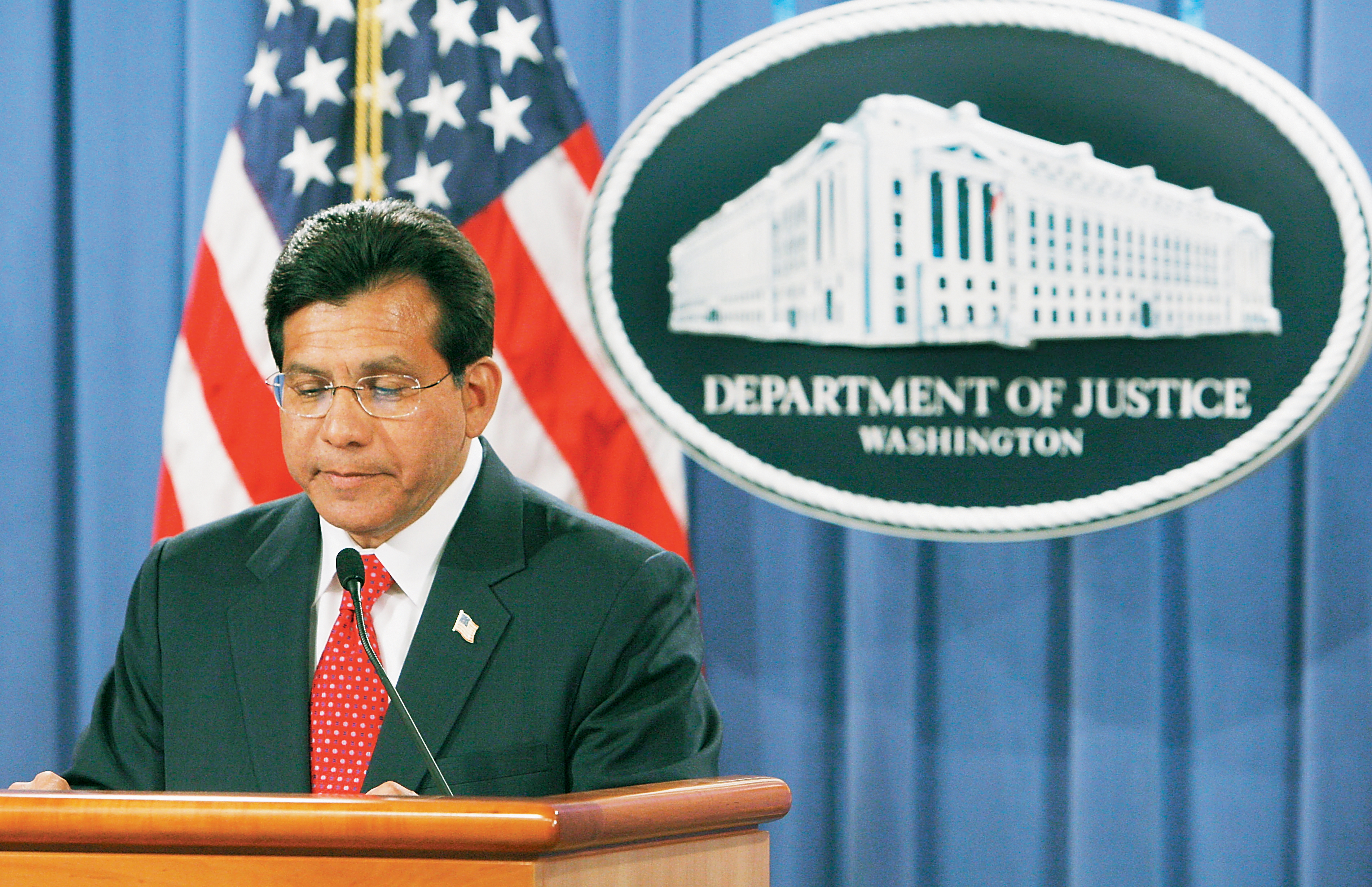
Attorney General Alberto Gonzales pauses while announcing his resignation at the Department of Justice in Washington. Gonzales resigned Monday, ending a standoff with critics, who questioned his honesty and competence at the helm of the Justice Department.
Resignations
The following individuals have resigned from the Bush administration amid the furor following last year’s firings of nine U.S. attorneys and the perceived politicization of the Justice Department.
Justice Department Officials
Attorney General Alberto Gonzales
Kyle Sampson, Gonzales’ chief of staff
Monica Goodling, Gonzales’ counselor
Michael Battle, head of the Executive Office of U.S. Attorneys
Deputy Attorney General Paul McNulty
Michael Elston, McNulty’s chief of staff
Tim Griffin, interim U.S. attorney for Arkansas
Bradley Schlozman, former acting civil rights chief and U.S. attorney for Kansas City
Wan Kim, chief, Civil Rights Division
White House Officials
Deputy Chief of Staff Karl Rove, White House’s top political adviser
Sara Taylor, political director
Washington ? With the resignation Monday of Attorney General Alberto Gonzales, the Bush administration faces its most daunting task: repairing the reputation of a Justice Department reeling from the controversy over the firings of nine U.S. attorneys last year.
After months of damaging disclosures about his competency and congressional scrutiny of his leadership, Gonzales announced that he’d be leaving Sept. 17 but offered little explanation for the timing.
Possible replacements
With no immediate replacement named by the White House, legal experts said the administration needed to select a new attorney general with significant legal experience and an unassailable reputation to end the criticism that had undermined the department since January.
“The Bush administration needs to pick someone from the outside who unquestionably will be seen as independent,” said Erwin Chemerinsky, a law professor at Duke University.
Among the names floated as permanent replacements are Homeland Security Secretary Michael Chertoff and Solicitor General Paul Clement, who was tapped as acting attorney general.
Departure a blow to Bush
Gonzales’ departure is another blow to a White House that’s struggled to regain its footing in the face of an unpopular war in Iraq and elections last fall that swept Republican majorities out of both houses of Congress.
Gonzales, the first Hispanic to serve as attorney general, was one of President Bush’s closest advisers and an enabling force behind the administration’s controversial policies on torture, domestic spying and the scope of presidential power.
In a brief statement, Gonzales didn’t elaborate on his resignation or respond to questions. His voice quavered as he spoke of his rise from the son of poor Mexican immigrants to the top federal law-enforcement official.
“I have lived the American dream,” he said. “Even my worst days as attorney general have been better than my father’s best days.”
Announcement’s timing
The timing of his resignation allowed him to leave on perhaps as high a note as the White House could hope for. The congressional investigation into the firings essentially has stalled with Bush’s claims of executive privilege, leaving Democrats with the option of a risky court fight. Gonzales also waited until Bush’s political adviser Karl Rove, whom Democrats saw as the more enticing target of their inquiry, had announced his own departure, giving Rove what amounted to political cover until the end.
Congressional leaders said that even with Gonzales gone, they had no intention of dropping their investigations into the controversies that ensnared him, from the prosecutors’ firings to the administration’s controversial and still secretive surveillance of Americans.
For months, the White House had insisted that Gonzales wasn’t going anywhere. On Monday, Bush said he’d reluctantly accepted his attorney general’s resignation after “months of unfair treatment.”
“It’s sad that we live in a time when a talented and honorable person like Alberto Gonzales is impeded from doing important work because his good name was dragged through the mud for political reasons,” Bush said in an appearance in Waco, Texas.
Several lawmakers and aides from both parties said they had no knowledge of any specific discovery or turn in the investigation that would have prompted the resignation.
Two congressional aides familiar with the probes into the Justice Department, both speaking on condition of anonymity, said Gonzales’ departure came as lawmakers were preparing to push for additional information about the administration’s wiretapping program, including more of FBI director Robert Mueller’s private notes about the controversy.
Lawmakers said Mueller’s notes might further contradict Gonzales’ sworn testimony or show a fuller picture of the attorney general’s role in surveillance programs, both in his past role as White House counsel and as attorney general.
Political liability
Some analysts said a resignation had almost become inevitable because Gonzales had turned into a major political liability.
“The question wasn’t whether he would go but when he would go,” said Kenneth Sherrill, a political science professor at Hunter College. “As long as he was a target, the entire administration was weakened, and the ongoing controversy could be used to discredit anything that came out of the White House or Justice Department.”
Gonzales’ legal career rose with Bush’s political trajectory: as a Texas Supreme Court justice, White House counsel and, since February 2005, the nation’s chief law enforcement officer. Bush once eyed his friend as a potential nominee to the U.S. Supreme Court.
What They’re Saying
Comments Monday on the resignation of Attorney General Alberto Gonzales:
Senate Majority Leader Harry Reid, D-Nev.: “This resignation is not the end of the story. Congress must get to the bottom of this mess and follow the facts where they lead, into the White House.”
Senate Republican leader Mitch McConnell of Kentucky: ” I thank Alberto Gonzales for his public service and wish him well in his future endeavors. It is my hope that whomever President Bush selects as the next attorney general, he or she is not subjected to the same poisonous partisanship that we’ve sadly grown accustomed to over the past eight months.”
Sen. Charles Schumer, D-N.Y.: “Under this attorney general, sadly, the Department of Justice has less credibility than FEMA.”
Rep. Adam Putnam, R-Fla., chairman of the House Republican Conference: “The Department of Justice now has the opportunity to benefit from fresh leadership. The Congress will soon take up debate on permanently modernizing our intelligence-gathering laws. A new attorney general should have the necessary credibility on Capitol Hill to give our intelligence and law enforcement communities the tools they need to intercept terrorist communications and stop attacks before they happen.”
National
Teens’ reading and math scores have stagnated, US test results show
WASHINGTON (AP) — Younger students have regained ground academically after the pandemic's disruptions while older ...
Lawyers for man accused of killing Charlie Kirk try to block death penalty

Trump’s name poised to come off Kennedy Center

Suspect in Texas shooting had fired at police days earlier, officials say
Man pleads guilty to killing a top Minnesota Democrat and her husband