Expert: Consider child’s age in talk about recall
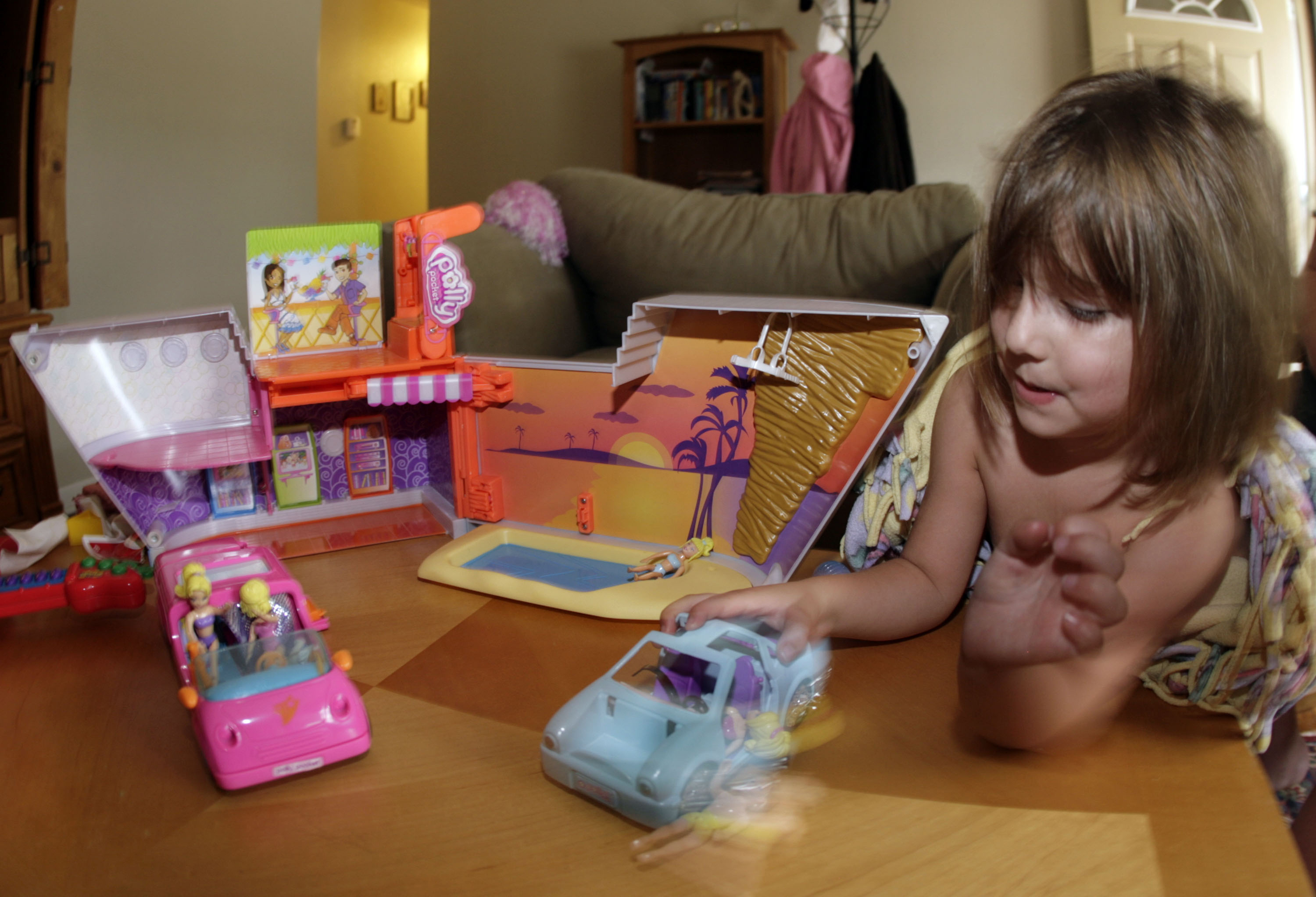
Allison Banda, 3, plays with a car containing a Polly Pockets doll. Polly Pockets and other toys were recalled by Mattel on Tuesday.
Milwaukee ? Concerned parents rushing to sweep their children’s Polly Pocket sets into the garbage may want to pause for a message from Ed de St. Aubin.
He’s a psychology professor at Marquette University and a specialist in child development, and he has some thoughts on talking to kids about the massive toy recall announced Tuesday by Mattel Inc.
“You have someone else do it,” he said.
That, of course, was a joke. De St. Aubin’s real advice is simply common sense – yours, that is. Use it.
Consider your child’s age and deliver an appropriate message. You don’t need to give a 2 1/2-year-old a long explanation about why you’re removing a toy you think is dangerous.
With older children, perhaps you can use the situation as a teachable moment to talk about safety, and maybe ethics. You might say Mattel realizes the toys could hurt kids and that they don’t want that to happen.
Some children might even be able to grasp some basics about business ethics, de St. Aubin said.
W. George Scarlett, a professor of child development at Tufts University in Medford, Mass., had some more common-sense advice: Use language kids will understand.
You might describe the recalled toys as broken, or as toys that might cause an accident, he wrote in an e-mail.
“On the other hand,” Scarlett added, “words such as ‘recall’ and ‘manufacturer’ and talk about lawsuits won’t mean a thing.”
And this probably isn’t the time to discuss 19th-century English economist David Ricardo, his theory of comparative advantage and why it helps explain that 80 percent of toys sold in the United States are manufactured in China.
National

Unhealthy air quality in California city as huge warehouse fire burns for 3rd day

Judge orders Trump administration to restore National Park changes at sites that ‘disparaged’ US
Teens’ reading and math scores have stagnated, US test results show
WASHINGTON (AP) — Younger students have regained ground academically after the pandemic's disruptions while older ...
Lawyers for man accused of killing Charlie Kirk try to block death penalty

Trump’s name poised to come off Kennedy Center